


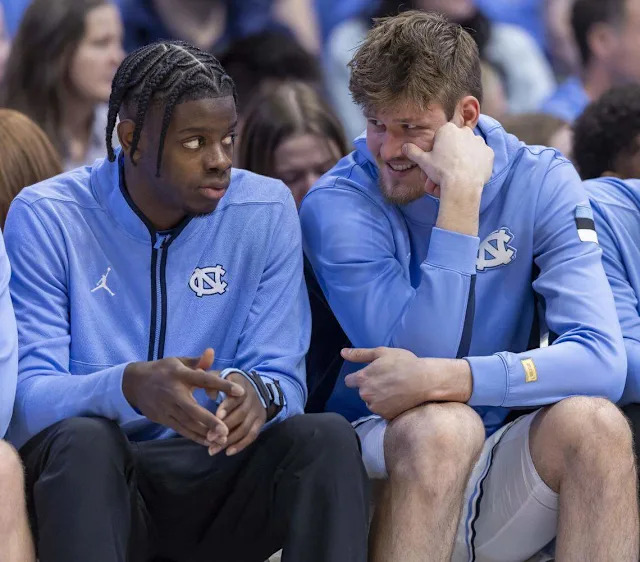
How much can one injury — or two — truly alter a team’s March destiny? For North Carolina, that question is no longer theoretical. As the Tar Heels navigate the pressure-packed stretch of ACC play, the absence of Caleb Wilson and Henri Veesaar hasn’t just affected rotations — it has potentially shifted their entire postseason trajectory. And when NCAA Tournament selection committee chair Keith Gill addressed the situation publicly, his comments revealed just how much context — including player availability — matters when March brackets are built.
North Carolina’s blowout loss to NC State on Tuesday didn’t happen in a vacuum. It came without two major contributors on the floor. Caleb Wilson, the Tar Heels’ dynamic freshman star, was sidelined with a hand injury that will keep him out indefinitely. Henri Veesaar also missed time due to a lower body injury and illness, though he returned Sunday against Syracuse.
On the surface, a February loss is just another data point on a résumé. But as the NCAA Tournament approaches and seeding discussions intensify, the circumstances behind that loss become critical.
And according to Gill, those circumstances absolutely matter.
Context Is Everything
Speaking during CBS’s Top 16 seed reveal, Gill emphasized that the committee’s evaluation process goes far beyond simply scanning win-loss columns.
“It’s a great question because the context matters,” Gill explained. “We’re trying to really have a nuanced evaluation of wins and losses, so player availability is really important.”
That single statement should resonate strongly in Chapel Hill.
The NCAA Tournament selection process has always been complex, but this season — riddled with injuries across the country — has forced the committee to weigh availability more heavily than ever. Teams missing star players during key games present evaluation challenges. Was the loss a true reflection of the team’s quality? Or was it an outlier caused by circumstances unlikely to repeat in March?
Gill made it clear: those details are being examined carefully.
The Caleb Wilson Factor
To understand the potential seeding implications, you must first understand Caleb Wilson’s impact.
Before his injury, Wilson was enjoying one of the most impressive freshman campaigns in recent UNC history. Across 24 games, he averaged 19.8 points, 9.4 rebounds, 1.5 steals, and 1.4 blocks per contest — leading North Carolina in all four categories. His 2.7 assists per game ranked second on the roster behind Kyan Evans.
Those numbers don’t just reflect productivity. They represent centrality.
Wilson wasn’t simply contributing — he was driving the team’s identity. Offensively, he provided reliable scoring at all three levels. Defensively, he anchored possessions with rebounding and rim protection. Emotionally, he played with the edge and confidence that energized teammates.
When he left the game against Miami with the injury — briefly returning before ultimately being ruled out indefinitely — the ripple effects were immediate.
North Carolina lost more than points. They lost stability.
Henri Veesaar’s Underrated Importance
While Wilson’s absence has drawn most of the headlines, Henri Veesaar’s injury also mattered significantly. Veesaar missed two games with a lower body issue in addition to illness before returning against Syracuse.
Depth becomes crucial in February. Rotation balance affects defensive consistency, rebounding margins, and foul management. Without Veesaar, UNC’s frontcourt rotation tightened considerably, forcing adjustments that exposed mismatches.
When both Wilson and Veesaar were unavailable against NC State, the Tar Heels struggled mightily. The result was a lopsided defeat that immediately sparked concern about their trajectory.
The NC State Loss: More Than Just One Game
North Carolina’s loss to NC State marked the program’s second defeat in three games, including the earlier setback to Miami — the contest in which Wilson sustained his injury.
Entering that stretch, UNC sat comfortably at 20-6 overall and 8-5 in ACC play. The résumé was solid. Momentum, while not overwhelming, was steady.
But late-season losses carry more weight.
They linger in the minds of committee members reviewing team sheets in early March. They influence seed lines. They shift narratives.
However, Gill’s comments offer reassurance that the committee isn’t blindly penalizing teams for injury-affected outcomes.
“Your two best scorers aren’t in the game; that’s going to impact it vs. the teams that beat that team with those players available,” Gill noted. “I do think it’s impactful. We’ve seen it up and down the seed line so far. It’s impacted us a lot this year.”
That acknowledgment is critical. It suggests UNC’s résumé won’t be judged in isolation from its injury context.
Seeding Implications
According to bracket projections from On3’s James Fletcher III, North Carolina currently projects as a No. 6 seed in the NCAA Tournament. That’s a respectable position — but not one that guarantees a smooth path.
The difference between a No. 4 seed and a No. 6 seed can mean facing significantly tougher matchups earlier in the tournament. It can mean travel disadvantages. It can alter regional dynamics.
If Wilson returns before Selection Sunday and demonstrates full health, the committee could view UNC differently than if he remains sidelined.
Availability matters not only in past evaluation — but in projecting future performance.
The committee’s mandate includes selecting the best teams — not necessarily the teams with the cleanest résumés absent context. If Wilson is healthy by March, UNC’s ceiling changes dramatically.
The Psychological Element
Beyond metrics and seed lines, injuries test locker rooms.
How does a team respond when its leading scorer goes down? Does the offense stagnate, or do others step up? Does defensive intensity slip, or does urgency increase?
North Carolina’s immediate response — a blowout loss — was concerning. But one game doesn’t define resilience.
In past seasons, teams that navigated adversity often entered March hardened rather than weakened. The key lies in adjustment.
Can UNC recalibrate offensively without overcompensating? Can they maintain defensive discipline without Wilson’s length and rebounding?
These questions will shape not just their seeding — but their tournament viability.
A Season Defined by Availability
Gill noted that injuries have been widespread across college basketball this year. That reality has forced the committee into deeper contextual analysis than in some previous seasons.
This isn’t simply about UNC. It’s about maintaining fairness across the bracket.
If a team lost key games without its star and then regained full strength in March, should it be penalized heavily? Or should it be evaluated as the team it will be during the tournament?
The committee appears committed to the latter approach — within reason.
That nuance could work in UNC’s favor if Wilson returns in time.
Wilson’s Message to Tar Heel Nation
Despite the uncertainty surrounding his return timeline, Wilson remains optimistic.
“I am grateful for whatever God is trying to tell me through this injury!!!” Wilson posted via X. “I will be back Tarheel Nation… I LOVE THIS TEAM AND PROGRAM #StayTuned”
That message carries emotional weight.
It signals belief. It signals intention.
For teammates and fans alike, it reinforces hope that this chapter isn’t closed.
The Road Ahead
North Carolina’s remaining ACC games now carry amplified importance. Without Wilson, every matchup becomes a test of adaptability. With him, they become opportunities to rebuild momentum.
The Tar Heels’ 20-6 overall record provides a solid foundation. An 8-5 ACC mark keeps them competitive in conference standings.
But March narratives are shaped in February.
Strong finishes matter. Quality wins matter. Visible growth matters.
If UNC steadies itself, reestablishes defensive consistency, and potentially reintegrates Wilson into the lineup, the committee could reward that trajectory.
If inconsistency persists, the seed line could slip.
Bigger Than a Seed Line
Ultimately, while seeding matters, team health matters more.
A healthy North Carolina squad with Caleb Wilson at full strength presents matchup problems for nearly anyone. His versatility — scoring, rebounding, defensive instincts — elevates UNC’s ceiling dramatically.
Henri Veesaar’s return already strengthens the rotation. Stability in the frontcourt helps restore identity.
The coming weeks will determine whether this injury stretch becomes a minor detour or a defining obstacle.
Keith Gill’s comments offer clarity: the committee is watching closely. Context counts. Player availability counts.
For North Carolina, that means hope remains alive.
But hope alone won’t secure positioning.
Execution will.
As March approaches, the Tar Heels face a simple but profound challenge: prove that the team which surged to 20 wins still exists beneath the adversity.
If they do, the bracket may still break their way.
If they don’t, the seeding consequences could linger long after Selection Sunday.
One injury changed the conversation.
How UNC responds will determine how it ends.




