


What happens when a season doesn’t break — but bends?
That’s the question hovering over Chapel Hill right now. Not because the North Carolina Tar Heels men’s basketball have collapsed. Not because the talent has vanished. But because the pieces don’t quite fit the way they once did. As North Carolina prepares for its rematch against the Syracuse Orange men’s basketball inside the JMA Wireless Dome, the biggest challenge isn’t a zone defense or hostile road crowd.
It’s a puzzle.
And Hubert Davis knows it.
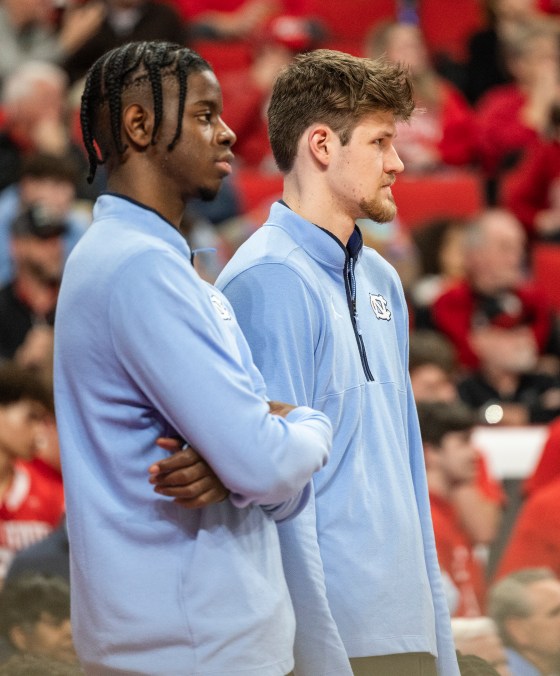
With Caleb Wilson sidelined and Henri Veesaar trending but still questionable entering the matchup, No. 16 Carolina finds itself navigating the possibility of playing without both frontcourt anchors for the third consecutive game. That reality shifts more than rotations. It shifts identity.
The Wilson Waiting Game
Let’s start with Caleb Wilson.
Wilson remains in evaluation mode, and Davis confirmed that more imaging is expected next week to determine a clearer timetable. While the uncertainty lingers publicly, internally there’s structure. Wilson has not participated in five-on-five drills. There’s no contact. But that doesn’t mean inactivity.
Davis emphasized that what Wilson is doing in the weight room and conditioning sessions is “real.” He’s staying in game shape. He’s shooting — with one adjustment. Teammates must bounce pass the ball to him rather than make standard chest passes.
It’s a small detail, but it speaks volumes.
He can shoot.
He can condition.
He can prepare.
He just can’t fully engage yet.
And when he returns, Davis insists he’ll be ready — not easing into shape, but prepared to contribute immediately.
There’s also something deeper driving Wilson.
Yes, he has NBA aspirations. But Davis made it clear there’s a burning desire within Wilson to return this season and compete alongside his teammates. That matters. In the modern era of draft projections and professional timelines, that commitment resonates inside a locker room.
Wilson isn’t thinking exit. He’s thinking return.
Henri Veesaar: Trending in the Right Direction
While Wilson remains a longer-term question mark, Veesaar is closer to resolution.
The junior center completed an individual workout Thursday and planned to participate in practice Friday. Still, Davis labeled him questionable, emphasizing that the decision would depend on how practice went.
“He’s getting better every day,” Davis said.
That phrase is subtle but powerful.
Trending upward isn’t the same as cleared.
Progress isn’t the same as certainty.
And until Veesaar is fully reintegrated, UNC’s interior equation remains unstable.
The Frontcourt Reality
The situation grows more complicated with James Brown out for the season following right foot surgery. Depth isn’t improving. Reinforcements aren’t coming.
Without Wilson and potentially Veesaar, the Tar Heels must recalibrate how they win.
North Carolina’s identity has long been tied to pace, paint touches, rim pressure, and rebounding dominance. Those pillars remain philosophically intact. But the path to achieving them shifts dramatically without full frontcourt strength.
Davis acknowledged the delicate balance.
“You have to be who you are,” he explained.
Yet he also admitted tweaks are necessary.
There must be pivots.
There must be alterations.
There must be flexibility.
The puzzle isn’t about abandoning identity. It’s about reshaping it temporarily without losing its essence.
Solving Variations All Season
Here’s the part many overlook: this isn’t new.
Davis walked through the season’s disruptions — eligibility questions, Seth Trimble’s earlier injury, shifting roles, lineup adjustments.
“This group has had to figure out a different puzzle pretty much the entire season,” he said.
That repetition builds resilience.
Teams that experience adversity in isolated bursts sometimes struggle to adjust. Teams that live in adaptation mode develop muscle memory for it.
UNC has been in adaptation mode for months.
Now they’re simply solving a new version of the riddle.
Zayden High: From Afterthought to Anchor
One of the clearest examples of that adaptability is Zayden High.
High didn’t play against Duke earlier in the season. Recently, he’s stepped into a starting role and delivered tangible production.
Davis didn’t mince words.
“What he’s doing is hard,” he said. “His production has been real.”
That authenticity matters. It’s not inflated numbers in garbage time. It’s meaningful contributions under pressure.
High’s emergence provides a lifeline. He may not replicate Wilson’s skill set or Veesaar’s versatility, but he brings effort, rebounding, and defensive engagement.
And in a puzzle, sometimes you don’t replace a missing piece — you find a different way to complete the picture.
Identity vs. Adaptation
The most fascinating tension in Davis’s comments is philosophical.
How much do you change?
How much do you stay the same?
“I think it’s figuring out this new way,” Davis said, “but also holding firm and staying connected to the things that allow you to be successful regardless of who’s in the lineup.”
That sentence encapsulates the entire season.
UNC can’t simply replicate its original blueprint without Wilson and Veesaar.
But it also can’t drift into something unrecognizable.
The answer lies somewhere in between.
Rebounding becomes even more critical.
Guards must crash.
Ball security must tighten.
Offensive rebounding must compensate for interior scoring dips.
Against N.C. State, UNC grabbed 17 offensive rebounds and posted a 41% offensive rebounding percentage. The second-chance points didn’t always materialize — but the effort signaled intent.
That effort must become habit.
The Syracuse Rematch Factor
The upcoming rematch adds another layer of intrigue.
In the first meeting, North Carolina built a commanding 32-point lead before Syracuse trimmed it late, resulting in an 87–77 final.
The lesson?
Execution must sustain for 40 minutes.
Syracuse can surge quickly.
Momentum shifts rapidly inside the Dome.
Zone and man defenses require patience and poise.
Without full frontcourt depth, focus becomes non-negotiable.
Davis emphasized ball security and offensive execution against both defensive looks. Paint touches remain essential. Transition remains a weapon.
But discipline will decide everything.
The Mental Component
Perhaps Davis’s most revealing quote wasn’t tactical — it was psychological.
“You’re really not in control of very much,” he said. “But what you are in control of is the circumstances ahead of you. How do you react and how do you respond?”
That mindset has shaped UNC’s season.
Injuries?
Adjust.
Eligibility questions?
Adjust.
Role changes?
Adjust.
Now, frontcourt uncertainty?
Adjust again.
The crash course in response has built something intangible.
Resilience.
What This Puzzle Could Mean Long-Term
If Wilson returns at full strength and Veesaar stabilizes, North Carolina’s ceiling rises dramatically.
But even before that moment, the process of solving this puzzle may strengthen the roster.
Players gain confidence in expanded roles.
Lineup versatility increases.
Defensive communication sharpens.
Guards learn to rebound aggressively.
Rotational trust deepens.
Sometimes adversity accelerates development in ways comfort never could.
If UNC navigates this stretch successfully, the payoff may extend into March.
The Stakes Are Real
At 20–6 overall and 8–5 in conference play, the Tar Heels remain firmly in the national conversation.
But margins tighten in February.
Every possession matters.
Every road game tests maturity.
Every injury magnifies pressure.
The puzzle isn’t theoretical.
It’s immediate.
The Final Piece: Belief
Davis’s confidence didn’t sound forced.
It sounded experienced.
He’s watched this group solve problems repeatedly. He’s seen role players step forward. He’s witnessed resilience form in real time.
“This group has had to figure out a different puzzle pretty much the entire season,” he said. “And we’ll figure this one out.”
That belief may be the most important piece of all.
Because puzzles are only intimidating until you start placing the pieces.
And right now, North Carolina isn’t panicking.
It’s adjusting.
Whether Wilson returns soon.
Whether Veesaar clears fully.
Whether rotations shift again.
The Tar Heels understand something deeper:
The season won’t be defined by who’s unavailable.
It will be defined by how they respond.
And in a year built on constant recalibration, that response may be what ultimately defines them.




