


Something happened in the final minutes of Kentucky’s loss at Auburn that won’t show up in the box score.
It wasn’t a missed free throw.
It wasn’t a blown defensive assignment.
And it wasn’t the final possession that slipped away.
Instead, it was what happened after the buzzer — words spoken in frustration, emotion caught on a hot mic, and a league office that decided enough was enough.
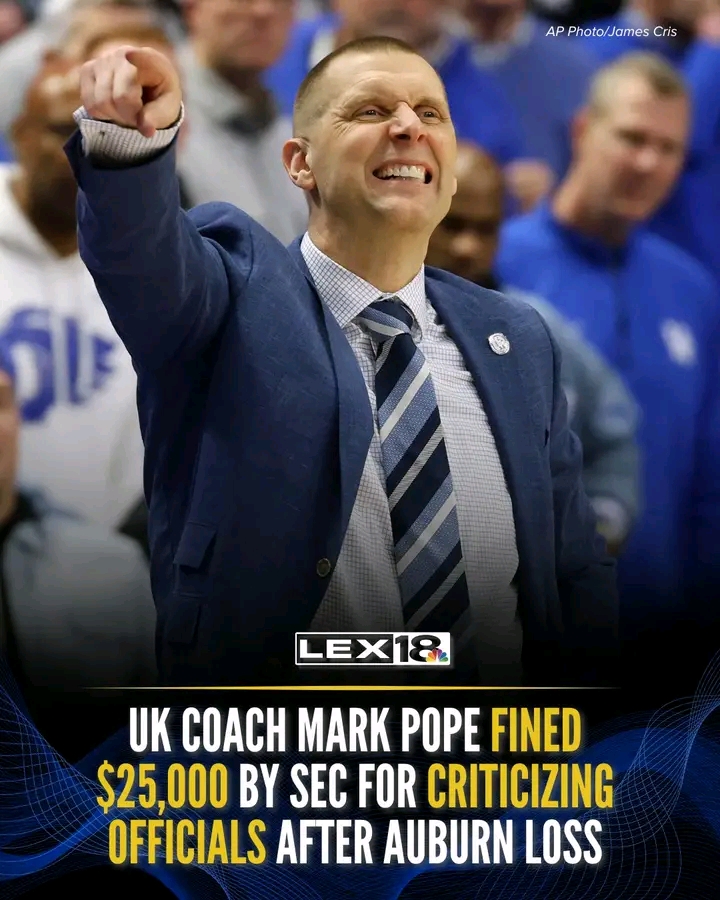
Now, ESPN CONFIRMED that Kentucky head coach Mark Pope has been publicly reprimanded and fined $25,000 by the Southeastern Conference for postgame conduct and comments regarding officiating following the Wildcats’ narrow loss to Auburn University on February 21.
But here’s the real question:
Was this just a routine league punishment — or a moment that could define the emotional temperature of Kentucky’s season?
Let’s unpack what really happened — and why this fine might matter more than it appears.
The Game That Sparked It All
The matchup itself had all the ingredients of a classic SEC thriller.
Kentucky, fighting for positioning and momentum late in the regular season, traveled into one of the toughest road environments in college basketball. Auburn’s home crowd brought relentless energy. Every whistle was magnified. Every possession felt decisive.
The Wildcats ultimately fell 75–74 in a razor-thin defeat that left players stunned and fans furious.
But the aftermath quickly overshadowed the game itself.
As frustration boiled over, cameras and microphones captured Pope expressing strong displeasure about officiating decisions. At one point, in what many described as an emotional exchange, he was heard voicing concerns about specific calls and the overall tone of the officiating crew.
Those comments didn’t stay inside the locker room.
And that’s where the problem began.
ESPN CONFIRMED the League’s Decision
Within days, the SEC office reviewed the situation. And then came the announcement.
ESPN CONFIRMED that Pope had been issued:
A public reprimand
A $25,000 fine
Formal discipline for violating conference rules prohibiting public criticism of officials
The league’s stance was clear: criticism of officiating — especially when public and amplified — crosses a line established to protect game integrity and respect toward officials.
In short, emotion is understandable.
Public accusations? Not acceptable.
Why the SEC Took Action
To understand the fine, you have to understand the culture of the conference.
The Southeastern Conference has long enforced strict policies against public criticism of officiating. Coaches can submit concerns privately. They can request reviews. They can communicate internally.
But once comments become public — especially implying bias or incompetence — the conference typically responds.
This isn’t the first time a coach has been fined for officiating remarks. But the timing, the visibility, and the emotional nature of this particular situation elevated it.
The SEC likely saw three key issues:
Public nature of the comments
Potential damage to officiating credibility
The high-profile visibility of Kentucky basketball
When one of the conference’s flagship programs speaks, people listen.
And when the head coach questions officiating, the ripple effect can spread quickly across social media, fan bases, and national media platforms.
The Pressure Cooker of Kentucky Basketball
There’s another layer here.
Kentucky basketball isn’t just another program. It’s a brand. A legacy. A national spotlight program with expectations measured in Final Fours and championships.
The Kentucky Wildcats men’s basketball carry a weight that few programs experience.
Every loss is dissected.
Every substitution is debated.
Every whistle becomes a talking point.
And when a close game slips away — especially one that could impact seeding or conference standing — emotions spike.
Was Pope simply defending his players?
Or did he cross a line in a moment of competitive fire?
That debate now divides fans.
The Emotional Factor: Was This About More Than One Game?
Coaches are human.
They invest months into preparation. They demand discipline. They preach execution. And when a single call feels decisive in a one-point loss, it can feel personal.
For Kentucky, this wasn’t just a February game.
It was momentum.
It was narrative.
It was positioning.
In tightly contested conference races, one possession can determine tournament seeding. One loss can shift perception.
So when frustration surfaced publicly, it likely came from a buildup of pressure — not just one whistle.
Still, the SEC’s message was unmistakable:
Passion is respected. Public condemnation of officials is not.
The Hot Mic Moment That Changed Everything
Reports indicate that part of the issue stemmed from a “hot mic” capture — a moment when Pope, believing he was speaking privately, voiced strong frustration about the officiating crew.
Those comments circulated rapidly online.
In today’s digital age, there are no quiet corridors. No private mutterings. No contained reactions.
Everything is potentially public.
And once those words reached national platforms — including coverage on ESPN — the league’s response became almost inevitable.
What Does $25,000 Really Mean?
Financially, $25,000 is significant but not crippling for a Power Five head coach.
Symbolically?
It’s louder.
A public reprimand sends a message not just to Pope — but to every coach in the league.
The SEC is reinforcing its guardrails before March, when emotions intensify and stakes rise even higher.
It’s preventative as much as it is punitive.
How This Could Impact Kentucky Moving Forward
Here’s where things get interesting.
Sometimes, moments like this fracture teams.
Other times, they galvanize them.
Players often rally around coaches who publicly defend them. They interpret it as loyalty. Protection. Shared accountability.
If handled correctly internally, this could:
Strengthen locker room unity
Create a “us against the world” mentality
Fuel a strong closing stretch
But it could also bring added scrutiny. Officials may watch interactions more closely. Media narratives may intensify.
How Pope responds next will matter just as much as what he said before.
A Defining Leadership Moment?
Every coach faces a crossroads at some point in a season.
This could be one of those moments for Pope.
Does he:
Double down on his stance?
Clarify his comments?
Shift the focus entirely back to player execution?
The best leaders often use adversity as recalibration.
The spotlight is now brighter. The messaging will be more careful. And every postgame comment will carry added weight.
The Broader Conversation: Officiating Transparency
While the SEC enforced its rules, the fine also reignites a broader discussion in college basketball:
How much transparency should there be in officiating?
Fans frequently demand explanations for controversial calls. Coaches privately seek clarity. Players want consistency.
But public criticism remains a sensitive boundary.
Balancing accountability and respect remains one of the sport’s most delicate tensions.
The Timing Before March
There’s another intriguing layer.
Late February is when teams start sharpening their postseason edge.
Every possession feels heavier. Every loss feels louder.
By issuing discipline now, the SEC effectively draws a line before tournament play begins.
No distractions. No officiating narratives. No public disputes.
Just basketball.
That clarity might be exactly what the conference wants heading into its most visible stretch of the season.
Could This Actually Help Kentucky?
Here’s the twist.
Sometimes controversy becomes fuel.
A perceived slight can sharpen focus. A fine can become motivation.
Kentucky players may see this as their coach standing up for them. They may interpret it as shared battle scars.
History shows that programs often rally after emotional flashpoints.
The real test isn’t what happened after Auburn.
It’s what happens next.
Final Thoughts: Bigger Than a Fine
On the surface, this is simple:
Coach criticizes officiating.
Conference enforces rule.
Fine issued.
But underneath?
This is about leadership under pressure.
It’s about emotional control in high-stakes environments.
It’s about the constant spotlight surrounding Kentucky basketball.
And most importantly, it’s about how a team responds when narrative shifts from hardwood to headlines.
ESPN CONFIRMED the discipline.
The SEC delivered its message.
The fine is official.
Now the next chapter belongs to Kentucky.
Will this moment fade quietly?
Or will it become the spark that defines their postseason run?
One thing is certain:
The Auburn loss may be recorded as a one-point defeat.
But the aftermath could echo far longer than the final score.




