


SOUTH BEND, Ind. — When a top-ranked team walks into a struggling opponent’s home arena in late February, expectations are clear. Control the tempo. Handle business. Leave with a win.
On Tuesday night inside Purcell Pavilion, No. 1 Duke didn’t just handle business — it delivered a masterclass.
Facing a depleted Notre Dame Fighting Irish men’s basketball squad that was without its two leading scorers and sitting at 3–11 in conference play, the Duke Blue Devils men’s basketball were heavily favored. But even the most optimistic projections could not have predicted the historic dismantling that followed.
Duke’s 44-point demolition marked the worst home loss in Notre Dame program history. It wasn’t merely a victory — it was a declaration.
From the opening tip, Duke imposed its will on every possession. The Blue Devils shot an efficient 46 percent from the field, 36 percent from beyond the arc and an elite 89 percent from the free-throw line. They dominated the glass with a staggering +22 rebounding margin and turned defensive stops into an avalanche of transition opportunities. By the final minutes, chants of “Let’s go, Duke!” echoed across a sea of stunned silence.
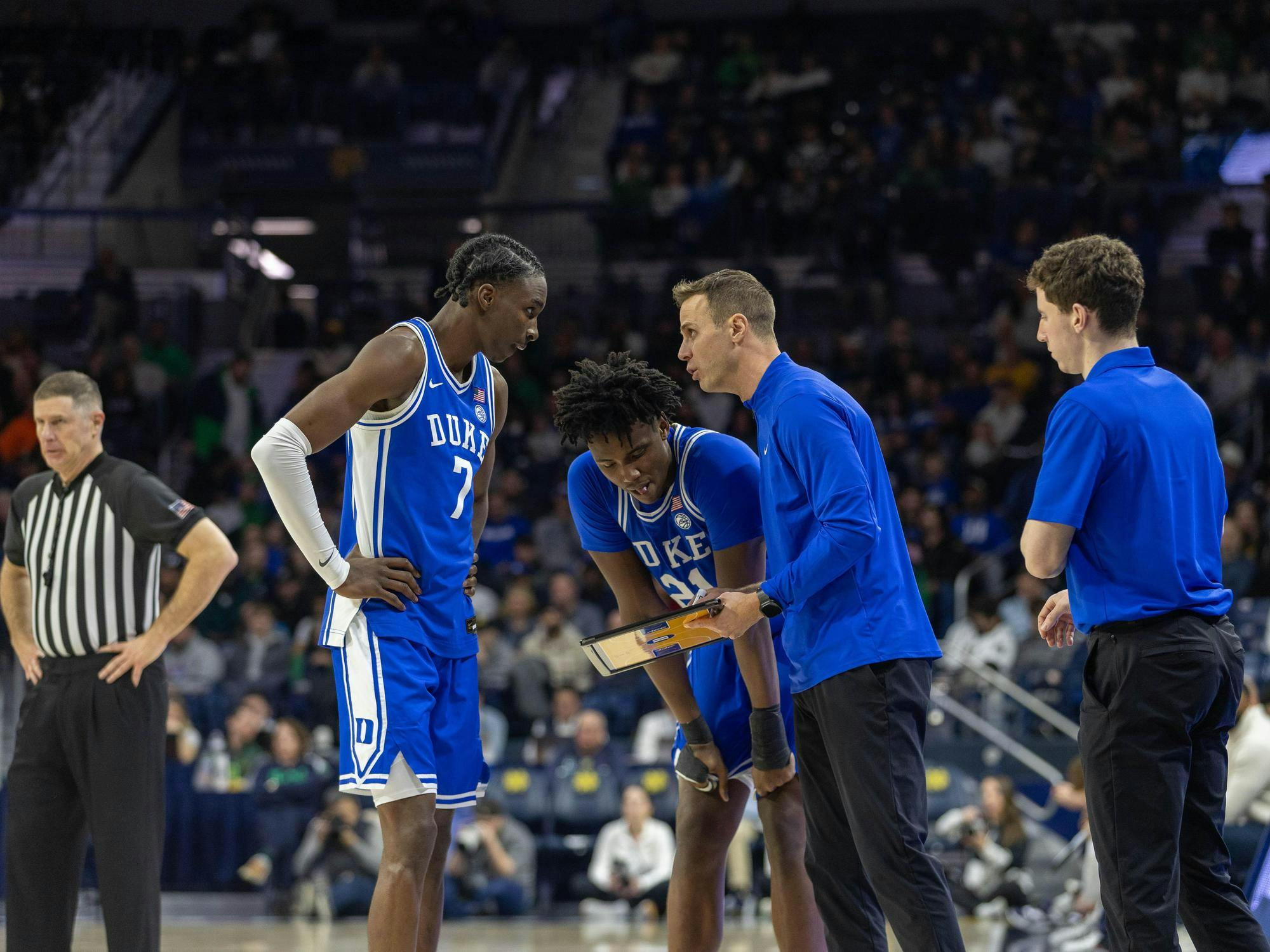
And yet, amid the fireworks and triple-digit scoring, Duke head coach Jon Scheyer focused not on the scoreboard, but on something deeper.
“For us, it’s more about winning in the margins,” Scheyer said. “And how can we win one or two more possessions in any area?”
That philosophy — winning the possessions most teams overlook — has become Duke’s identity.
OWNING THE GLASS, OWNING THE GAME
Championship teams understand that offensive rebounds are demoralizing. They extend possessions, exhaust defenses and often result in high-percentage looks. Duke turned that concept into a weapon.
The Blue Devils grabbed 14 offensive rebounds, consistently creating second-chance opportunities. Freshman phenom Cameron Boozer and veteran center Maliq Brown led the charge with four apiece.
One defining sequence late in the first half encapsulated Duke’s dominance. After a missed three-pointer, Brown battled through traffic to secure the rebound over Notre Dame’s Ryder Frost. Without hesitation, he kicked the ball out to Cayden Boozer, who quickly found his brother spotting up in the corner. Cameron Boozer’s smooth catch-and-shoot three splashed through the net, pushing Duke’s lead to 26 and effectively draining the building of hope.
Offensive rebounds are more than hustle plays — they are psychological blows. Time and again, Duke turned missed shots into points, whether through immediate put-backs, drawn fouls or kick-out threes. Boozer, poised beyond his years, attacked the rim off second chances and converted at the line. Brown’s physicality set the tone inside.
By halftime, the rebounding disparity was glaring. By game’s end, it was overwhelming.
DEFENSE THAT CREATES OFFENSE
If rebounding won Duke extra possessions, its defense turned those possessions into momentum.
The Blue Devils forced 15 turnovers, including 11 steals. Active hands, sharp rotations and relentless pressure suffocated Notre Dame’s ballhandlers.
Boozer and Brown again made their presence felt defensively, recording three steals each. But it was sophomore guard Darren Harris who emerged as the unsung catalyst.
Playing extended minutes for the first time since December, Harris delivered a career-high 16 points while also snatching two steals. His defensive anticipation led to fast-break chances that swung the energy entirely in Duke’s favor.
Late in the game, Harris capped his breakout performance with a highlight sequence — stripping Frost clean near midcourt, racing the other way and drawing a foul against Brady Koehler. He calmly sank both free throws, pushing Duke past the 100-point mark and punctuating a night that showcased his readiness.
“I’m on the best team in the country,” Harris said. “My job is just to be ready. Every time I get out there, I just try to make the most of it.”
That mentality — preparation meeting opportunity — defines this Duke roster. Depth is not a luxury; it is a weapon.
FAST BREAKS AND SECOND CHANCES: THE DIFFERENCE-MAKERS
Duke converted its hustle into 14 second-chance points and 19 fast-break points. Those numbers tell the story of a team that doesn’t merely react — it attacks.
In late February, many teams are still searching for consistency. Duke, by contrast, appears to be sharpening its edge.
Since its Feb. 7 loss to rival North Carolina Tar Heels men’s basketball, the Blue Devils have responded with purpose. The lessons from that defeat are evident in their discipline. Rotations are tighter. Closeouts are sharper. Communication is constant.
“Our defense has grown tremendously,” Scheyer reflected. “We have to continue to have that edge on the defensive end.”
Defense travels. Rebounding translates. Hustle compounds.
As postseason play approaches, Duke’s emphasis on marginal gains may prove decisive. In March, games are rarely won by 44 points. They are won by one possession, one loose ball, one extra rebound. A single offensive board in the final minute. A timely steal that flips momentum. A pair of free throws under pressure.
Scheyer understands this reality. His players are buying in.
A STATEMENT BEYOND THE SCOREBOARD
Blowouts can be misleading. Sometimes they inflate confidence without revealing weaknesses. But this performance felt different. It wasn’t built solely on hot shooting or mismatches. It was constructed possession by possession, rebound by rebound, steal by steal.
Duke didn’t just overwhelm Notre Dame with talent — it overwhelmed them with habits.
The Blue Devils’ formula is sustainable because it doesn’t rely on perfection. It relies on effort, positioning and awareness. It relies on the understanding that greatness often hides in details.
As the final horn sounded and Duke supporters celebrated in South Bend, one truth stood out: this team is evolving at the right time.
The margins — those seemingly small moments — are where championships are forged.
And right now, no one in college basketball is owning them quite like Duke.




