


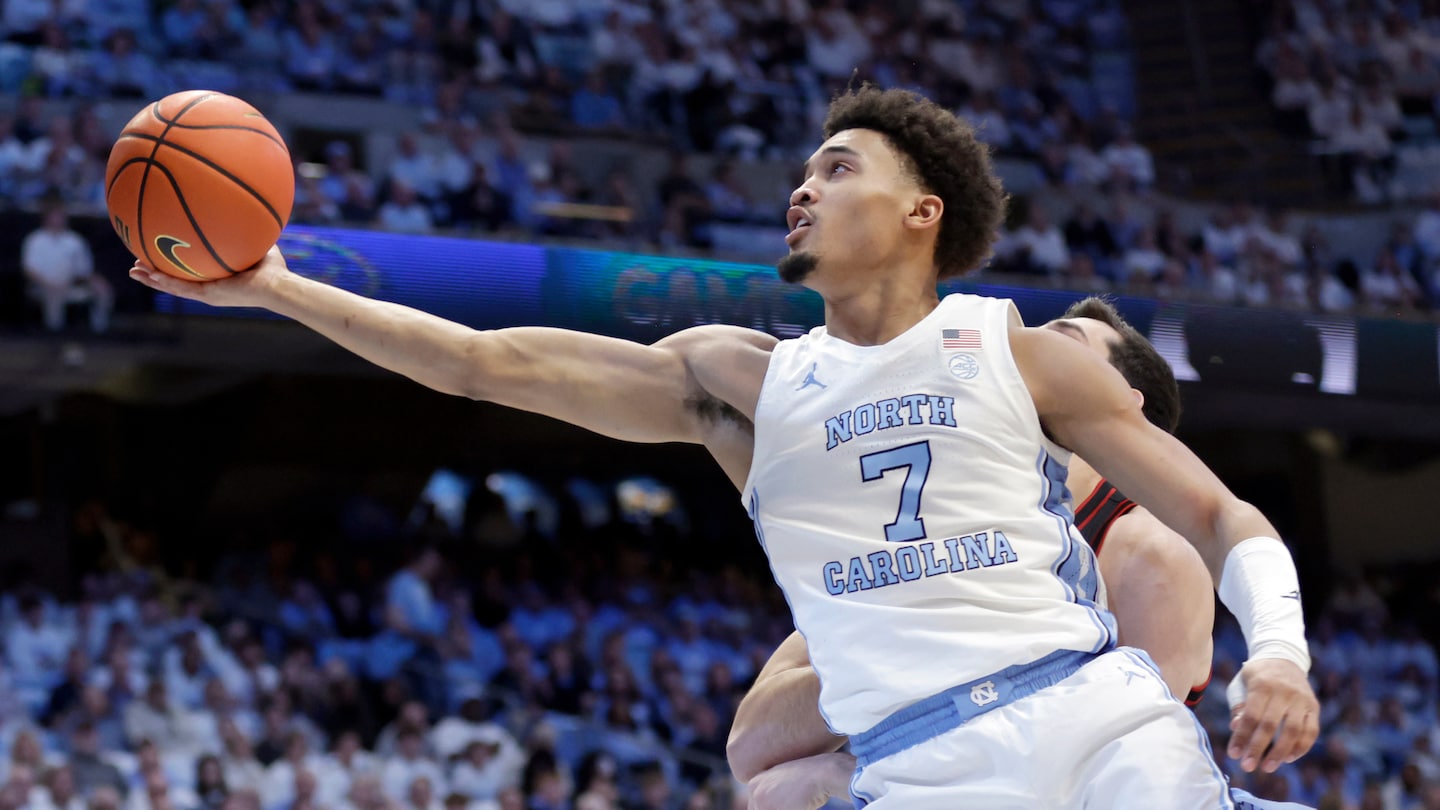
On a night filled with cameras, framed jerseys, and the emotion of Senior Night inside the Dean Dome, one quiet truth lingered heavier than the final score: we may never see this again. Not like this. Not in this era. As college basketball morphs into something closer to professional free agency, where rosters flip overnight and loyalty often feels negotiable, Seth Trimble stood at midcourt not just as a senior — but as a symbol. A symbol of patience. Of development. Of staying when leaving would have been easier. And for the North Carolina Tar Heels men’s basketball, that choice may become one of the most meaningful stories of this generation.
A Different Kind of Celebration in Chapel Hill
CHAPEL HILL — Senior Night at the Dean Smith Center is always emotional. Legends have walked that hardwood for decades. Banners hang above as reminders of history that stretches back through eras of dominance, heartbreak, and redemption.
But Trimble’s Senior Night felt different.
It wasn’t just about a 67–64 win over Clemson. It wasn’t just about a framed jersey presented pregame or a heartfelt speech delivered postgame. It was about something far rarer in today’s game — continuity.
In an offseason that saw five rotation players enter the transfer portal and 11 newcomers arrive in Chapel Hill ahead of the 2025–26 season, Trimble’s four-year journey suddenly looked like an endangered species.
And that reality hit home for many fans: he might be the last true four-year Tar Heel for a long time.
The Era of Movement — and the Rarity of Staying Put
College basketball has changed. The transfer portal has reshaped roster construction into an annual reshuffling exercise. Programs reload rather than rebuild. Players seek larger roles, better NIL deals, or new opportunities with increasing frequency.
The sport’s structure incentivizes mobility.
In that environment, development arcs like Trimble’s have become uncommon. A player who arrives as a freshman, grows through adversity, accepts fluctuating roles, and remains committed to the same program through senior night? That’s rare.
Very rare.
And that’s why his decision to stay resonates beyond box scores.
It Would Have Been Easy to Leave
Let’s be honest: there were moments when leaving would have made sense.
Trimble didn’t step into Chapel Hill as an instant superstar. He wasn’t handed the offense. He wasn’t guaranteed All-ACC minutes from day one. His early seasons featured stretches of adjustment — learning the system, adapting to physical ACC defenses, fighting for consistency.
In the modern game, many players in that position explore the portal.
Some leave to find more usage. Some leave to escape depth charts. Some leave simply because the option exists.
Trimble didn’t.
Instead, he leaned into the grind.
Growth Over Time — The Carolina Way
Development has long been a hallmark of Carolina basketball. Under current head coach Hubert Davis, that philosophy hasn’t changed — but the environment around it has.
Trimble’s progression from role player to dependable leader didn’t happen overnight. It was incremental. He improved defensively. He sharpened his decision-making. He refined his shot selection. He embraced responsibility when it came.
By his senior year, he wasn’t just contributing — he was central.
His scoring jumped. His poise improved. His ability to control tempo and create off the dribble became invaluable. And perhaps most importantly, his voice in the locker room carried weight.
Leadership in today’s locker rooms is complex when half the roster may be new each season. But Trimble became a stabilizer — someone who understood the culture because he lived it.
Loyalty in a Business-Like Landscape
The truth is, college basketball no longer functions purely as a developmental amateur system. NIL collectives, endorsement deals, and transfer freedom have professionalized the experience.
There is nothing inherently wrong with that evolution. Players deserve opportunities.
But loyalty now carries different meaning.
When Trimble stayed in Chapel Hill despite roster turnover, he made a choice rooted in belief — belief in the program, belief in development, belief in finishing what he started.
That choice speaks loudly to a fan base that still romanticizes four-year players.
What His Commitment Means to UNC Fans
For Carolina supporters, players who stay become more than athletes. They become familiar faces across seasons — part of the emotional rhythm of fall practices, winter conference battles, and March dreams.
Seeing a freshman grow into a senior creates connection.
Trimble’s journey allowed fans to witness growth in real time. They saw his early flashes. They endured his learning curves. They celebrated his breakthroughs.
By Senior Night, it felt personal.
And in an era where rosters often feel temporary, that personal connection matters.
The Symbolism of “The Last Four-Year Player”
There is a real possibility that Trimble could be UNC’s final true four-year player for the foreseeable future.
That isn’t an indictment of the program it’s a reflection of the sport’s evolution.
Coaches now recruit knowing that retention is uncertain. Players enter with options open. Even those who thrive may test the waters annually.
Trimble’s four-year arc may soon be an exception rather than a template.
If that proves true, his story will age even more gracefully.
A Win That Felt Bigger Than the Scoreboard
The 67–64 victory over Clemson was gritty. Defensive. Tense.
But the real story unfolded before tipoff and after the buzzer.
The framed jersey. The embrace with teammates. The speech that carried emotion not because it was rehearsed, but because it was earned.
You could sense it in the arena — appreciation layered with nostalgia.
This wasn’t just about a senior playing his final home game.
It was about witnessing the end of a chapter in how college basketball once operated.
Leadership When It Was Needed Most
This season in particular required steadiness.
Roster turnover meant integrating new personalities and skill sets. Injuries reshuffled rotations. Expectations remained high.
Trimble became an anchor.
His consistency allowed younger players to settle. His understanding of the system accelerated newcomers’ adjustments. His defensive tenacity set tone.
In moments of late-game tension, he didn’t look overwhelmed. He looked experienced.
Experience built not through transferring, but through staying.
What the Transfer Portal Can’t Replace
The portal can supply talent. It can add shooting, length, veteran presence.
But it cannot manufacture institutional memory.
It cannot instantly create emotional attachment to a program’s identity.
Trimble carried that memory.
He understood what Carolina meant because he experienced it fully — practices in October, road losses in January, redemption games in March.
That accumulation of moments cannot be replicated in a single-season rental.
The Future of Carolina Basketball
UNC will continue to recruit at a high level. The portal will remain a tool. Roster management will evolve.
But fans may look back at Trimble as a benchmark — the final bridge between eras.
Between the time when players stayed and the time when mobility dominates.
That doesn’t diminish future stars.
It simply elevates what Trimble represented.
A Legacy Beyond Statistics
When the record books are revisited years from now, Trimble’s statistical profile will sit alongside many others.
But his legacy will extend further.
He stayed.
He developed.
He finished.
In the modern landscape, those three words carry power.
Final Reflection
“In the Transfer Portal Era, Seth Trimble Chose Loyalty — And UNC May Never See Another Story Like This Again.”
The headline may feel dramatic today.
But years from now, it may feel prophetic.
Because what happened in Chapel Hill wasn’t just a senior celebration.
It was a reminder of what commitment looks like.
And for UNC fans who watched it unfold from freshman promise to senior leadership — it
was something worth cherishing.
Not just because of what Trimble did on the court.
But because of the choice he made off it.
And in this era, that choice might be the rarest achievement of all.




