


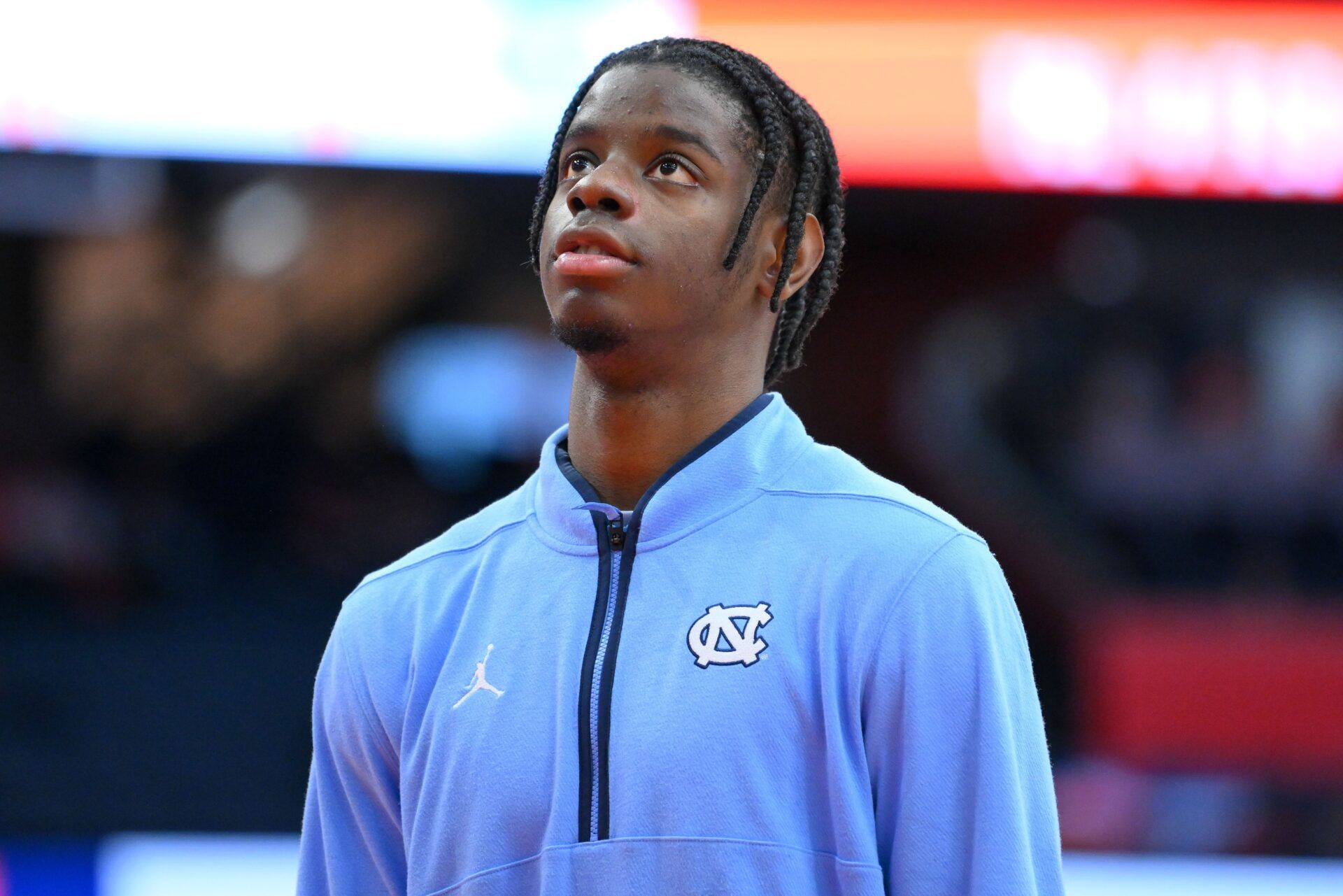
There are certain prospects who generate buzz. And then there are the ones who quietly force evaluators to pause, rewind the tape, and ask a more dangerous question: What if we’re underselling him? At just 19 years old, Caleb Wilson has already positioned himself as one of the most intriguing talents in the 2026 NBA Draft class. He leads the NCAA in dunks. He rebounds like a veteran. He defends across positions. And increasingly, scouts are whispering a name that carries serious weight — Pascal Siakam.
But here’s the twist: what if Wilson isn’t just following Siakam’s developmental blueprint? What if he’s actually ahead of it?
A Rising Star in Chapel Hill
At University of North Carolina, Wilson has emerged as a cornerstone talent. Despite suffering a broken left hand against Miami on Feb. 10, head coach Hubert Davis has suggested Wilson’s return could come sooner rather than later — potentially with a protective cast or splint.
That detail matters.
Projected as a consensus top-four pick in 2026, Wilson has nothing left to prove in terms of draft stock. Yet he’s pushing to get back on the court. That competitiveness — that refusal to sit comfortably on potential — mirrors a trait that defined Siakam’s climb from late first-round selection to multiple All-NBA honors.
The comparison isn’t lazy. It’s layered.
The Siakam Parallel: Where It Began
In a recent mock draft, respected analyst Sam Vecenie projected the Indiana Pacers selecting Wilson fourth overall. His reasoning? If Wilson’s shooting develops, the similarities to Siakam are striking.
Siakam, now starring for the Indiana Pacers, wasn’t always the polished All-NBA forward fans recognize today. During his sophomore season at New Mexico State, scouting reports highlighted elite motor, length, rebounding instincts, and defensive switchability — but questioned shot creation and ball-handling.
Sound familiar?
Wilson’s current critiques center on nearly identical areas: developing tighter handles, improving self-creation in half-court settings, and extending range beyond the interior.
History has shown those weaknesses can evolve.
Statistical Echoes That Demand Attention
The numbers deepen the intrigue.
Siakam shot 73.7% at the rim in college.
Wilson is converting 72.3%.
That’s nearly identical efficiency.
But here’s where Wilson separates himself: 54.1% of his attempts come at the rim. Siakam hovered closer to 36% during his collegiate career. Conversely, Siakam relied more heavily on non-rim twos, which made up over 60% of his attempts. Wilson sits closer to 36% in that zone.
Translation?
Both players thrive at the rim.
Wilson lives there.
He currently leads the NCAA in dunks and has attempted just 27 three-pointers all season — a stat that underscores both his strengths and developmental priorities. His offensive identity is built on force, timing, cutting, transition runs, and relentless rim pressure.
That kind of rim gravity changes defensive schemes.
Physical Tools: Similar Frame, Different Timeline
Physically, Wilson stands 6-foot-9 and is slightly taller than Siakam was entering the draft, though roughly 10 pounds lighter at the same stage. But here’s the more telling detail: Siakam was 22 years old on draft night.
Wilson just turned 19.
Three years in NBA development time can mean everything. Muscle mass. Footwork refinement. Handle progression. Shot repetition. Defensive IQ layering.
Wilson’s body and game are still expanding.
And yet, he’s already performing at a level that has him firmly in top-four territory in a loaded draft class.
Defensive Versatility: The Real Connector
The cleanest overlap between Wilson and Siakam may be defensive impact.
Siakam’s college scouting reports consistently praised his wingspan, lateral agility, and ability to defend wings and guards despite being a forward. He wasn’t just long — he was coordinated.
Wilson fits that mold.
He slides laterally with smaller players, rotates instinctively from the weak side, contests without gambling excessively, and rebounds with precision. His defensive floor is arguably what gives him such a high draft projection.
Modern NBA defenses require versatility. Teams switch more than ever. Bigs must survive on the perimeter.
Wilson already checks those boxes.
Development Curve: Is Wilson Ahead?
This is where the conversation becomes fascinating.
Siakam’s ascent is one of the league’s most inspiring development stories. Drafted late in the first round, he spent time in the G League under Jerry Stackhouse, led Raptors 905 to a championship, earned Finals MVP honors, and gradually expanded his offensive arsenal.
Wilson likely won’t take that path.
He enters the draft more polished. More productive. More anticipated.
He may not need G League reps. His role will likely be immediate.
At 19, he’s producing rim efficiency numbers comparable to Siakam’s college peak — but doing so at a younger age and with a larger offensive load near the basket.
That suggests he may be ahead of schedule.
But development isn’t linear.
The Ball-Handling Question
The biggest swing skill in Wilson’s projection is shot creation.
Right now, he thrives off movement, cuts, transition, and second-chance opportunities. He doesn’t yet consistently create separation off the dribble in isolation settings.
Siakam eventually developed a spin move package, improved handle counters, and midrange pull-up comfort that transformed him from energy forward to offensive hub.
Can Wilson do the same?
His work ethic suggests yes. His age suggests time. His competitive drive suggests hunger.
But projecting skill growth is always the most uncertain part of scouting.
Other Comparisons: Garnett, Barnes, Isaac
Wilson’s archetype stretches beyond Siakam.
He has drawn comparisons to:
Kevin Garnett
Scottie Barnes
Jonathan Isaac
Chris Bosh
Each comparison highlights overlapping traits: length, defensive mobility, rebounding instincts, developmental upside.
None are perfect matches.
But Siakam remains the cleanest stylistic parallel — a multi-level forward who entered the league raw in certain areas but possessed elite motor and defensive elasticity.
Fit in Indiana: A Full-Circle Scenario?
If the Pacers were to select Wilson and pair him with Siakam, the mentorship dynamic would be fascinating.
Imagine learning footwork, spacing reads, and professional habits from the very player you’re compared to.
Siakam’s journey proves that development can eclipse expectations.
Wilson’s trajectory suggests he might not just match that arc — he could accelerate it.
And if Indiana believes in internal growth structures, drafting a player who mirrors their current All-Star could create continuity in identity and culture.
Ceiling vs. Projection
Comparisons can sometimes limit imagination.
Calling Wilson “the next Siakam” implies a ceiling.
But what if his athleticism, rim frequency, and age trajectory point even higher?
He’s already attacking the rim more aggressively than Siakam did in college. He’s already projecting as a lottery lock rather than a developmental gamble.
The question isn’t whether he can replicate Siakam’s path.
It’s whether his path might diverge into something even more dynamic.
Final Thought: Ahead of the Curve — Or Just Beginning?
Caleb Wilson is 19. He leads the NCAA in dunks. He defends multiple positions. He rebounds with elite timing. He plays through injury. He’s projected in the top four of a loaded class.
And evaluators see Pascal Siakam when they watch him.
That’s high praise.
But perhaps the more compelling storyline isn’t whether Wilson becomes Siakam.
It’s whether he surpasses the comparison.
Because at this stage — younger, statistically aligned at the rim, and already carrying lottery expectations — Wilson might not just be following a blueprint.
He might be rewriting it.
And if that’s true, the 2026 draft conversation isn’t just about where he’s picked.
It’s about how high his ceiling truly goes.




