


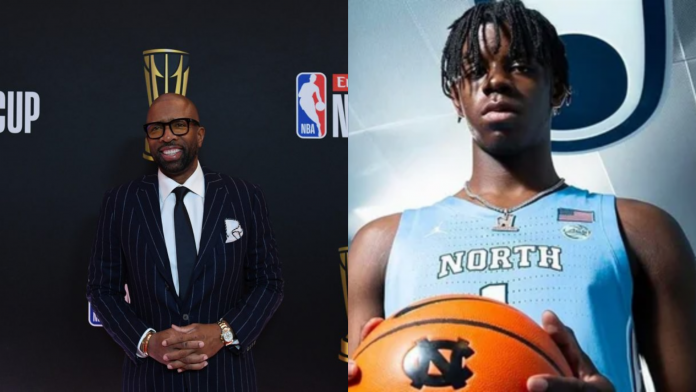
At first glance, it looked like just another postgame photo — three smiling figures standing shoulder to shoulder inside an ACC arena. But within minutes, the image began circulating across social media, igniting conversations among North Carolina fans everywhere. Why? Because that snapshot wasn’t just a picture. It was a bridge between eras. And for Caleb Wilson, it became something far more meaningful than a viral moment — it became a lesson in legacy he didn’t even know he needed.
College basketball is built on tradition. At certain programs, tradition isn’t simply celebrated — it’s protected, polished, and passed down like a family heirloom. Few schools embody that reality more than the North Carolina Tar Heels.
From championship banners to Hall of Fame alumni, the Tar Heels don’t just recruit talent. They recruit players into history.
And on a January night in Atlanta, history tapped Caleb Wilson on the shoulder.
The Game That Set the Stage
On Saturday, Jan. 31, North Carolina walked into McCamish Pavilion and delivered a statement. Head coach Hubert Davis guided his squad to a convincing 91–75 victory over the Georgia Tech Yellow Jackets, coached by Damon Stoudamire.
Wilson was electric.
The freshman scorer poured in 22 points on 9-of-15 shooting, adding six rebounds, five assists, and two combined steals and blocks. He wasn’t just efficient — he was confident. Controlled. Composed beyond his years.
In a season where North Carolina has leaned heavily on emerging talent, Wilson has quickly carved out a role as one of the offensive engines of the team.
But as impactful as his stat line was, what happened after the final buzzer is what truly put him on the map.
A Photo That Meant More Than It Seemed
Following the win, NBA legend and former Tar Heel Kenny Smith shared a photo on social media.
Standing beside him? Caleb Wilson.
On the other side? Another North Carolina icon — Charlie Scott.
Three generations.
One program.
One frame.
For many fans, the symbolism was immediate. Smith represents the proud 1980s era of Carolina basketball, a national champion and long-time voice on “Inside the NBA.” Scott represents something even deeper — courage, barrier-breaking, and historical significance as the first African American scholarship basketball player in ACC history and a former NBA All-Star.
Wilson, meanwhile, is the present — and possibly the future.
But here’s where the story took an unexpected turn.
Wilson admitted he didn’t initially know who Charlie Scott was.
And that’s where Kenny Smith stepped in.
The Lesson That Changed the Moment
During an “Inside the NBA” segment later that week, Smith explained how he introduced Wilson to Scott after the game.
Wilson, being part of a younger generation, simply hadn’t been exposed to the full depth of Carolina’s history yet. It wasn’t ignorance — it was youth.
Smith didn’t scold him.
He educated him.
He told Wilson: “Wait, Caleb, this is the first African American basketball player in the ACC and with North Carolina.”
He didn’t stop there.
“He’s not just that — he’s an NBA All-Star. He had 2,000 points in three years.”
Wilson’s reported reaction?
“Dang.”
One word.
But within that single word lived realization.
Respect.
Perspective.
Why This Moment Matters for UNC
Programs like North Carolina are built on continuity.
When you put on that Carolina blue jersey, you aren’t just playing for yourself. You’re representing decades of excellence — from Michael Jordan soaring through the 1982 national championship to the countless pros who followed.
For Wilson, meeting Charlie Scott wasn’t just about shaking hands with a legend.
It was about understanding the shoulders he stands on.
Scott didn’t just score points. He broke barriers. He walked into ACC arenas during a turbulent era in American history and competed at an elite level while carrying enormous social weight.
That context changes how you view the jersey.
That context deepens your responsibility.
Caleb Wilson’s Rapid Rise
What makes this story even more compelling is how quickly Wilson has become essential to the Tar Heels.
In just his first year, he’s emerged as one of the go-to scorers in Hubert Davis’ system. His versatility — scoring off the dribble, attacking in transition, finding teammates — has made him difficult to guard.
Against Georgia Tech, his performance wasn’t flashy. It was surgical.
He read defenses.
He made the right passes.
He picked his spots.
And as the Tar Heels continue navigating ACC play, Wilson’s growth has been one of the biggest reasons optimism remains high in Chapel Hill.
But talent alone doesn’t define a Carolina great.
Connection to the program does.
And that’s what the viral photo symbolized.
Three Generations, One Standard
In that image, you could see the timeline of UNC basketball:
Charlie Scott — the trailblazer.
Kenny Smith — the champion and ambassador.
Caleb Wilson — the next chapter.
It’s rare to witness such a clear visual representation of legacy in real time.
For older fans, it was nostalgic.
For younger fans, it was educational.
For Wilson, it was transformational.
Because now, when he steps onto the floor, he does so knowing more than just the playbook.
He knows the lineage.
The Transfer Portal Era and Identity
In today’s college basketball landscape, players transfer frequently. Rosters flip quickly. Continuity is harder to maintain.
Moments like this matter even more because they anchor players to something permanent.
UNC isn’t just another stop.
It’s an institution.
And when legends take time to educate the next generation, it reinforces that identity.
Wilson’s one-word response — “Dang” — wasn’t dismissive.
It was awakening.
You could almost feel the realization settling in: This is bigger than me.
Hubert Davis’ Quiet Influence
While the viral moment centered on Smith and Scott, it also reflects the culture Hubert Davis continues to cultivate.
Davis understands legacy.
He lived it as a player.
He carries it as a coach.
His program consistently emphasizes connection to alumni, respect for history, and pride in wearing Carolina blue.
Wilson’s growth — both on and off the floor — mirrors that philosophy.
What Comes Next
The viral moment may fade from timelines, but its impact could linger.
Players often speak about defining memories from their college careers. For Wilson, this might be one of them.
Years from now, if he reaches the NBA or returns to Chapel Hill as an alumnus, he’ll remember the night he learned about Charlie Scott not from a textbook — but from Kenny Smith himself.
And perhaps one day, Wilson will stand in a similar photo with a future Tar Heel star.
Explaining the history.
Sharing the legacy.
Continuing the chain.
More Than a Photo
In a sport driven by highlight reels and trending clips, it’s refreshing when a viral moment carries substance.
Caleb Wilson didn’t go viral for a dunk.
He went viral for a lesson.
For humility.
For connection.
For growth.
And that might matter even more.
Because championships are celebrated.
But legacy?
Legacy is inherited — and protected.
And on that January night in Atlanta, Caleb Wilson officially became part of something much bigger than himself.
UNC fans saw it immediately.
Three generations.
One powerful image.
One unforgettable lesson.
And perhaps, the beginning of Wilson’s own legendary chapter in Carolina history.




