


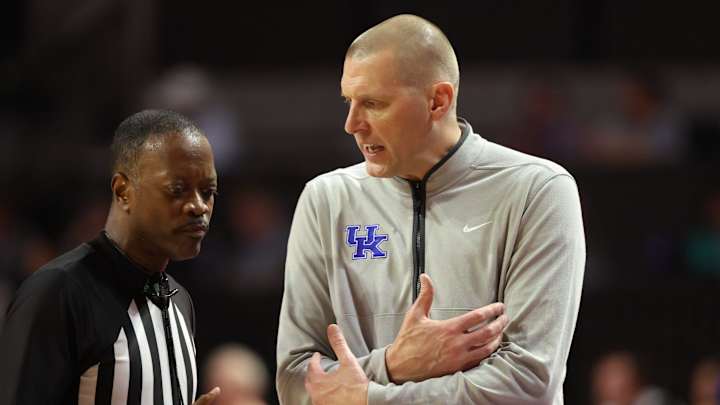
There are moments in a long college basketball season when a single comment from a head coach can stop an entire fan base in its tracks. Not because it’s dramatic. Not because it’s controversial. But because it reveals something deeper — something that might quietly determine how a season ends. That moment may have just arrived for Kentucky basketball. When Wildcats head coach Mark Pope spoke openly about fatigue after Kentucky’s loss to Texas A&M Aggies men’s basketball, it wasn’t just a routine postgame remark. For many in Big Blue Nation, it sounded more like a warning. With the intensity of March Madness just around the corner, the question suddenly hanging over Lexington is both simple and terrifying: could exhaustion be the one thing that derails Kentucky’s championship dreams?
A Season Tested by Injuries
From the very beginning of the season, Kentucky has been forced to navigate an obstacle course of injuries and roster challenges. While every team deals with bumps and bruises over the course of a long season, the Wildcats have endured more than their fair share.
One of the most devastating blows came when guard Jaland Lowe suffered a season-ending shoulder injury. Losing a key contributor at such a critical position instantly placed additional pressure on the rest of the roster. Guards who were already playing heavy minutes suddenly had to do even more.
The injury concerns didn’t stop there. Forward Kam Williams has missed a significant portion of conference play due to a broken foot, removing another important piece from Kentucky’s rotation. Meanwhile, talented big man Jayden Quaintance has been dealing with knee swelling after working his way back from ACL surgery — a recovery process that is never simple or predictable.
Individually, each of these injuries is manageable. But together, they have created a domino effect that has drastically changed the way Kentucky operates on the court.
A Shortened Rotation Creates Heavy Minutes
One of the trademarks of Mark Pope’s coaching philosophy has always been depth. He prefers playing multiple players, keeping energy high and allowing fresh legs to pressure opponents throughout the game.
But injuries have forced him to abandon that approach.
Instead of the deep rotation he prefers, Kentucky has been operating with a nine-player lineup — sometimes even tighter depending on matchups and availability. That means certain players are now logging significantly heavier minutes than originally planned.
Guards Otega Oweh and Denzel Aberdeen have shouldered much of that burden. Both have been playing more than 35 minutes per game recently, often carrying the offensive workload while also defending opposing stars.
For a few games, that kind of workload can be managed through adrenaline and determination. But over weeks — especially in the physically demanding Southeastern Conference — the toll begins to add up.
And that’s where the concern begins.
Mark Pope’s Honest Admission
After Kentucky’s loss to Texas A&M, Mark Pope addressed the media and didn’t sugarcoat the situation. Instead, he spoke candidly about the physical challenges facing his team.
“These Saturday-Tuesday turnarounds have been a little bit challenging for us with our limited roster size right now,” Pope admitted.
At first glance, the comment might seem harmless. Coaches frequently talk about scheduling difficulties or physical wear.
But context matters.
College basketball’s late-season schedule is already demanding, and the Wildcats are entering the most intense stretch of the year. If fatigue is already becoming an issue with two days between games, the postseason could amplify the problem dramatically.
The Brutal Reality of the SEC Tournament
The first challenge looming ahead is the SEC Tournament.
For Kentucky, the path through that tournament could be grueling. If the Wildcats lose their upcoming matchup against Florida Gators men’s basketball, they could be forced into the worst possible scenario: starting tournament play on Wednesday.
Winning the championship from that position would require five games in five days.
Five.
For a team already battling fatigue.
For a roster already stretched thin.
It’s the type of schedule that pushes even the deepest teams to their limits. For Kentucky’s current rotation, it could be a serious test of endurance.
March Madness Brings No Relief
Even if Kentucky navigates the SEC Tournament successfully, the physical demands won’t ease.
The NCAA Tournament — the chaotic, magical spectacle known as March Madness — is equally unforgiving.
Teams typically play two games in three days during the opening weekend. If Kentucky plays on a Friday, they would be back on the floor Sunday with minimal recovery time.
Then comes the second weekend.
Another Friday-Sunday gauntlet.
For teams with deep benches and healthy rotations, this rhythm can be managed. But for a roster already showing signs of wear, every extra minute played now could have consequences later.
The Only Possible Reinforcements
Hope for Kentucky rests partly on the potential return of injured players.
Kam Williams could still make his way back before the postseason, and Jayden Quaintance’s knee continues to be monitored carefully. If either player returns to full strength, it could give Mark Pope the extra depth he desperately needs.
Even adding one reliable body to the rotation could significantly reduce the strain on Kentucky’s most heavily used players.
More rest.
More flexibility.
More energy late in games.
Those factors can make the difference between a deep tournament run and an early exit.
The Mental Battle Ahead
Fatigue isn’t only physical.
It’s mental, too.
When players are tired, decision-making slows. Defensive rotations come a step late. Shots fall short. Turnovers increase.
And in postseason basketball — where every possession matters — even the smallest mental lapse can swing an entire game.
Kentucky’s leaders know this. Veterans like Otega Oweh and Denzel Aberdeen understand that the coming weeks will demand everything they have.
The challenge isn’t just to survive.
It’s to thrive.
Kentucky’s Championship DNA
Despite the concerns, writing off Kentucky would be a mistake.
Programs with the tradition and talent of the Wildcats have a long history of overcoming adversity.
Throughout its storied history, Kentucky Wildcats men’s basketball has built its reputation on resilience. Generations of players have worn the blue and white knowing the expectations that come with it.
And when March arrives, that tradition often fuels performances that defy logic.
Players dig deeper.
Energy appears where none seemed left.
Moments become memories.
The Final Stretch
As the regular season winds down, the Wildcats face a delicate balancing act.
They must compete with urgency — every game still matters.
But they must also preserve energy for the battles ahead.
That responsibility falls heavily on Mark Pope. Managing minutes, adjusting rotations, and keeping players physically prepared could determine how far Kentucky goes in March.
The margin for error is razor thin.
Big Blue Nation Is Watching
Perhaps no fan base in college basketball is more passionate than Kentucky’s. Every possession is analyzed, every lineup debated, every comment from the head coach dissected.
So when Mark Pope mentioned fatigue, fans listened.
Some heard honesty.
Others heard concern.
But everyone heard the same underlying message: the road ahead won’t be easy.
One Question Remains
The Wildcats still have talent. They still have experience. They still have the ability to beat anyone on the right night.
But the lingering question remains impossible to ignore.
When the lights of March Madness shine brightest… will Kentucky still have enough energy left to shine with them?
If the Wildcats can push through the exhaustion, overcome the injuries, and rediscover the depth that once defined them, this team could still write a memorable chapter in Kentucky basketball history.
But if fatigue truly becomes the enemy Mark Pope fears…
Big Blue Nation may witness one of the most frustrating “what if” seasons in recent memory.




