


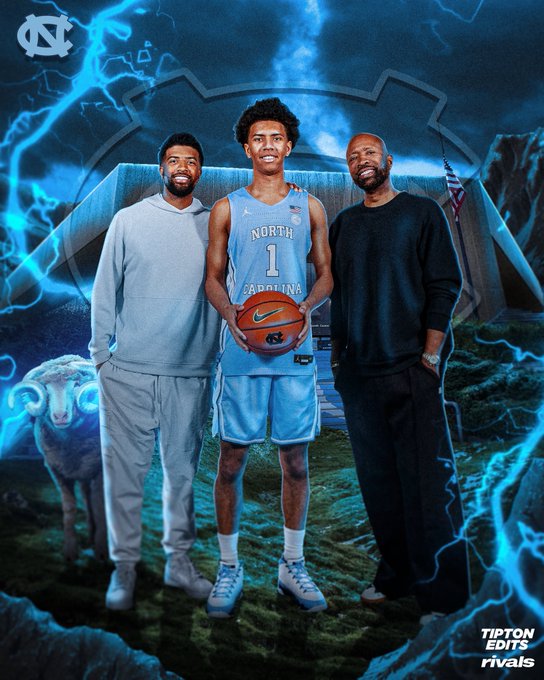
The world of college basketball recruiting often brings excitement, hope, and sometimes controversy. That was certainly the case when the University of North Carolina secured a commitment from Malloy Smith, the son of former Tar Heels legend and NBA champion Kenny “The Jet” Smith. While the news should have been a moment of celebration for the North Carolina program and its loyal fan base, the reaction from some corners of the basketball community quickly turned complicated.
Instead of focusing entirely on the potential of the young guard or the emotional connection between father and son returning to Chapel Hill, many fans took to social media with questions and criticisms. Some even accused the North Carolina program and head coach Hubert Davis of favoritism or nepotism. The debate quickly spread online, turning what might have been a routine recruiting story into a widely discussed topic among college basketball followers.
For North Carolina, a program with one of the richest traditions in college basketball history, scrutiny comes with the territory. The Tar Heels have produced legendary players, won multiple national championships, and built a reputation for attracting top-tier talent. Any recruiting decision is often analyzed closely by fans, media members, and rivals alike.
Malloy Smith’s commitment brought additional attention because of his family name. His father, Kenny Smith, is one of the most recognizable figures connected to the Tar Heels program. Before becoming a popular NBA analyst and television personality, Kenny Smith was a star guard at North Carolina under legendary coach Dean Smith. He helped lead the program during the 1980s and later went on to enjoy a successful NBA career, including winning two championships with the Houston Rockets.
Given that history, the idea of his son continuing the family connection at North Carolina naturally created headlines. However, it also sparked questions from some fans who wondered whether the opportunity was based on merit or legacy.
Critics on social media were quick to voice their opinions. Some pointed to Malloy Smith’s high school statistics and recruiting status, arguing that the scholarship might have been better used on a more highly ranked prospect. One fan commented that the guard averaged only eight points during the season and suggested that other players who might have stronger statistical profiles deserved the opportunity.
Another critic questioned whether the announcement was receiving attention primarily because of his father’s name rather than his own performance. Others went even further, claiming that scholarships were being taken away from players who might need them more.
There were also comments suggesting that Smith could spend much of his college career on the bench. A few critics compared the situation to other cases where the children of former players joined programs but struggled to find playing time.
The comments illustrated the sometimes harsh environment of modern sports discussions, especially on social media platforms where opinions are often shared instantly and without much context. For young athletes, being the son of a famous player can bring both opportunities and enormous pressure.
Despite the criticism, many supporters of the North Carolina program pushed back against the accusations. They argued that recruiting decisions are rarely as simple as fans assume and that coaching staffs evaluate players based on a wide range of factors beyond statistics alone.
College basketball recruiting often involves projecting a player’s potential development rather than judging only current production. Coaches frequently look for traits such as work ethic, basketball IQ, defensive ability, leadership, and long-term upside. A player who might not be a top-ranked prospect today could develop significantly in a structured college program.
Supporters also noted that the Tar Heels coaching staff, led by Hubert Davis, has built a reputation for valuing character and culture within the program. Davis, himself a former North Carolina player, often emphasizes the importance of team chemistry and a strong locker room environment.
From that perspective, bringing in a player who understands the traditions of the program and the expectations that come with wearing the Carolina blue jersey could be seen as a positive move.
Malloy Smith himself addressed his decision to attend North Carolina in an interview following his commitment. Rather than focusing on his father’s legacy, he emphasized the personal connection he felt with the university and the coaching staff.
He explained that the campus environment and the relationships he built with the coaches made Chapel Hill feel like home. According to Smith, the trust and belief shown by the coaching staff played a significant role in his decision.
He also pointed to the history and traditions of the North Carolina program as major factors. For many young basketball players, the opportunity to play for a school with such a storied legacy is a dream scenario. The Tar Heels have produced countless NBA players and remain one of the most recognizable brands in college sports.
Another element that appealed to Smith was the fact that many members of the coaching staff have direct ties to the program. North Carolina has a long tradition of former players returning to serve as coaches, which helps maintain the culture that has defined the program for decades.
Smith said that seeing coaches who once wore the same jersey and experienced the same expectations gave him confidence that they understood what it takes to succeed at North Carolina.
Currently playing for Mater Dei High School, Malloy Smith is described by some scouts as a player with significant potential. While he may not yet carry a star rating from recruiting services, analysts often note that rankings can change dramatically as players develop physically and gain experience.
Many successful college players and even future NBA stars entered college without elite recruiting rankings. Development at the college level can transform a player’s trajectory, especially within programs known for strong coaching and player development.
For Hubert Davis, the situation highlights the delicate balance coaches must maintain in modern recruiting. Every scholarship decision is closely examined, and programs must constantly navigate the expectations of fans, alumni, and the broader basketball community.
Davis, who took over the Tar Heels program in 2021, has already experienced both praise and criticism during his tenure. Leading a program with such a historic legacy means every move is analyzed, from recruiting decisions to game strategies.
However, Davis has repeatedly emphasized that building a successful team requires looking beyond outside opinions. Coaches must trust their evaluations and focus on what they believe will best position the program for success.
In the end, the true answer to the debate surrounding Malloy Smith’s commitment will likely unfold over the coming years. If he develops into a valuable contributor for the Tar Heels, the early criticism may quickly fade. If he struggles to find playing time, the discussion may resurface.
For now, Smith enters college basketball carrying both the weight of his father’s legacy and the opportunity to create his own story. Being the son of a Tar Heels legend will inevitably bring comparisons, but it also connects him to one of the most passionate fan bases in college sports.
North Carolina fans have seen generations of players leave their mark on the program. Some arrived as highly ranked prospects, while others developed quietly before becoming key contributors.
Malloy Smith now joins that long list of players who will attempt to carve out their own place in Tar Heels history. Whether the early criticism proves justified or misplaced remains to be seen, but one thing is certain: the spotlight will follow him as he begins his journey in Chapel Hill.
And as the reaction to his commitment continues to turn heads, both supporters and critics will be watching closely to see how the story ultimately unfolds.




