


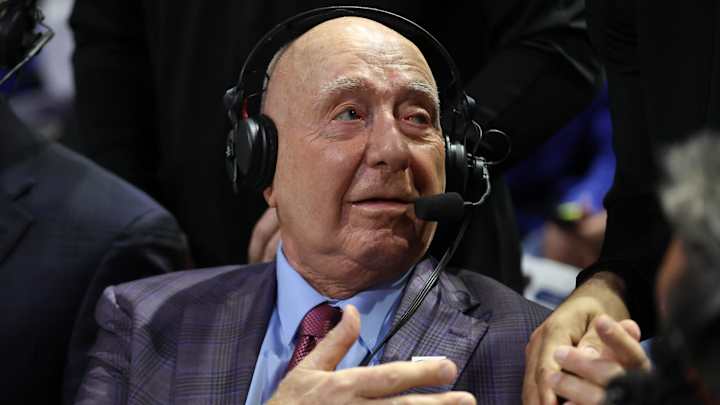
For a program built on banners, blue-blood expectations, and one of the most passionate fan bases in sports, even coming close simply isn’t good enough. That reality hit home once again when legendary broadcaster Dick Vitale delivered a brutally honest assessment of the current state of Kentucky Wildcats men’s basketball. As the final moments ticked away inside the iconic Rupp Arena, Kentucky’s late push to close the gap on the scoreboard might have impressed some observers—but Vitale made it clear he wasn’t buying into the idea of “moral victories.” For a program like Kentucky, he argued, the only thing that matters is winning.
That moment summed up a season that has been difficult for many fans of Big Blue Nation to accept. Kentucky basketball is a program synonymous with greatness. From national championships to NBA superstars, the Wildcats have long been viewed as the gold standard in college basketball. Yet this season has been filled with inconsistencies, missed opportunities, and growing questions about whether the team truly lived up to the lofty expectations surrounding it.
The frustration reached a boiling point during the Wildcats’ regular-season finale. Early in the game, Kentucky stumbled badly out of the gate, falling behind 11–0 and eventually trailing by as many as 20 points. For a team playing on its home court in front of thousands of devoted fans, the start was nothing short of alarming.
Still, in typical fashion, the Wildcats refused to completely go away. In the final minutes, Kentucky mounted a furious comeback attempt that electrified the arena. Several times in the closing stretch, the team managed to cut the deficit down to a single possession, raising hopes that an improbable rally might still be possible.
For many teams, such resilience would be celebrated as a sign of heart and determination. But for Kentucky, the conversation is always different. Expectations are higher. Standards are tougher. And according to Vitale, that’s exactly how it should be.
During the broadcast on ESPN, Vitale did not hold back when discussing the program’s performance.
“Moral victories do not count at this level of basketball,” Vitale said during the game. “People may leave here saying we kept it close. Bottom line is you’re Kentucky, and you’ve got to leave here, especially at home. There are no moral victories.”
The statement immediately resonated across social media and among fans watching the game. It was vintage Dickie V—passionate, direct, and unapologetically honest.
But Vitale didn’t stop there.
Earlier in the broadcast, he raised another issue that has become a major talking point around the program: roster construction. According to various reports, Kentucky’s NIL-related spending on its roster reached staggering levels, with estimates suggesting the Wildcats had as much as $22 million tied to player support and opportunities.
Vitale suggested that with that level of financial backing and the passionate support of the fan base, Kentucky should have been able to build a more dominant team.
“I’m going to say this right here,” Vitale said. “Win or lose. I’ve done several Kentucky games now. Win or lose, $22 million this team is, according to reports, is the NIL for their players. With $22 million, they could have put together a better roster than they did.”
For many fans, that comment struck a nerve.
Kentucky supporters have long prided themselves on providing unmatched energy and support for the program. Big Blue Nation is famous for filling arenas, traveling to neutral-site games, and creating one of the most electric atmospheres in college basketball.
Vitale acknowledged that passion while emphasizing that the fans deserve a product on the floor that reflects their dedication.
“These Big Blue Nation fans are so passionate,” he continued. “They deserve better.”
The numbers from the season help explain why the criticism has gained traction. Kentucky finished the regular season with a 19–12 record—a respectable mark by many standards but far from what is typically expected in Lexington.
For many programs across the country, a 19-win season would be seen as a success or at least a solid campaign. But Kentucky is not just any program.
The Wildcats measure success differently.
Fans remember championship banners, dominant SEC runs, and teams loaded with NBA-bound talent. Anything short of competing for a national title often feels like falling short of the program’s legacy.
The inconsistency throughout the season only added to the frustration.
At times, Kentucky looked capable of beating anyone in the country. The Wildcats recorded impressive victories against top competition, including notable comeback wins over the Tennessee Volunteers men’s basketball and the Arkansas Razorbacks men’s basketball.
Those victories showcased the team’s potential. When everything clicked, Kentucky could play with speed, energy, and confidence that made them dangerous.
But just as often, the team struggled against opponents it was expected to handle comfortably. Kentucky found itself needing dramatic rallies even against teams like the LSU Tigers men’s basketball and the Mississippi State Bulldogs men’s basketball.
While some of those comeback wins ultimately ended in victory, they revealed deeper issues that repeatedly surfaced throughout the year—slow starts, defensive lapses, and inconsistent offensive execution.
Over time, those issues began to pile up.
Losses that might have seemed manageable early in the season started to carry greater weight as the schedule progressed. By the time the regular season concluded, Kentucky had accumulated twelve losses.
For a program accustomed to competing near the top of the rankings, that number felt unusually high.
The result was a less-than-ideal postseason path. Instead of entering the conference tournament as one of the top seeds, Kentucky found itself scheduled to begin play earlier than fans would have liked in the SEC Men’s Basketball Tournament.
That reality alone underscored how far the Wildcats had drifted from the standard many supporters expect.
Yet even amid the criticism, there are signs that the team still possesses the fight necessary to make noise in March.
The comeback attempts that have become a recurring theme throughout the season demonstrate that Kentucky’s players have not given up on one another. Time and time again, they have shown the ability to battle back when the odds appear stacked against them.
The question is whether those late surges can be converted into complete performances.
In postseason basketball, there is little room for slow starts or extended scoring droughts. Every game becomes a win-or-go-home scenario, where one mistake or one cold shooting night can end a season.
That is why Vitale’s comments carried such weight.
His message was not merely criticism—it was a reminder of the standard that Kentucky basketball has always represented.
Programs with Kentucky’s history are expected to chase greatness every year. They are expected to compete for championships, dominate at home, and consistently field teams capable of making deep tournament runs.
Anything less inevitably sparks debate.
For the Wildcats, the upcoming postseason now represents both a challenge and an opportunity.
On one hand, the inconsistency of the regular season has raised legitimate concerns about how far the team can go. On the other hand, college basketball history is filled with examples of teams that found their rhythm at exactly the right time.
March has a way of rewriting narratives.
A strong run in the conference tournament—or beyond—could quickly change the tone surrounding Kentucky’s season. Players who were criticized in February can become heroes in March with a few clutch performances.
But if the struggles continue, the questions raised by Vitale will only grow louder.
Ultimately, the Wildcats now stand at a crossroads.
They can either prove that the flashes of brilliance shown throughout the season were a sign of untapped potential, or they can allow the inconsistencies that plagued them to define the year.
Either way, one thing is certain: the spotlight on Kentucky basketball is never dim.
And when a legendary voice like Dick Vitale speaks out, the entire college basketball world listens.




