


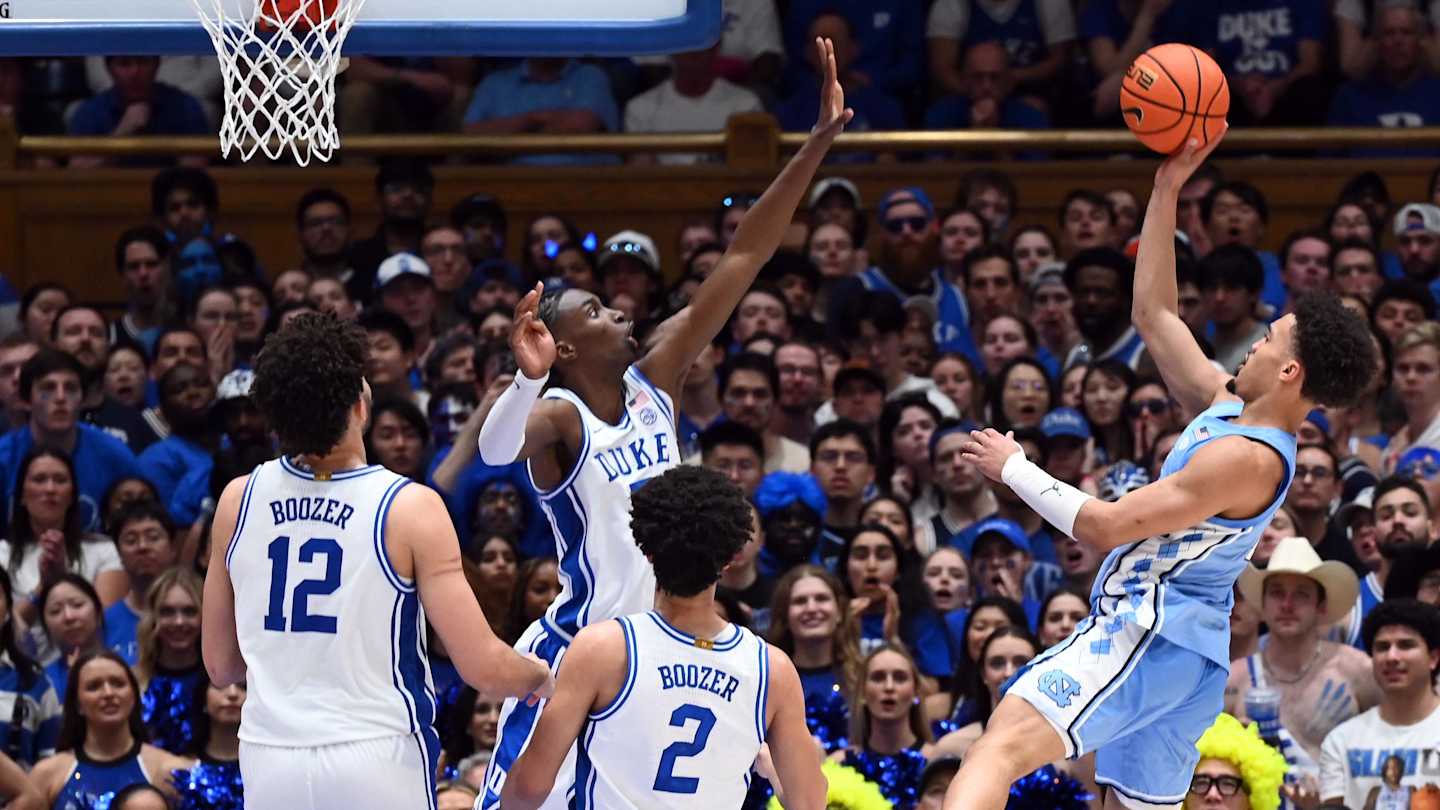
The rivalry between the North Carolina Tar Heels men’s basketball and the Duke Blue Devils men’s basketball rarely lacks intensity, but the latest meeting at Cameron Indoor Stadium delivered a harsh reality check for North Carolina fans.
Coming into the game without their star guard Caleb Wilson, Tar Heel supporters feared the worst—and unfortunately, those fears proved justified. Duke, playing with the confidence of the nation’s top team and fueled by revenge after their earlier loss in Chapel Hill, controlled the game and secured a decisive double-digit victory.
Still, while the result was disappointing, the game revealed several important lessons for North Carolina. More importantly, it showed that the Tar Heels still have time to regroup and make noise when the postseason arrives.
1. The Absence of Caleb Wilson Changed Everything
Losing Caleb Wilson wasn’t just about missing nearly 20 points per game. It was about losing the engine that made the entire UNC offense run smoothly.
In the first meeting between the teams, Wilson delivered a spectacular performance, scoring 23 points and carrying the offense during critical stretches. His ability to create shots under pressure forced Duke’s defense to adjust constantly.
Without him in the rematch, North Carolina struggled to find that same rhythm. Wilson’s season-ending thumb injury removed not only their leading scorer but also their most reliable playmaker. The Tar Heels simply lacked the player who could consistently break down Duke’s defense and generate quality looks when possessions became difficult.
Against a team as talented and disciplined as Duke, that kind of absence becomes impossible to ignore.
2. The Wilson–Veesaar Connection Was Missing
Another major impact of Wilson’s absence was the disruption of UNC’s high-low offensive game with Henri Veesaar.
When both players share the floor, they form one of the most effective inside combinations in the conference. Their chemistry—particularly on elbow passes and alley-oop connections—often creates easy scoring opportunities.
Without Wilson, Veesaar faced the full force of Duke’s interior defense. Cam Boozer did an excellent job pushing him away from the paint, while Maliq Brown disrupted entry passes and helped contest inside attempts.
The result was a quieter night for Veesaar and an offense that struggled to create high-percentage scoring opportunities.
3. Duke’s Talent Depth Was Hard to Match
One of the most obvious takeaways from the game was the depth and overall talent gap between the two rosters.
Even with injuries sidelining Patrick Ngongba and Caleb Foster, Duke still fielded a lineup filled with elite athletes and versatile defenders.
For UNC, only a handful of players could realistically compete for spots in Duke’s rotation. Wilson would certainly qualify, while Veesaar and Seth Trimble might earn bench roles.
Meanwhile, Duke continued to receive contributions from across the roster. Brown’s impressive stat line—15 points, nine rebounds, and five steals—highlighted how impactful their supporting cast can be.
That depth allows Duke to maintain intensity for the full 40 minutes, something few teams can match.
4. Cam Boozer Delivered a Superstar Performance
While many players contributed to Duke’s victory, Cam Boozer’s dominance stood out above the rest.
In the first matchup, Boozer struggled with foul trouble due in part to Wilson’s aggressive play. This time, without that defensive challenge, he operated with complete freedom.
Boozer showcased his full skill set—scoring inside, hitting perimeter shots, and orchestrating the offense with exceptional court awareness. His combination of size, skill, and basketball IQ made him nearly impossible for UNC defenders to contain.
When a player of Boozer’s caliber gets into rhythm, even well-organized defenses can struggle to slow him down.
5. A Crushing Run Turned Hope Into Defeat
For a brief moment early in the second half, North Carolina seemed poised to challenge Duke.
Three-pointers from Derek Dixon and Luka Bogavac brought UNC within a single point, sparking hope among Tar Heel fans.
But that hope vanished quickly.
Duke responded with a devastating 28–6 run, fueled by relentless defense and transition scoring. Steals, fast breaks, and offensive rebounds turned the game into a mathematical nightmare for North Carolina.
Despite shooting better percentages from the field, from three-point range, and even from the free-throw line, UNC still lost comfortably. Duke simply generated far more scoring opportunities.
The Blue Devils turned turnovers into 24 points and dominated the offensive glass, creating extra possessions that ultimately decided the game.
Looking Ahead: The Tar Heels Still Have Something to Prove
While the loss highlighted several weaknesses, it doesn’t define the season for North Carolina.
The Tar Heels have already shown resilience by defeating strong conference opponents despite Wilson’s absence. Their ability to bounce back from adversity will determine how dangerous they can become in the postseason.
Rivalry losses always sting—especially against Duke—but they also offer valuable lessons. If UNC can apply those lessons moving forward, this defeat could become the turning point that fuels a deeper tournament run.
For Tar Heel fans, the message is simple: the road just got tougher, but the season’s biggest opportunities are still ahead.




