


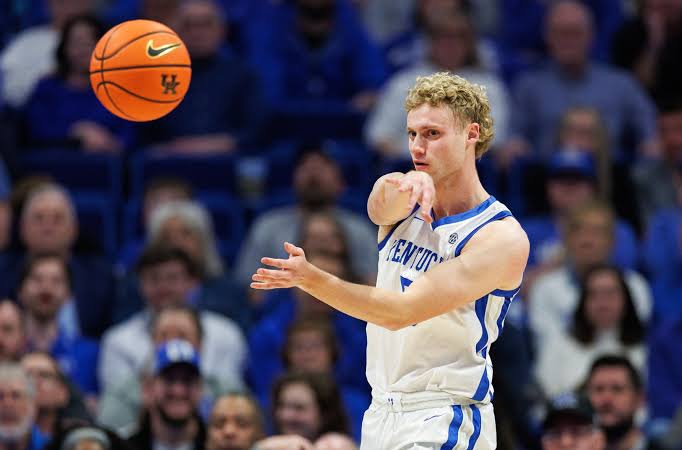
March is approaching fast, and for the Kentucky Wildcats men’s basketball, the path to survival may rest heavily on one name that fans are watching more closely than ever—Collin Chandler. When Kentucky wins, Chandler’s fingerprints are almost always all over the scoreboard. But when he goes quiet, the Wildcats suddenly look vulnerable. The numbers tell a story that is difficult to ignore: if Chandler isn’t scoring, Kentucky’s chances of making serious noise in March may disappear just as quickly as they arrived.
Kentucky’s March Hopes May Depend on Collin Chandler
As the postseason approaches, every college basketball team begins to look for the formula that can carry them through the chaos of tournament play. For Kentucky, that formula appears increasingly clear.
The Wildcats need scoring from multiple players, but more specifically, they need consistent production from one of their most dangerous offensive weapons: Collin Chandler.
The importance of Chandler’s scoring has become more obvious as the season has progressed. When he is aggressive, confident, and knocking down shots, Kentucky’s offense flows with energy and balance. When he struggles to find his rhythm, the Wildcats suddenly look far easier to defend.
That pattern has become impossible to ignore.
The Rise of the “Three Headed Goat”
During one of Kentucky’s most explosive performances of the season against the Vanderbilt Commodores men’s basketball, guard Otega Oweh introduced a nickname that quickly captured the attention of fans.
After combining with Denzel Aberdeen and Collin Chandler for a massive 61-point performance, Oweh jokingly referred to the trio as the “Three Headed Goat.”
The nickname stuck.
For many Kentucky fans, the phrase symbolized the offensive firepower the team can unleash when its three key scorers are clicking at the same time. Oweh brings explosive scoring ability, Aberdeen provides leadership and playmaking at the point guard position, and Chandler offers elite shooting that can stretch defenses across the court.
When all three players are performing well, Kentucky becomes extremely difficult to stop.
But recent games have shown what happens when one of those heads stops producing.
The Numbers Behind Chandler’s Impact
Statistics often reveal truths that are easy to miss while watching games in real time. In Chandler’s case, the numbers make one thing abundantly clear.
Kentucky performs significantly better when he scores.
During conference play, Chandler has averaged 10.5 points per game, a respectable number that highlights his role as a reliable offensive contributor. But the more interesting story lies in how his scoring correlates with Kentucky’s success.
In games where Chandler scores at least 10 points, Kentucky has posted a strong 7–3 record.
In games where he scores fewer than 10 points, the Wildcats have struggled, going just 3–5.
Those numbers are not just a coincidence. They demonstrate how Chandler’s scoring directly impacts the team’s chances of winning.
Simply put, when Chandler contributes offensively, Kentucky becomes a much more balanced and dangerous team.
Recent Losses Highlight the Problem
Kentucky’s recent defeats have made Chandler’s importance even more obvious.
Against the Texas A&M Aggies men’s basketball and the Florida Gators men’s basketball, Chandler was held to a combined six total points.
For a player capable of changing games with his shooting, that kind of quiet performance leaves a noticeable hole in Kentucky’s offense.
Opposing teams have clearly recognized his importance and are adjusting their defensive strategies accordingly. Defenders are closing out faster, contesting every shot, and making it difficult for Chandler to find open looks from beyond the arc.
That attention speaks volumes about how dangerous opponents believe he can be.
Mark Pope’s Perspective
Head coach Mark Pope has acknowledged the challenge of keeping Chandler involved offensively.
According to Pope, defensive pressure from opposing teams has played a role in limiting Chandler’s scoring opportunities. However, he has also suggested that Kentucky as a team must do a better job creating chances for their sharpshooter.
Basketball is rarely about one player alone.
For Chandler to thrive, his teammates must help him by setting screens, moving the ball effectively, and creating the spacing necessary for him to operate.
When the offense becomes stagnant, Chandler often finds himself tightly guarded with few opportunities to get clean shots.
One of the SEC’s Most Dangerous Shooters
Despite recent struggles, Chandler remains one of the most dangerous shooters in the Southeastern Conference.
In conference play, he ranks among the top three in three-point shooting percentage, connecting on an impressive 45.7 percent of his attempts.
That level of accuracy makes him a nightmare for opposing defenses.
Every time Chandler touches the ball beyond the arc, defenders know they must react quickly—or risk giving up three points.
His shooting ability forces opponents to stretch their defensive coverage, which in turn creates driving lanes for teammates like Oweh and opens passing opportunities for Aberdeen.
In many ways, Chandler’s presence changes the geometry of the court.
More Than Just a Shooter
While Chandler is best known for his outside shooting, his offensive arsenal extends beyond the three-point line.
He possesses the athleticism to attack the basket, finish through contact, and even deliver highlight-reel dunks that energize the crowd.
Those moments remind fans that Chandler is more than just a perimeter threat.
When he plays aggressively and mixes driving with shooting, he becomes a far more difficult player to defend. Opponents can no longer focus solely on guarding the three-point line.
Instead, they must account for his ability to score in multiple ways.
That versatility is exactly what Kentucky needs heading into tournament play.
The Role of Oweh and Aberdeen
Of course, Chandler is not alone in carrying Kentucky’s offensive responsibilities.
Otega Oweh has emerged as one of the team’s most consistent scoring threats, capable of taking over games with his athletic drives and fearless mentality.
Meanwhile, Denzel Aberdeen has stepped confidently into the role of primary point guard after Jaland Lowe suffered a season-ending injury.
Aberdeen’s leadership and decision-making have helped stabilize Kentucky’s offense during a challenging stretch of the season.
But for the “Three Headed Goat” concept to work fully, all three players must contribute.
If Chandler struggles to score, the balance of the offense disappears, allowing defenses to focus more heavily on Oweh and Aberdeen.
March Madness Demands Offensive Balance
The NCAA Tournament is famously unpredictable.
Every March, underdogs rise, favorites fall, and teams must survive intense single-elimination matchups to continue their championship dreams.
For Kentucky, success in this environment will require a balanced offense capable of producing points from multiple sources.
Opposing teams will study every weakness, exploit every cold shooting night, and punish any offensive droughts.
That is why Chandler’s scoring is so critical.
His ability to stretch defenses and hit clutch shots could be the difference between an early exit and a deep tournament run.
The Challenge Ahead
The road ahead for Kentucky will not be easy.
The SEC Tournament and the NCAA Tournament present a gauntlet of talented opponents, each determined to extend their own seasons.
For the Wildcats to survive and advance, they must play their best basketball at exactly the right time.
And that likely means Collin Chandler must rediscover the scoring rhythm that made him such a dangerous player earlier in the season.
Final Thoughts
The story surrounding Kentucky’s postseason hopes may ultimately come down to a simple equation.
When Collin Chandler scores, the Wildcats win more often.
When he doesn’t, their path becomes far more difficult.
The numbers prove it, the recent games highlight it, and the upcoming tournament will likely confirm it.
If Kentucky hopes to make noise in March, the “Three Headed Goat” must return in full force—with Chandler leading the charge from beyond the arc.
Otherwise, the Wildcats’ postseason dreams could fade far sooner than anyone in Big Blue Nation hopes.




