


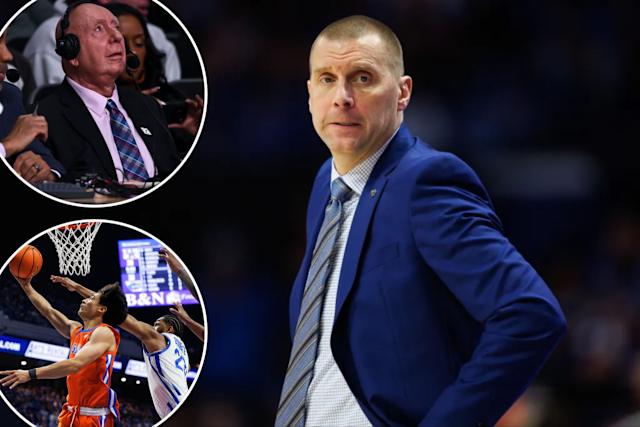
Sometimes the loudest criticism in sports doesn’t come from rival fans or opposing coaches—it comes from voices that truly love the game. That’s exactly what happened when legendary broadcaster Dick Vitale delivered a stunning on-air critique of the Kentucky Wildcats men’s basketball during their matchup with the Florida Gators men’s basketball. As the Wildcats battled on their home floor, Vitale didn’t hold back, questioning how a team reportedly built with $22 million in NIL resources could be struggling to live up to expectations. His blunt comments instantly ignited debate across college basketball: has Kentucky truly gotten the value expected from one of the most expensive rosters in the sport?
The remarks came during an intense game in Lexington, but the conversation they sparked stretches far beyond a single night of basketball. For Kentucky fans, analysts, and the broader college basketball world, Vitale’s words reopened a growing discussion about money, expectations, and the rapidly changing landscape of college sports.
A Legendary Voice Speaks His Mind
Few voices carry as much weight in college basketball as Dick Vitale’s. Known for his passionate commentary, signature catchphrases, and decades of coverage on ESPN, Vitale has long been one of the sport’s most recognizable ambassadors.
His enthusiasm has helped define college basketball broadcasts for generations. But on this particular night, the Hall of Fame analyst was not celebrating a spectacular play or praising a rising star.
Instead, he was raising serious questions about Kentucky’s roster construction.
During the broadcast, with the Gators extending their lead in the first half, Vitale made a remark that immediately caught viewers’ attention. According to reports surrounding NIL spending, Kentucky’s roster had reportedly been assembled with approximately $22 million in name, image, and likeness resources.
For Vitale, the Wildcats’ record simply didn’t match that level of investment.
“I’m going to say this right here,” he said during the broadcast. “I’ve done several Kentucky games now, win or lose. Twenty-two million dollars in terms of the NIL for their players. I think with $22 million, they could have put together a better roster than they did.”
Those words were as direct as they were surprising.
The NIL Era Changes Everything
Vitale’s criticism highlights one of the biggest transformations in modern college athletics: the rise of NIL.
Name, Image, and Likeness opportunities allow college athletes to earn compensation through endorsements, partnerships, and collective-backed deals. While the system was originally designed to give players fair financial opportunities, it has also created a new competitive landscape for programs.
Major schools with strong donor support and organized NIL collectives can assemble highly talented rosters by offering lucrative opportunities to top recruits and transfers.
Programs like Kentucky—one of the most historic brands in college basketball—have been expected to thrive in this new environment.
Yet the NIL era also introduces a new reality: money raises expectations.
If a team is believed to have spent tens of millions of dollars building its roster, fans and analysts naturally expect elite results.
When those results don’t arrive, the criticism grows louder.
Vitale’s comments were essentially a reflection of that new reality.
Kentucky’s Season Under the Microscope
Under head coach Mark Pope, Kentucky entered the season with optimism and ambition. The Wildcats had assembled a roster filled with talent, hoping to build on momentum from a previous run that reached the Sweet 16.
But the 2025–26 campaign proved to be inconsistent.
The Wildcats finished the regular season 19–12 overall and 10–8 in SEC play, numbers that fell short of the championship expectations that surround the program.
At a school with the tradition and history of Kentucky, those records rarely satisfy the fan base.
The Wildcats have long been associated with excellence, producing NBA stars, conference titles, and national championship runs.
Anything less than competing for the top of the conference—and deep tournament runs—often feels like disappointment in Lexington.
A Tough Night Against Florida
The game that triggered Vitale’s comments only added to the frustration.
Facing a talented Florida team ranked among the top squads in the nation, Kentucky found itself fighting uphill throughout the contest.
Florida’s aggressive defense and efficient offense gradually built a lead, and when guard Isaiah Brown knocked down key free throws to extend the margin, Vitale voiced his now-famous critique.
The Wildcats battled to stay within striking distance, but the Gators ultimately held on for an 84–77 victory.
While the scoreline suggested a competitive contest, Vitale made it clear he wasn’t impressed with the idea of taking comfort in a close loss.
“There Are No Moral Victories”
Late in the game, Vitale returned to the subject with another pointed statement.
With the final minutes ticking away, he dismissed the notion that Kentucky could view the close score as a positive outcome.
“Moral victories don’t count at this level of basketball,” he said emphatically during the broadcast.
For a program like Kentucky, playing close games isn’t the goal.
Winning them is.
Vitale emphasized that point repeatedly, reminding viewers of the high standards associated with the Wildcats’ name.
“You’re Kentucky,” he said. “You’ve got to leave here with a win—especially at home.”
Those comments resonated with fans who believe the Wildcats should always expect more.
The Pressure of the Kentucky Name
Few programs in college basketball face the level of expectation that surrounds Kentucky.
With multiple national championships, countless NBA alumni, and one of the largest fan bases in the sport, the Wildcats operate under a microscope.
Every season carries championship hopes.
Every recruiting class generates national headlines.
Every loss sparks debate.
That environment creates both opportunity and pressure.
When Kentucky wins, it reinforces the program’s legendary reputation.
When it struggles, the criticism becomes unavoidable.
Vitale’s comments simply amplified a conversation already taking place among fans and analysts.
What the Loss Means for the Wildcats
The defeat to Florida carried real consequences beyond the emotional reaction.
By falling to the Gators, Kentucky missed an opportunity to improve its standing heading into postseason play.
The result also left the Wildcats entering the SEC Tournament as the No. 9 seed, a position that makes a deep run significantly more difficult.
Higher-seeded teams often enjoy easier paths and additional rest.
Lower seeds, on the other hand, must survive multiple high-pressure games against elite opponents.
For Kentucky, that path suddenly became much steeper.
The Challenge Facing Mark Pope
Mark Pope’s tenure as Kentucky’s head coach has been closely watched since he took over one of the most prestigious jobs in college basketball.
Leading the Wildcats is both an honor and a challenge.
The expectations are enormous, and every season is judged by championship potential.
While Pope has shown promise as a leader and strategist, this season’s inconsistency has fueled debates about the program’s direction.
Vitale’s comments did not directly target the coaching staff, but they inevitably added pressure.
When a team is believed to have assembled a roster worth tens of millions in NIL support, the spotlight becomes even brighter.
The Bigger Question: Can Money Guarantee Success?
Perhaps the most interesting element of this story is the broader question it raises about the future of college basketball.
Does spending more money guarantee better results?
The answer, as Kentucky’s season suggests, is complicated.
Basketball success depends on chemistry, leadership, player development, and coaching strategy.
Talent alone—even highly paid talent—does not always translate into wins.
Teams must find ways to build cohesion, trust, and identity.
Without those elements, even the most expensive rosters can struggle.
Vitale’s criticism wasn’t just about Kentucky—it was about the evolving economics of college sports.
The Road Ahead
Despite the criticism and the difficult season, Kentucky’s story is not finished.
The SEC Tournament still provides an opportunity to change the narrative.
A strong performance could restore confidence and silence some of the doubts surrounding the program.
College basketball has always been unpredictable, especially in March.
Teams that appear flawed in February sometimes catch fire at exactly the right moment.
If Kentucky can find that spark, Vitale’s comments may eventually be remembered as motivation rather than condemnation.
Final Thoughts
Dick Vitale’s passionate critique of Kentucky’s $22 million roster quickly became one of the most talked-about moments of the college basketball season.
His words captured the frustration felt by many observers who believe the Wildcats should be performing at a higher level.
But they also highlighted the complex reality of modern college athletics.
In the NIL era, money can help assemble talent—but it cannot guarantee championships.
For Kentucky, the challenge now is to prove that the season still holds promise.
And for fans across the sport, one question continues to linger:
Was Vitale right—or can the Wildcats still prove him wrong when it matters most?




