


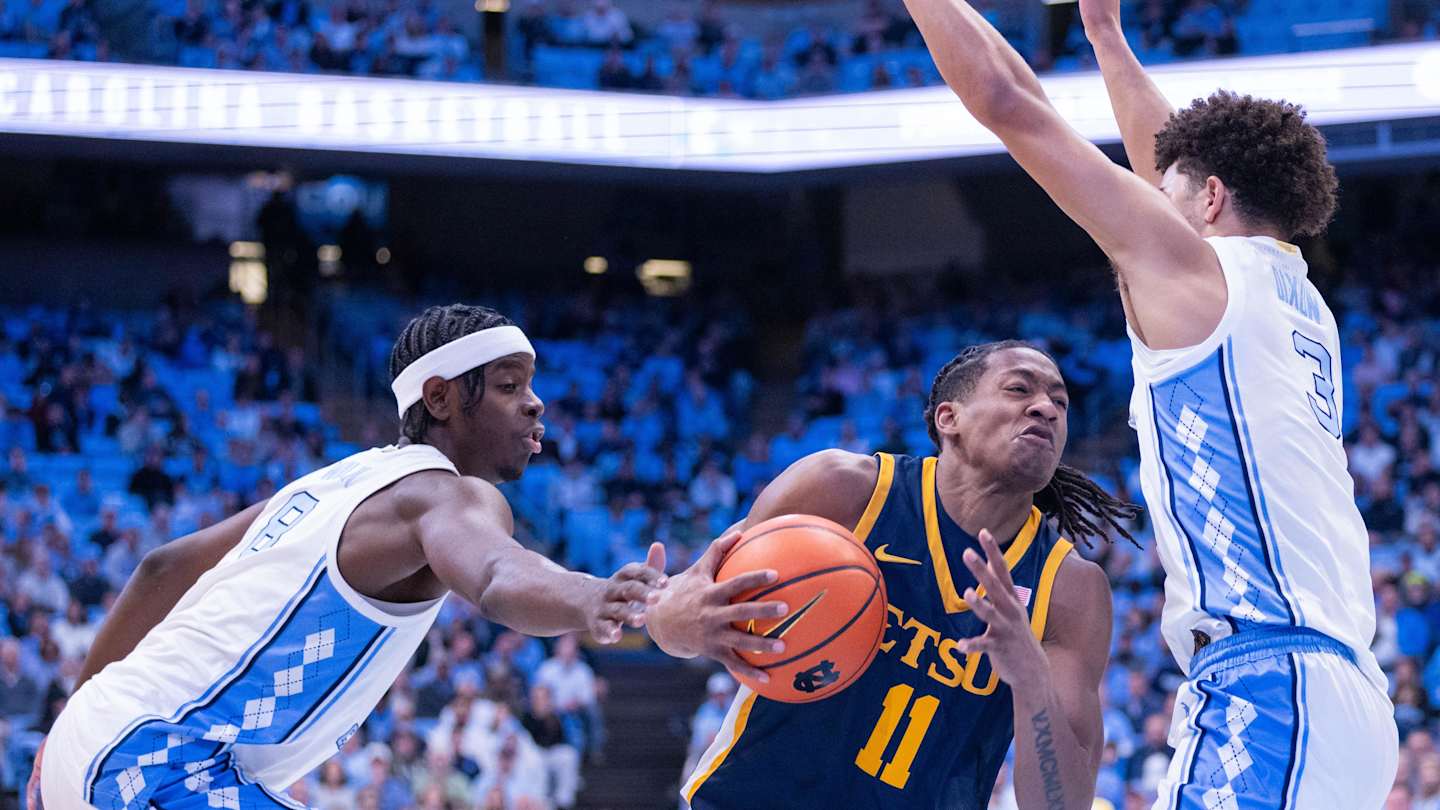
The road to March Madness has never been easy, but for the North Carolina Tar Heels, this season has been a true test of resilience. Through injuries, inconsistent performances, and constant lineup adjustments, the Tar Heels have been forced to adapt on the fly. Now, as the NCAA Tournament approaches, one key rotation adjustment could determine whether North Carolina simply participates in the tournament—or makes a deep, memorable run.
From the very beginning of the season, adversity seemed determined to follow the Tar Heels. One of the earliest setbacks came when guard Seth Trimble suffered a fractured forearm in a gym accident in early November. The injury immediately disrupted the team’s plans, forcing the coaching staff to adjust the backcourt rotation before the season had even found its rhythm.
Fortunately for North Carolina, Trimble’s recovery was quicker than expected. The senior guard made his return against the Ohio State Buckeyes in early December and immediately reminded everyone why he is such an important part of the Tar Heels’ system. His presence stabilized the offense and brought renewed energy to the backcourt, allowing North Carolina to regain momentum during a crucial stretch of the schedule.
Despite Trimble’s return, the season remained unpredictable. Entering the offseason, North Carolina had hoped that adding former Colorado State Rams guard Kyan Evans through the transfer portal would strengthen the team’s guard rotation. Evans arrived in Chapel Hill with expectations of providing experience, playmaking, and consistent scoring.
On paper, the addition made perfect sense. Evans had shown flashes of offensive creativity in previous seasons, and the Tar Heels believed his skill set would blend well with their system. The coaching staff envisioned a balanced backcourt where Evans and Trimble would handle playmaking responsibilities while contributing reliable production on the scoreboard.
However, the season didn’t unfold the way many had expected.
Evans struggled to find his rhythm throughout the year. Instead of becoming a steady offensive contributor, the junior guard experienced prolonged shooting slumps and difficulty maintaining consistency. His statistical output reflected those struggles. Evans averaged just 4.2 points, 2.6 assists, and 1.3 rebounds per game while shooting 33.1 percent from the field and 30.8 percent from three-point range.
For a team hoping to compete at the highest level in college basketball, those numbers fell short of expectations.
Recognizing the need for a spark, head coach Hubert Davis made a significant decision as conference play approached. Instead of continuing with the same lineup, Davis promoted freshman guard Ian Jackson Dixon—commonly referred to as Dixon—into the starting unit.
The move carried risk, but it also brought opportunity.
Dixon quickly proved that the coaching staff’s confidence in him was not misplaced. The young guard brought fresh energy, defensive activity, and a willingness to take big shots when the team needed them most. While his overall numbers may not jump off the page, they tell the story of a player who contributes in multiple ways.
Dixon is averaging 6.1 points, 2.6 assists, and 2.2 rebounds per game while shooting an impressive 38.1 percent from three-point range. More importantly, he has delivered several timely performances that helped the Tar Heels secure critical victories during the season.
In college basketball—especially during March—momentum and confidence can often matter more than raw statistics. Dixon’s ability to stretch the floor and create spacing has opened opportunities for other scorers, making North Carolina’s offense more dynamic.
Still, like most freshmen navigating a demanding schedule, Dixon experienced his own ups and downs. During the heart of conference play, he went through a noticeable shooting slump that temporarily cooled his early-season momentum. Opposing defenses began focusing on limiting his perimeter looks, forcing him to adjust and expand his offensive approach.
But recent performances suggest that Dixon may be rediscovering his rhythm at the perfect time.
In the Tar Heels’ last two games, Dixon erupted from beyond the arc, shooting an outstanding 9-of-14 from three-point range. That surge not only boosted his confidence but also provided North Carolina with the offensive firepower it desperately needed.
Hot shooting streaks can be game-changers during the NCAA Tournament. A single player catching fire from the perimeter can swing momentum, silence opposing crowds, and shift the outcome of tightly contested games. Dixon’s recent surge suggests he could become exactly that kind of difference-maker.
At 6-foot-5 and 200 pounds, Dixon also offers valuable size and versatility in the backcourt. His ability to guard multiple positions, contribute on the boards, and move the ball within the offense gives the Tar Heels greater flexibility in their rotation.
For North Carolina Tar Heels, the timing of Dixon’s resurgence could not be more important.
March Madness is defined by unexpected heroes and breakout performances. Every year, young players step into the spotlight and deliver unforgettable moments that propel their teams forward. Dixon now has the opportunity to become one of those players.
Meanwhile, the leadership of veterans like Seth Trimble will remain essential. Experience often becomes the deciding factor in high-pressure tournament environments, and Trimble’s steady presence will help guide the younger players through intense matchups.
Head coach Hubert Davis understands that success in the NCAA Tournament requires the right combination of talent, chemistry, and timely adjustments. His decision to reshape the rotation earlier in the season may ultimately prove to be one of the most important moves of the year.
If Dixon continues his recent hot streak and the Tar Heels maintain their defensive intensity, North Carolina could transform from an inconsistent regular-season team into a dangerous postseason contender.
The path through the NCAA Tournament is never easy. Upsets, buzzer-beaters, and dramatic finishes define the tournament’s legacy. But teams that peak at the right moment often find themselves advancing further than anyone predicted.
For the Tar Heels, that moment might be arriving right now.
And if Dixon continues to deliver under the bright lights of March, this bold rotation adjustment could become the spark that fuels an unforgettable tournament run




