


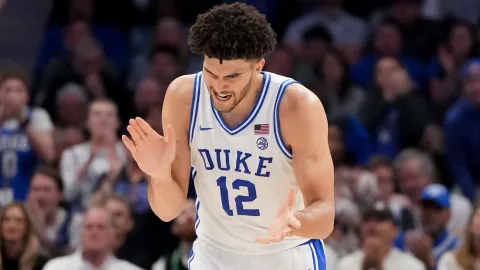
Is Cameron Boozer Being Misjudged? His Latest Words Say a Lot Before March Madness. Is the Narrative All Wrong?
As the spotlight intensifies ahead of the NCAA Tournament, few players are drawing more attention—and scrutiny—than Cameron Boozer. Widely projected as a future No. 1 NBA Draft pick and already a dominant force for Duke Blue Devils, Boozer finds himself in a familiar yet complicated position: praised as elite, but still questioned in key areas.
And now, just days before his highly anticipated March Madness debut, Boozer has made it clear—he believes the criticism is not only exaggerated, but flat-out wrong.
A Star Under the Microscope
For most freshmen, adjusting to the college game is the challenge. For Boozer, it’s managing expectations that seem almost impossibly high.
After an extraordinary regular season—averaging over 22 points, 10 rebounds, and 4 assists per game—Boozer has done everything expected of a generational talent. His efficiency numbers have been equally impressive, placing him among the most productive players in the country.
Yet despite those achievements, a narrative has persisted: his outside shooting needs improvement.
It’s a critique that, on the surface, might seem minor. But in today’s game—where versatility and spacing are everything—it’s the kind of label that can shape perception, especially heading into the NCAA Tournament.
Boozer Pushes Back
In a recent interview, Boozer didn’t dodge the criticism—he confronted it head-on.
He pointed to his track record, including a near 47% shooting clip from three-point range during his high school career and a strong 40% mark in his freshman season at Duke. For Boozer, the numbers speak for themselves.
More importantly, his response revealed something deeper: a player fully aware of the narratives surrounding him—and unwilling to let them define him.
That mindset could be just as important as his physical tools once the tournament begins.
Why the Criticism Exists
Still, the question remains: if the numbers support Boozer, why does the criticism persist?
Part of it comes down to perception. At 6-foot-9 and 250 pounds, Boozer’s physical dominance in the paint is so overwhelming that it sometimes overshadows his perimeter game. Opponents often focus on limiting his interior impact, which can skew how his overall offensive profile is viewed.
Additionally, expectations for a player of his caliber are different. Being “good” at something isn’t always enough—especially when you’re projected to be the face of the next generation of basketball.
In Boozer’s case, anything less than complete dominance in every facet of the game invites scrutiny.
The March Madness Test
Now, all of that talk will be put to the ultimate test.
Duke enters the tournament as a No. 1 seed, with Boozer at the center of its championship aspirations. Their opening matchup against Siena Saints may seem favorable on paper, but March Madness has a long history of rewriting expectations.
For Boozer, this tournament isn’t just about advancing—it’s about validation.
Can he stretch the floor consistently under pressure?
Can he silence critics on the biggest stage?
Or will the narrative continue, regardless of what the numbers say?
More Than Just a Prospect
What makes Boozer’s situation particularly compelling is how it reflects a broader truth about modern basketball: narratives often move faster than reality.
In an era driven by highlights, social media, and instant analysis, even the most complete players can find themselves reduced to a single perceived flaw.
But Boozer’s response suggests he isn’t interested in playing along.
Instead, he’s betting on his game—and on the idea that, when it matters most, performance will outweigh perception.
The Verdict Awaits
As the NCAA Tournament tips off, the conversation around Cameron Boozer is far from settled.
Is he being unfairly judged?
Are the critiques outdated or overblown?
Or will the pressure of March Madness reveal something deeper?
One thing is certain: by the time this tournament ends, the narrative surrounding Boozer won’t just be debated—it will be decided on the court.




