


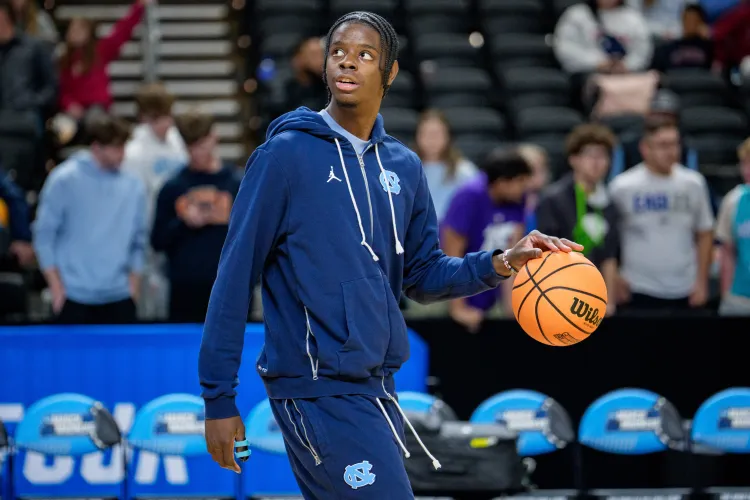
Just when the basketball world had already penciled Caleb Wilson in as a sure-fire NBA departure, one stunning statement has flipped the script entirelyleaving fans wondering if a superstar on the verge of going pro might shock everyone by choosing unfinished business over the bright lights of the NBA.
A Statement That No One Saw Coming
In today’s college basketball landscape, elite players rarely hesitate when it comes to their future. The moment a freshman dominates at a high level, the path is almost automatic: declare for the NBA Draft and take the next step.
That’s why what Caleb Wilson said hit so differently.
He didn’t confirm his departure.
He didn’t lock in his future.
Instead, he did something far more surprising:
He left the door open.
And in doing so, he introduced uncertainty into what was supposed to be one of the easiest decisions in basketball.
The Rise of a Freshman Phenomenon
To understand why this moment matters so much, you have to look at what Wilson has already accomplished.
Playing for the North Carolina Tar Heels men’s basketball, he didn’t just meet expectations—he shattered them.
From the very beginning of the season, Wilson looked like a player far beyond his years. His ability to score, rebound, and create plays made him the centerpiece of the Tar Heels’ system.
He wasn’t just good for a freshman.
He was one of the best players in the country.
Numbers That Tell a Dominant Story
Wilson’s production speaks volumes:
Nearly 20 points per game
Over 9 rebounds per game
Strong assist numbers for a forward
Defensive contributions across the board
But what made those numbers even more impressive was the consistency behind them.
He didn’t disappear in big games.
He didn’t fade under pressure.
Instead, he thrived—night after night—against top competition.
A Future That Seemed Certain
Before his shocking statement, there was almost no debate about Wilson’s future.
He was widely projected to:
Be a top NBA Draft pick
Possibly enter the lottery
Begin his professional career immediately
For players in his position, staying in college is rarely even considered.
The NBA offers:
Financial security
Global exposure
The chance to compete at the highest level
So when Wilson didn’t fully commit to that path, it caught everyone’s attention.
The Injury That Changed Everything
Part of what makes this situation so unique is how his season ended.
Wilson suffered a series of injuries, including:
A broken bone in his hand
A broken thumb that ultimately ended his season
These injuries didn’t just stop his momentum—they took away his chance to play in the NCAA Division I Men’s Basketball Tournament.
And that matters more than people realize.
Because for many players, March Madness is the defining stage of their college careers.
Wilson never got that moment.
The Pull of Unfinished Business
This is where things start to get interesting.
Wilson’s decision isn’t just about talent or opportunity—it’s about something deeper.
Unfinished business.
He never got to:
Lead his team in the NCAA Tournament
Experience the intensity of March Madness
Build his legacy on the biggest stage
For a competitor, that can be hard to walk away from.
And it may be the biggest reason why he’s even considering staying.
Love for the Game… and the Program
Another factor that cannot be ignored is Wilson’s connection to North Carolina.
He has openly shown appreciation for:
His teammates
The coaching staff
The program’s culture
For some players, college is just a stepping stone.
But for others, it becomes something more.
And for Wilson, that connection might be strong enough to make him pause before jumping to the next level.
The Risk of Staying
Of course, choosing to return to college is not without risk.
In fact, it could be seen as a gamble.
If Wilson stays, he risks:
Injury that could hurt his draft stock
Increased expectations and pressure
The possibility that his value doesn’t rise further
From a purely strategic standpoint, entering the NBA Draft now would be the safer move.
Which is exactly why his hesitation is so surprising.
The Reward of Returning
But with risk comes potential reward.
If Wilson returns, the upside is enormous.
He could:
Become the undisputed best player in college basketball
Lead North Carolina to a deep tournament run
Cement his legacy as one of the program’s all-time greats
And perhaps most importantly, he could finish what he started.
What This Means for UNC
For the North Carolina Tar Heels men’s basketball, Wilson’s decision could change everything.
If he leaves:
The team must rebuild
New leaders must emerge
Expectations may shift
If he returns:
UNC becomes an instant contender
The team gains one of the best players in the nation
The entire outlook of the season changes
It’s not just a roster decision—it’s a program-defining moment.
The Ripple Effect Across College Basketball
Wilson’s decision doesn’t just impact one team.
It could send shockwaves through the entire sport.
A return would:
Alter preseason rankings
Shift championship predictions
Change how other teams prepare
In a landscape where elite talent often leaves quickly, a player like Wilson staying would be a rare and powerful statement.
A New Era of Player Decisions?
There’s also a bigger trend at play here.
More players are beginning to:
Think beyond immediate NBA entry
Value development and experience
Consider legacy alongside opportunity
Wilson’s situation could reflect a shift in how young stars approach their careers.
The Waiting Game
For now, the basketball world waits.
There is no final decision.
No official announcement.
Just possibility.
And sometimes, that’s even more powerful than certainty.
Because as long as the door remains open, anything can happen.
Final Thought: A Decision That Could Define Everything
Moments like this are rare.
A player with elite talent.
A program with championship aspirations.
A decision that could reshape both futures.
Right now, Caleb Wilson stands at the center of it all.
Will he take the leap to the NBA?
Or will he return and finish what he started?
No matter what he chooses, one thing is clear:
His decision won’t just define his futureit could change the future of college basketball itself.




