


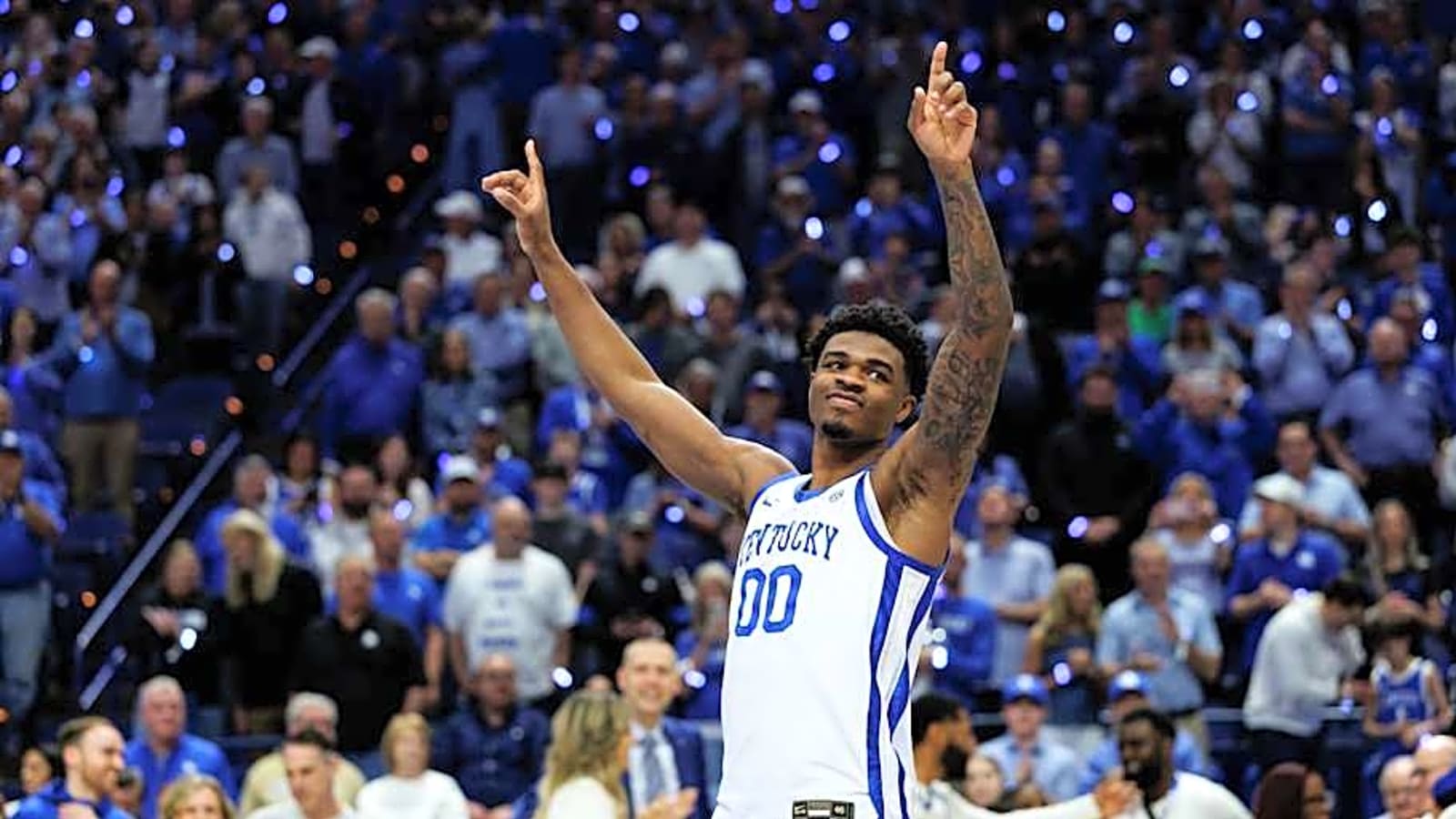
The conversation around Otega Oweh heading into the NCAA Tournament has been nothing short of puzzling, especially for those who have closely followed his impact this season.
While national narratives often gravitate toward flashy names and top-seeded programs, Oweh’s consistent excellence for the Kentucky Wildcats has somehow been pushed into the background.
Coming into the year, expectations were sky-high after Oweh was named Preseason SEC Player of the Year.
Despite dealing with a lingering foot injury that slowed his early rhythm, he never allowed adversity to define his season. Instead, he steadily built momentum, evolving into the offensive engine Kentucky desperately relies on. By the time conference play rolled around, Oweh wasn’t just contributing—he was dominating.
In SEC play, Oweh elevated his numbers to another level, averaging around 21 points per game against some of the toughest competition in college basketball.
Night after night, he proved he could carry the scoring load, create his own shot, and break down defenses that were specifically designed to stop him. His ability to attack the rim, absorb contact, and still finish makes him one of the most dangerous slashers in the country.
Yet, when Jeff Borzello released his ranking of the top 50 players in the tournament, placing Oweh at No. 38 raised eyebrows across the college basketball community. It wasn’t just the ranking itself—it was the lack of clear justification. For a player who has consistently delivered in high-pressure moments, being slotted that low feels more like an oversight than an informed evaluation.
What makes Oweh’s case even stronger is his two-way impact. While many players earn recognition purely for their scoring ability, Oweh contributes just as much on the defensive end.
His quick hands and anticipation lead to frequent steals, often turning into fast-break points. Those momentum-shifting plays—what fans often call “pick-sixes”—have bailed Kentucky out of difficult stretches multiple times this season.
Beyond the stats, Oweh’s value lies in his reliability.
When the Wildcats’ offense stalls, he is the player who can reset everything with a single aggressive drive or a tough, contested bucket. That kind of presence cannot be easily quantified, but it is essential for success in March, where games are often decided by individual brilliance in crucial moments.
Under the leadership of Mark Pope, Kentucky has leaned heavily on Oweh’s versatility and mental toughness. Pope has consistently trusted him in late-game situations, and more often than not, Oweh has delivered. His growth over the course of the season reflects not just talent, but a willingness to adapt, improve, and lead.
The perceived disrespect doesn’t stop at national rankings. Oweh being named only Second Team All-SEC remains a major talking point among fans and analysts alike. Given his production, efficiency, and overall importance to his team, many believe he was more than deserving of First Team honors. It’s another example of how his contributions have been undervalued on a broader stage.
However, if there’s one thing that could work in Oweh’s favor, it’s this very narrative. Great players often thrive when doubted, and the NCAA Tournament provides the perfect platform to silence critics. Every game is an opportunity, every possession a statement—and Oweh has shown he’s more than capable of rising to the occasion.
If Kentucky makes a deep run, it’s almost guaranteed that Oweh will be at the center of it. His ability to take over games, combined with his defensive intensity, makes him one of the most complete players in the field—regardless of where he’s ranked. And if he delivers on that stage, those rankings will quickly look outdated.
Even if the Wildcats fall short of a championship, Oweh’s legacy in Lexington is already secure. He has established himself as one of the most impactful players of his era for Kentucky, a relentless competitor who gave everything to the program. Over time, the numbers, performances, and memories will speak louder than any ranking ever could.
For now, though, the message is clear: underestimate Otega Oweh at your own risk. March has a way of exposing narratives—and rewriting them entirely.




