


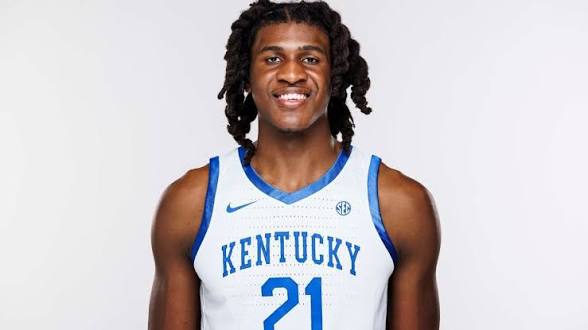
Just when the stakes couldn’t get any higher for the Kentucky Wildcats men’s basketball, a quiet but powerful question is beginning to echo across the entire NCAA Tournament landscape—will Jayden Quaintance make a shocking return when it matters most, or is Kentucky preparing for a tournament run without one of its most intriguing young talents?
As March Madness officially tips off, excitement, pressure, and uncertainty collide in a way only the NCAA Tournament can deliver. For Kentucky, a program built on expectations and legacy, every tournament carries a sense of urgency. But this year feels different.
Not because of seeding. Not because of matchups.
But because of one name that continues to hover over everything: Jayden Quaintance.
The question isn’t just whether Kentucky can win games. It’s whether they’ll ever have the chance to do it at full strength.
And right now, no one seems to have a clear answer.
The Situation: A Talent on the Sideline
Jayden Quaintance arrived with significant attention and intrigue. Known for his size, defensive instincts, and potential as a dominant presence in the paint, he represented something Kentucky values deeply: upside.
The kind of upside that can change games.
The kind of upside that can swing tournament momentum.
But instead of becoming a central figure in Kentucky’s rotation, Quaintance’s season has been defined by something far less glamorous—injury.
A lingering knee issue, connected to a previous ACL concern, has kept him sidelined for an extended period. Since early January, he has been unavailable, forcing Kentucky to adapt without him.
And as the tournament begins, that absence is still being felt.
The Reality of His Injury
Injuries in basketball are never simple, but knee injuries—especially those involving the ACL—carry a different level of caution.
They aren’t just about pain tolerance.
They aren’t just about conditioning.
They’re about stability. Confidence. Long-term health.
For Kentucky’s coaching staff, the priority has been clear: do not rush the process.
While Quaintance has reportedly made progress in his recovery, there is a difference between “getting better” and being ready for high-intensity, win-or-go-home basketball.
And that difference is exactly why expectations for his return remain low—at least in the early stages of the tournament.
🚫 The Early Tournament Outlook
Heading into the first weekend of March Madness, the message from within Kentucky’s program has been consistent:
Don’t expect Jayden Quaintance to play.
Head coach Mark Pope has indicated that while Quaintance is improving, he has not yet reached the point where he can safely return to game action.
That means:
No first-round appearance
Likely no second-round appearance
And in a tournament where survival is everything, those are the games that matter most.
For Kentucky, this creates a difficult reality. They must find a way to advancewithout knowing if one of their key pieces will ever rejoin them.
The “What If” Factor
Despite the cautious outlook, one thing keeps the conversation alive: uncertainty.
Quaintance has not been ruled out for the entire tournament.
There is no official statement declaring his season over.
And in a tournament defined by unexpected twists, that leaves the door slightly open.
What if Kentucky advances further than expected?
What if his recovery accelerates?
What if the team suddenly needs a defensive presence in the paint?
These “what ifs” are what make the situation so compelling.
Because even a limited return—even a few minutes—could have a ripple effect.
Why His Absence Matters More Than It Seems
At first glance, it might be easy to downplay the impact of a player who hasn’t been on the court for weeks. After all, Kentucky has already adjusted to life without Quaintance.
But tournament basketball is different.
Depth matters more. Matchups matter more. Every possession matters more.
And Quaintance brings something that can’t easily be replaced:
Rim protection
Physical presence
Defensive versatility
These are the kinds of traits that become crucial in tight games—especially against elite competition.
Without him, Kentucky loses an option. A layer. A potential advantage.
The Mental Side of the Situation
There’s also a psychological element to consider.
When a team knows a key player might return, it can create:
Hope
Motivation
A sense of “something extra” waiting in the wings
But it can also create uncertainty.
Players may wonder:
When will he be back?
How will roles change?
Will chemistry be affected?
Managing that balance is part of what makes this situation so delicate.
For Kentucky, the focus must remain on the present—winning the next game—while quietly acknowledging that the future could look different.
Can Kentucky Still Make a Run Without Him?
This is the question that ultimately matters.
And the answer is… complicated.
On one hand, Kentucky has already shown that it can compete without Quaintance. The team has adapted, adjusted rotations, and found ways to stay competitive.
On the other hand, March Madness is unforgiving.
The margin for error is razor-thin.
The level of competition is elite.
And every missing piece becomes magnified.
Experts believe that Kentucky’s chances of making a deep run would improve significantly with Quaintance available. But they also acknowledge that the team still has enough talent to make noise—even without him.
It all comes down to execution.
The Possibility of a Late-Tournament Twist
Imagine this scenario:
Kentucky survives the first weekend.
They build momentum.
Confidence grows.
And suddenly, there’s talk of Quaintance getting closer.
At that point, everything changes.
Even the possibility of his return becomes a storyline. Opponents have to prepare differently. Rotations become more flexible. Energy shifts.
This is the kind of twist that March Madness thrives on.
Unpredictable. Dramatic. Game-changing.
But for now, it remains just that—a possibility.
⚖️ Risk vs. Reward
One of the biggest decisions facing Kentucky’s coaching staff is whether bringing Quaintance back—if he becomes available—is even worth the risk.
Rushing a player back from a knee injury can have serious consequences. Not just for the tournament, but for the player’s long-term career.
So the question becomes:
Is a potential boost in March worth the risk of re-injury?
For a program like Kentucky, the answer isn’t simple. It requires balancing immediate goals with long-term responsibility.
And that’s why caution continues to guide every decision.
What We Know vs. What We Don’t
What We Know:
Quaintance has been out since early January
He is recovering from a knee/ACL-related issue
He is not expected to play in the early rounds
What We Don’t Know:
Whether he will return later in the tournament
How close he truly is to game readiness
How his potential return would impact the team
This gap between knowledge and uncertainty is what keeps the story alive.
💭 Why This Story Matters
In many ways, Jayden Quaintance represents more than just a player.
He represents potential. Possibility. The unknown.
And in a tournament built on chaos and surprises, those elements are powerful.
Because sometimes, the biggest stories aren’t about what’s happening—they’re about what might happen.
Final Takeaway: A Waiting Game in the Middle of Madness
As Kentucky begins its March Madness journey, one thing is clear:
They will have to fight, compete, and survive without Jayden Quaintance—at least for now.
But beyond that, everything is uncertain.
Will he return?
Will his presence be felt later?
Will Kentucky even get the chance to find out?
Those questions remain unanswered.
And maybe that’s what makes this story so compelling.
Because in a tournament where anything can happen, the biggest twist might still be waiting.
And if that moment comes, it could change everything for Kentucky.




