


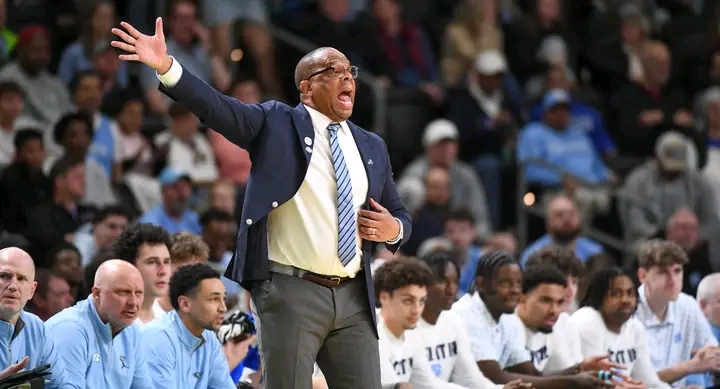
CHAPEL HILL IN SHOCK: Up 19. Then Overtime. Then Loss. Now the Question Everyone Is Asking but No One Wants to Answer: Is It Time?
The clock showed 14 minutes remaining in the second half. The scoreboard read North Carolina Tar Heels men’s basketball 58, [Opponent] 39. Inside the roaring Dean E. Smith Center, it felt over.
Nineteen points. Comfortably in control. Another expected win.
But what followed wasn’t just a comeback—it was a collapse that may redefine the trajectory of a program, and intensify scrutiny around head coach Hubert Davis.
By the time overtime ended, the scoreboard told a completely different story:
[Opponent] 82, North Carolina 78.
THE COLLAPSE THAT CHANGED EVERYTHING
For 26 minutes, North Carolina looked like the team fans believed it could be. Efficient offense, composed defense, rhythm, confidence—everything aligned.
Then something shifted.
The 19-point cushion slowly dissolved. Possessions grew tighter. Shots stopped falling. Defensive rotations lagged. What once felt inevitable turned fragile.
By the two-minute mark, the game was tied.
By overtime, it felt lost.
And when the final buzzer sounded, the silence inside the Dean Dome said more than any stat line ever could.
INSIDE THE LOCKER ROOM
After the game, the mood was described as “devastating.”
Players reportedly sat in stunned silence. Some stared at the floor. Others struggled to even process what had happened.
“It wasn’t just losing,” one insider shared. “It was how it happened. That’s what broke them.”
For seniors, the weight was even heavier—possibly their final home game ending in a way no one could have imagined.
Coach Hubert Davis addressed the team with composure, staying true to his calm demeanor. He spoke about resilience, about staying together.
But even in that moment, the reality was unavoidable: this loss meant more than just one game.
THE QUESTION NOW LOUDER THAN EVER
Is it time to move on from Hubert Davis?
It’s a question that once felt almost disrespectful. Davis is deeply tied to Carolina tradition—former player, longtime assistant under Roy Williams, and a symbol of continuity.
But results have complicated the narrative:
- Year 1: A stunning run to the national championship game
- Year 2: Missed NCAA Tournament
- Year 3: Inconsistency—and now, a historic collapse
At a program like North Carolina, expectations aren’t occasional success—they’re sustained dominance.
And this loss doesn’t feel isolated. It feels like a breaking point.
THE CASE FOR AND AGAINST CHANGE
Why some believe it is time:
- Repeated late-game collapses
- Inconsistent identity and execution
- Failure to meet elite program standards
Why others urge patience:
- Early success proves potential
- Coaching growth takes time
- Stability matters—especially after a legendary era
There’s also the financial factor: moving on from Hubert Davis would reportedly cost over $10 million in buyout obligations.
But for many around the program, the debate isn’t about cost—it’s about direction.
WHAT THE PLAYERS ARE SAYING
Publicly, players have taken responsibility.
“We’re the ones on the floor,” one said. “This isn’t on Coach.”
They’ve expressed strong support for Davis, emphasizing trust and respect within the locker room.
Privately, sources suggest that bond is genuine.
But in college basketball—especially at a place like North Carolina—relationships alone don’t determine outcomes.
Wins do.
PRESSURE BUILDING BEHIND THE SCENES
Athletic director Bubba Cunningham has maintained public support. Officially, nothing has changed.
Unofficially, scrutiny is intensifying.
At North Carolina, missing expectations doesn’t go unnoticed. And losses like this don’t fade quietly—they echo.
Every remaining game now carries more weight than before. Not just for postseason hopes, but for the future of the program itself.
FAN BASE IN TURMOIL
The reaction has been immediate—and emotional.
Some fans are calling for change. Others are urging patience. Many are simply trying to process what they witnessed.
A 19-point lead… gone.
At home.
In a game that felt won.
This isn’t just frustration—it’s uncertainty. The kind that forces a fan base to confront uncomfortable questions about identity, expectations, and the future.
WHAT COMES NEXT
For now, the season continues.
But everything has changed.
Every possession, every result, every decision from here forward will be viewed through a different lens. One shaped by what happened in those final 14 minutes.
Because this wasn’t just a loss.
It was a moment.
And moments like this don’t disappear—they define what comes after.
THE NUMBERS THAT STILL DON’T MAKE SENSE
- 19 – Largest lead
- 14:00 – Time remaining when control was absolute
- 72–72 – Regulation ending, after complete collapse
- 82–78 – Final score in overtime
- $10M+ – Estimated buyout
- ? – The question surrounding the future
FINAL THOUGHT
For the North Carolina Tar Heels men’s basketball, this was more than a defeat.
It was a turning point.
Whether it becomes a rallying cry—or the beginning of a major change—depends on what happens next.
But one thing is certain in Chapel Hill:
The question is no longer whispered.
It’s being asked out loud.
Is it time?




