


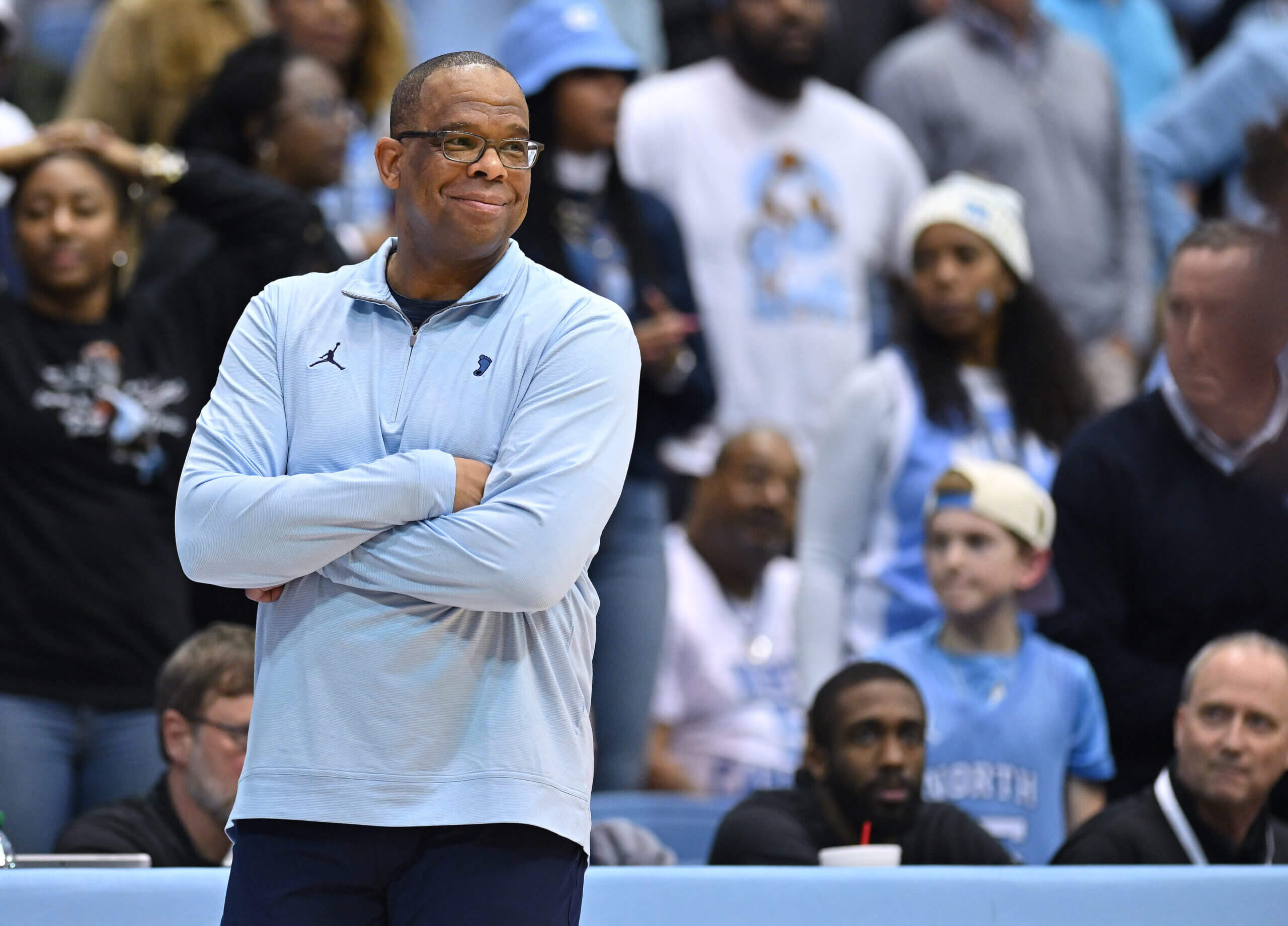
Something is quietly shifting around North Carolina Tar Heels men’s basketball—and the names now being whispered could change the future of the program faster than anyone expected.
A Conversation That Refuses to Stay Quiet
In Chapel Hill, conversations about the future are never taken lightly. This is a program built on legacy, excellence, and a standard that has been carefully protected for generations. But lately, something feels different.
The noise isn’t loud—yet.
It’s subtle. It’s growing. And it’s becoming harder to ignore.
The topic? The future of Hubert Davis.
Now, let’s be clear—this isn’t about calling for immediate change. It’s about curiosity. It’s about possibility. And most importantly, it’s about what happens if things don’t go the way fans, alumni, and insiders hope they will.
Because when expectations are as high as they are at North Carolina, even the idea of change carries weight.
Why This Conversation Is Happening Now
Every great program faces moments of reflection. Moments where results, trajectory, and identity all come into question at once.
For UNC, that moment seems to be creeping closer.
There have been flashes of brilliance—games that remind everyone exactly what this program is capable of. But there have also been frustrating inconsistencies, unexpected collapses, and performances that leave more questions than answers.
And in a place where banners hang as reminders of greatness, inconsistency doesn’t just frustrate—it unsettles.
Fans aren’t just asking, “What went wrong?”
They’re asking something deeper:
“What if this isn’t the right long-term direction?”
The Weight of the Carolina Standard
To understand why this discussion feels so significant, you have to understand what North Carolina represents.
This isn’t just another basketball program. It’s a pillar of college basketball history.
Names like Dean Smith and Roy Williams didn’t just win—they defined eras. They built cultures. They established a standard that goes far beyond wins and losses.
That standard?
Compete for championships
Develop elite talent
Perform under pressure
Represent the program with pride
Anything less doesn’t just feel disappointing—it feels out of place.
The “What If” Scenario
Let’s be honest: no one is making decisions today.
But college basketball moves fast. And when a program like UNC starts asking “what if,” it’s worth paying attention.
What if the struggles continue?
What if the results don’t match the expectations?
What if a change becomes unavoidable?
That’s where this list comes in—not as a prediction, but as a window into what could be.
1. Jay Wright — The Dream That Feels Almost Too Big
If you’re talking about dream scenarios, this is at the top of the list.
Jay Wright isn’t just a great coach—he’s a culture builder. During his time at Villanova, he created a program that was synonymous with discipline, intelligence, and championship-level execution.
Two national titles. Consistent excellence. A reputation for doing things the right way.
On paper, he fits UNC perfectly.
But there’s one massive obstacle: he’s retired.
Convincing him to return to coaching would take something extraordinary. It would require the perfect situation, the perfect pitch, and perhaps a sense that there’s unfinished business.
Would UNC be that opportunity?
It’s unlikely—but the fact that fans even dream about it says everything.
2. Nate Oats — The Modern Game-Changer
If UNC wants to embrace the future of basketball, Nate Oats is a name that stands out immediately.
His teams play fast. They shoot a lot of threes. They prioritize efficiency and spacing in a way that reflects where the game is heading.
At Alabama, he has transformed the program into a national contender, proving that his system works at the highest level.
For UNC, hiring Oats would represent more than a coaching change—it would signal a philosophical shift.
It would say:
“We’re not just trying to keep up with the modern game—we’re trying to lead it.”
That’s exciting. But it also comes with risk.
Would that style align with Carolina’s identity?
Or would it redefine it completely?
3. Mark Few — The Model of Consistency
Few coaches in college basketball can match the consistency of Mark Few.
Year after year, Gonzaga is in the conversation. Deep tournament runs. Elite player development. A system that produces results regardless of roster changes.
He’s not flashy. He’s not loud.
But he’s effective.
For UNC, that kind of stability could be incredibly appealing—especially if the program is looking to reset and refocus.
The challenge?
Few has built something special at Gonzaga. Leaving that behind wouldn’t be easy.
But then again… opportunities like North Carolina don’t come around often.
4. Danny Hurley — The Firestarter
If intensity had a face, it might look like Danny Hurley.
He brings energy. Passion. Accountability.
His teams reflect his personality—tough, relentless, and unafraid of the moment.
For a UNC program that has occasionally struggled with consistency and composure, that kind of presence could be transformative.
Hurley wouldn’t just coach the team—he would challenge it.
Push it.
Demand more from it.
The question is whether that level of intensity aligns with UNC’s culture—or whether it would reshape it entirely.
5. Wes Miller — The Carolina Connection
Sometimes, the answer isn’t about making the biggest splash.
It’s about coming home.
Wes Miller understands North Carolina. He’s lived it. He’s played in it. He knows what the program means—not just to players, but to the entire community.
As a coach, he’s still building his résumé, but the potential is there.
Hiring him wouldn’t be about instant headlines.
It would be about continuity. Identity. Trust.
And sometimes, that matters more than anything else.
The Bigger Picture
This list isn’t about replacing Hubert Davis tomorrow.
It’s about understanding the possibilities.
It’s about recognizing that in college basketball, conversations like this don’t come out of nowhere. They grow from expectations, from results, and from the constant pursuit of greatness.
And at UNC, that pursuit never stops.
Where Does Hubert Davis Stand?
Through all of this, it’s important to remember:
Hubert Davis is still the head coach.
He still has the opportunity to shape the narrative, to answer the questions, and to lead this program forward.
Moments like these can define a career—not because of the pressure, but because of how someone responds to it.
Final Thoughts
In the end, this isn’t just about five names.
It’s about a program at a crossroads.
It’s about expectations that never fade.
And it’s about a future that feels just uncertain enough to spark curiosity.
Because when UNC starts imagining “what’s next,” one thing is certain:
The rest of college basketball is already paying attention.




