


It starts as a whisper, grows into a debate, and suddenly becomes a full-blown conversation—because in Chapel Hill, when fans begin to question the future, it usually means something bigger is quietly unfolding.
A Program That Lives on Expectations
Few programs in college basketball carry the weight of expectation like the North Carolina Tar Heels men’s basketball. This is not just a team—it’s a tradition, a legacy, a standard that has been built over decades by some of the greatest minds and players the sport has ever seen.
From championship banners to unforgettable March moments, UNC isn’t measured by participation—it’s measured by dominance. And when that dominance begins to feel inconsistent, even for a short period, questions begin to rise.
That’s exactly where things stand now.
This isn’t panic. It’s not even outright criticism.
It’s curiosity.
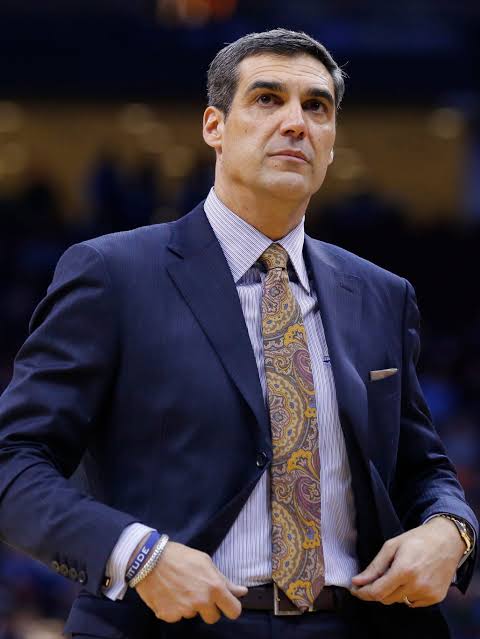
And at the center of that curiosity is a name that refuses to go away: Jay Wright.
Why This Conversation Is Happening
To understand why fans are even asking this question, you have to look at the bigger picture surrounding Hubert Davis.
Davis stepped into one of the most pressure-filled roles in sports, following legends and inheriting expectations that leave very little room for error. Early in his tenure, he showed promise—leading UNC on a deep run that reminded everyone of what the program is capable of.
But since then, the journey has been… uneven.
There have been moments of brilliance—games where the team looks elite, cohesive, and dangerous. But those moments have often been followed by stretches of inconsistency, missed opportunities, and performances that leave fans searching for answers.
And in a place like North Carolina, inconsistency doesn’t just raise eyebrows—it raises questions about direction.
Enter Jay Wright: The Name That Changes the Conversation
Whenever fans begin to imagine alternatives, the names they bring up say a lot about what they believe is missing.
And Jay Wright’s name?
It says everything.
Because Wright isn’t just another successful coach—he’s a symbol of what modern college basketball success looks like when everything is aligned.
A Resume That Demands Respect
Let’s start with the obvious.
Jay Wright’s career is built on winning at the highest level:
Two NCAA National Championships
Multiple Final Four appearances
A sustained run of excellence at Villanova
Consistent top-tier recruiting and player development
But numbers alone don’t tell the full story.
What makes Wright special isn’t just that he won—it’s how he won.
Building a Culture That Lasts
At Villanova, Wright didn’t inherit a powerhouse—he built one.
Over time, he created a program defined by:
Discipline
Selfless play
High basketball IQ
Strong leadership from within
His teams didn’t just rely on talent—they relied on structure, chemistry, and a clear identity.
And perhaps most importantly:
His teams rarely beat themselves.
For UNC fans watching frustrating losses or late-game collapses, that detail matters more than anything.
Thriving When the Pressure Is Highest
March Madness is where legacies are made—or broken.
And Wright didn’t just survive March—he mastered it.
His teams were known for:
Executing under pressure
Making smart decisions in critical moments
Staying composed when everything was on the line
That level of consistency in high-pressure situations is something UNC fans deeply value—and, at times, feel has been missing.
Adapting to the Modern Game
Another reason Wright’s name carries so much weight is his ability to evolve.
College basketball has changed dramatically over the years, with a greater emphasis on:
Three-point shooting
Floor spacing
Tempo and efficiency
Wright didn’t resist those changes—he embraced them.
His Villanova teams became models of modern basketball, blending analytics with fundamentals in a way that produced results.
For UNC, hiring someone like Wright wouldn’t just be about stability—it would also be about staying ahead of the curve.
Leadership That Commands Respect
Beyond strategy and results, Wright brings something that can’t be easily measured: presence.
He leads with:
Calm authority
Clear communication
Unshakeable composure
In high-pressure environments, that kind of leadership can define a program’s identity.
Players trust it. Fans believe in it. And opponents respect it.
The Biggest Obstacle: Reality
As perfect as the idea sounds, there’s one major complication:
Jay Wright is no longer coaching.
He stepped away from the game voluntarily, at a time when he was still highly successful.
This wasn’t a forced exit—it was a personal decision.
Which raises the most important question of all:
Would he even want to come back?
Because while UNC is one of the most prestigious jobs in college basketball, returning to the grind of coaching—recruiting, managing rosters, handling pressure—is a completely different decision.
Why Fans Are Still Pushing for Him
Despite the uncertainty, UNC fans continue to bring up Wright’s name for one simple reason:
He represents certainty in an uncertain moment.
When fans feel unsure about direction, they gravitate toward what feels proven, reliable, and safe.
And in college basketball, few names feel safer than Jay Wright.
The Case for Staying with Hubert Davis
While it’s easy to get caught up in the excitement of “what could be,” it’s just as important to evaluate what already exists.
Hubert Davis is not an unproven outsider—he’s deeply connected to UNC.
He understands:
The culture
The expectations
The responsibility that comes with the job
And perhaps most importantly, he has already shown flashes of what he can do at a high level.
Growth Takes Time
One of the biggest challenges in modern sports is patience.
Fans want results immediately. Programs want consistency instantly.
But coaching—especially at a place like UNC—is a process.
Davis is still developing:
His system
His rotations
His approach to high-pressure situations
And while the results haven’t always been perfect, the potential is still there.
The Risk of Starting Over
Replacing a head coach isn’t just a change—it’s a reset.
New systems. New philosophies. New expectations.
Even with a proven coach, there are no guarantees of immediate success.
And that’s something UNC must consider carefully.
Because while Jay Wright represents a dream scenario, moving on from Hubert Davis would be a decision with long-term consequences.
A Program at a Crossroads
This is where things become truly interesting.
UNC isn’t in crisis—but it’s not completely settled either.
It’s in a space where:
Questions exist
Expectations remain high
Possibilities are being explored
And that’s exactly why this conversation feels so important.
Final Verdict
So, is Jay Wright the right man for the job?
Yes—on paper, absolutely.
His résumé, leadership, and track record make him one of the most qualified candidates imaginable.
But is he realistic?
That’s far less certain.
And should UNC move on from Hubert Davis?
Not yet.
Because while the curiosity is understandable, the smartest decisions are often the most measured ones.
Closing Thought
In the end, this isn’t just about Jay Wright or Hubert Davis.
It’s about what UNC wants to be moving forward.
A program that reacts?
Or a program that builds?
Because sometimes, the answer isn’t found in chasing the biggest name…
It’s found in giving the right person the time to become exactly what you need.




