


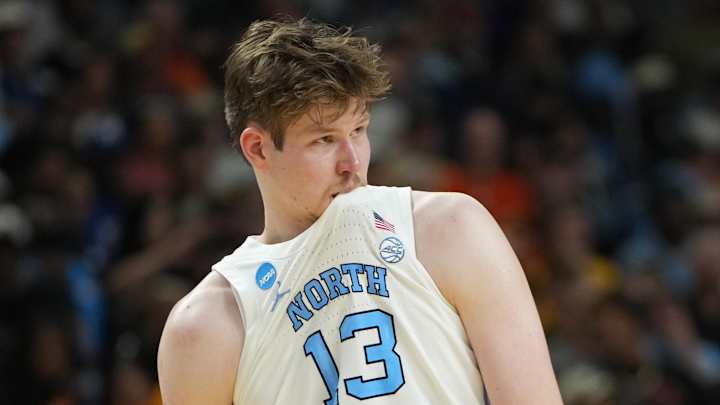
What if that painful March exit wasn’t just a loss—but the beginning of something far bigger? What if behind the heartbreak lies a complete reset, one that could either send North Carolina back to dominance… or deeper into uncertainty? The names leaving are massive. The names linked to replace them? Even bigger. And right now, Chapel Hill is standing at a crossroads that could define its future.
The offseason has officially arrived for North Carolina, and it didn’t come the way anyone in Tar Heel Nation hoped it would. A season that once carried promise and expectation came crashing down in a moment that still lingers painfully in the minds of fans. The loss to VCU wasn’t just a defeat—it was a statement. A harsh reminder that in today’s college basketball landscape, standing still is the fastest way to fall behind.
And now, everything is changing.
For a program with the prestige, history, and expectations of North Carolina, early tournament exits don’t just lead to reflection—they lead to action. The kind of action that reshapes rosters, redefines roles, and reimagines what the future should look like. This offseason isn’t about tweaking. It’s about transformation.
Because make no mistake—the Tar Heels are on the verge of a complete reset.
THE DEPARTURES THAT COULD SHAKE EVERYTHING
Every great reset begins with difficult goodbyes. For North Carolina, three names stand out as the pillars of change—players whose departures could leave massive holes both statistically and emotionally.
First, there’s Seth Trimble. A player whose energy, defensive presence, and leadership quietly anchored the team in crucial moments. Trimble’s graduation marks the end of an era defined by hustle and heart. He wasn’t always the headline, but he was often the difference. Losing him means losing a tone-setter—someone who brought intensity every single night.
Then comes the looming possibility of Caleb Wilson. A rising force whose impact goes far beyond the stat sheet, Wilson represents the kind of modern player every program craves—versatile, explosive, and capable of taking over games when it matters most. If he declares for the NBA Draft, North Carolina isn’t just losing a player—they’re losing a potential centerpiece.
And finally, Henri Veesaar. The stretch big who quietly became one of the most intriguing pieces on the roster. His ability to space the floor, protect the rim, and contribute on both ends made him invaluable. But with NBA aspirations becoming more realistic by the day, his departure feels increasingly inevitable.
Three players. Three massive voids.
And suddenly, the question becomes impossible to ignore:
Who replaces them?
ENTER THE TRANSFER PORTAL ERA
College basketball has changed. The transfer portal isn’t just a tool anymore—it’s the battlefield where seasons are rebuilt and championships are shaped. For North Carolina, it represents both urgency and opportunity.
The Tar Heels don’t have the luxury of waiting. They need immediate impact. They need proven production. They need players who can step into the spotlight and deliver from day one.
And that’s where three names begin to emerge—three players who could define the next chapter of Carolina basketball.
TYLER LUNDBLADE: THE SHOOTER UNC DESPERATELY NEEDS
If there’s one glaring weakness that haunted North Carolina this past season, it was perimeter shooting. In a game that increasingly revolves around spacing and efficiency, the Tar Heels often found themselves struggling to consistently knock down shots from beyond the arc.
Enter Tyler Lundblade.

The Belmont guard isn’t just a good shooter—he’s a game-changer. Averaging 15.6 points per game while shooting an impressive 43% from the field, Lundblade established himself as one of the most dangerous offensive threats in the transfer portal. But what truly separates him is his three-point efficiency—an elite 40.6% from deep.
That’s not just valuable. That’s essential.
Imagine Lundblade in Carolina blue, stretching defenses, creating space, and forcing opponents to rethink their entire defensive strategy. Suddenly, driving lanes open up. Offensive flow improves. The entire system becomes more dynamic.
But his impact goes beyond numbers. Lundblade brings confidence, composure, and a scorer’s mentality—qualities that UNC desperately needs as it transitions into a new era.
With players like Dylan Mingo and Maximo Adams projected to take on larger roles, and Derek Dixon expected to return, Lundblade fits seamlessly into the puzzle. He doesn’t just fill a gap—he elevates the entire roster.
STEFAN VAAKS: THE STAR WHO COULD CHANGE EVERYTHING

Every offseason has that one name—the player who doesn’t just improve a team, but transforms it.
For North Carolina, that name might be Stefan Vaaks.
The Providence standout has quickly risen to the top of the transfer portal rankings, and for good reason. At 6-foot-7, Vaaks combines size, skill, and versatility in a way that makes him incredibly difficult to defend. Averaging 15.2 points and 3.2 assists as a freshman, he’s already proven he can perform at a high level.
But here’s what makes this situation even more intriguing.
Vaaks shares a connection with Henri Veesaar—both hail from Estonia. In a world where relationships and familiarity often influence decisions, that connection could play a pivotal role. Could Veesaar’s presence—or even his departure—impact Vaaks’ decision?
It’s a storyline worth watching.
On the court, Vaaks brings exactly what UNC needs: scoring, playmaking, and the ability to create his own shot. He’s not just a shooter—he’s a complete offensive weapon. The kind of player who can take over games, ignite runs, and deliver in clutch moments.
If North Carolina lands Vaaks, it wouldn’t just be a big win—it would be a statement.
A statement that the Tar Heels aren’t rebuilding.
They’re reloading.
DREW SCHARNOWSKI: THE SIZE AND STABILITY FACTOR

While guards and wings often steal the spotlight, championships are still built on balance. And if Henri Veesaar departs, North Carolina will need to address one critical area: size.
That’s where Drew Scharnowski enters the picture.
The 6-foot-9 Belmont forward might not have the same headline buzz as some portal stars, but his impact could be just as significant. Averaging 10.7 points and 6.0 rebounds, Scharnowski brings consistency, physicality, and a strong interior presence.
But perhaps his biggest advantage?
Chemistry.
Having already played alongside Tyler Lundblade, Scharnowski offers a built-in connection that could translate immediately. In a system that’s constantly evolving, familiarity can be a powerful asset.
Scharnowski isn’t just about filling a role—he’s about stabilizing the frontcourt. Providing rebounding, interior defense, and reliable production. The kind of player every successful team needs, even if he doesn’t always make headlines.
And in a season where UNC is searching for identity, that kind of reliability could prove invaluable.
A PROGRAM AT A CROSSROADS
This offseason isn’t just important for North Carolina.
It’s defining.
The combination of key departures and high-profile transfer targets creates a moment of truth for the program. A moment that will test leadership, vision, and execution.
For head coach Hubert Davis, the challenge is clear. Adapt or fall behind. Embrace the new era of college basketball or risk being left in the past.
The good news?
The opportunity is there.
With the right additions, the Tar Heels can turn heartbreak into momentum. They can transform uncertainty into excitement. They can build a roster that doesn’t just compete—but contends.
THE FINAL QUESTION
As the dust settles and the offseason unfolds, one question continues to echo through Chapel Hill:
Will this reset lead to redemption… or regret?
Because in college basketball, the margin between those two outcomes is razor-thin.
Three players are likely leaving.
Three players could be arriving.
And somewhere in that transition lies the future of North Carolina basketball.
One thing is certain—this is no ordinary offseason.
This is The Great UNC Reset.




