What if one statement—just a few words about millions of dollars—was enough to shake the entire foundation of college basketball? What if behind the headlines, the rumors, and the viral debates lies a deeper truth about power, perception, and the new era of the game? Because right now, Kentucky isn’t just battling opponents on the court… they’re battling a narrative that could define everything moving forward.
The world of college basketball has changed—and not slowly, not quietly, but dramatically and almost overnight. The introduction of Name, Image, and Likeness (NIL) deals has completely transformed how programs recruit, how players make decisions, and how fans interpret the business behind the game. But every once in a while, a story emerges that doesn’t just highlight that change—it explodes it into the spotlight.
That’s exactly what happened when Yaxel Lendeborg made a claim that instantly sent shockwaves through the sport.
According to Lendeborg, he turned down a massive NIL offer from Kentucky reportedly worth between $7 million and $9 million. A number so staggering that it didn’t just raise eyebrows—it sparked debates, divided opinions, and triggered questions across the entire college basketball landscape.
And at the center of it all?
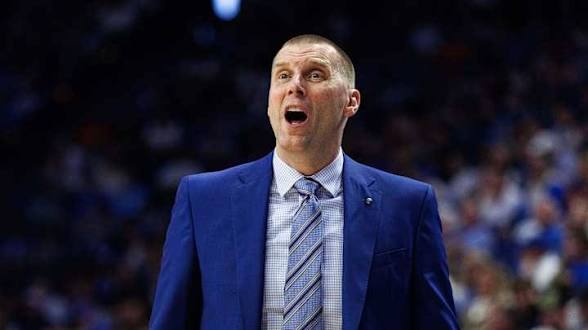
Kentucky head coach Mark Pope.
THE CLAIM THAT STOPPED EVERYONE IN THEIR TRACKS
When Lendeborg revealed that Kentucky had allegedly offered him a deal in the multi-million-dollar range, the reaction was immediate and intense. In a world where NIL deals are already pushing boundaries, this wasn’t just another big number—it felt like a line had been crossed.
Fans, analysts, and insiders all began asking the same questions:
Is this what recruiting has become?
Are programs really offering professional-level money to college athletes?
And most importantly… is it even true?
Because while NIL has opened doors for players to earn, a figure approaching $9 million for a single player is almost unheard of in college basketball.
Yet, the story spread like wildfire.
And just as quickly, the pressure shifted to Kentucky to respond.
MARK POPE’S RESPONSE: CALM, CALCULATED… AND TELLING
When Mark Pope was finally asked about the claim, many expected a strong denial or at least some clarification.
Instead, he delivered something far more intriguing.
He didn’t confirm the number.
He didn’t outright deny it either.
What he said instead was simple, yet powerful:
Don’t believe everything you read.
At first glance, it may seem like a generic response. But in reality, it was a carefully chosen statement—one that reveals just as much in what it avoids as in what it says.
By refusing to directly engage with the number, Pope accomplished two things:
He avoided validating a potentially exaggerated claim
He kept the focus away from distractions and back on basketball
But for fans and observers, his response only added another layer of mystery.
Because if the number wasn’t real, why not say so?
And if it was even partially true… what does that say about the current state of the sport?
THE NIL ERA: WHERE TRUTH AND HYPE COLLIDE
To fully understand the significance of this situation, you have to understand the environment in which it exists.
College basketball is no longer just about tradition, coaching, and player development. It’s about branding, marketing, and yes—money.
Big money.
The NIL era has introduced a level of financial competition that mirrors professional sports. Programs are no longer just selling playing time or championships—they’re selling opportunities, exposure, and financial packages that can rival early professional contracts.
But with that evolution comes a new challenge:
Transparency.
Unlike professional leagues, NIL deals are often private, loosely structured, and heavily influenced by third parties. That creates a space where rumors can thrive, numbers can be inflated, and narratives can take on a life of their own.
So when Lendeborg mentions a figure like $7 million, it doesn’t just raise questions about Kentucky—it raises questions about the entire system.
WHY LENDENBORG’S DECISION MATTERS
Lost in the noise of the dollar amount is a decision that might be even more important.
Lendeborg didn’t take the offer.
Instead, he chose a different path—one that reportedly prioritizes development, fit, and long-term growth over immediate financial gain.
In a landscape increasingly dominated by money, that choice stands out.
It sends a message that while NIL is powerful, it’s not the only factor. That players still value coaching, system, exposure, and their future beyond college.
And in a way, it challenges the assumption that the highest bidder always wins.
For Kentucky, that’s both reassuring and concerning.
Because while it shows that money isn’t everything, it also suggests that even massive offers—real or perceived—don’t guarantee results.
THE PERCEPTION PROBLEM FOR KENTUCKY
Whether the $7 million figure is accurate or not, one thing is certain:
The perception is now out there.
And in today’s media-driven world, perception can be just as powerful as reality.
For Kentucky, being associated with such a massive NIL offer changes how people view the program:
Are they trying to “buy” talent?
Are they leading the NIL arms race?
Or are they simply victims of exaggerated reporting?
These questions don’t just affect fans—they affect recruits, rival programs, and the broader college basketball community.
And that’s where Mark Pope’s leadership becomes crucial.
Because navigating this new era isn’t just about building a roster—it’s about managing a brand.
MARK POPE AND THE NEW KENTUCKY IDENTITY
Mark Pope stepped into one of the most high-pressure jobs in college basketball with a clear mission: restore Kentucky’s dominance while adapting to a rapidly changing game.
But situations like this highlight just how complex that mission really is.
He’s not just coaching players.
He’s managing expectations, narratives, and the evolving dynamics of NIL.
His response to the Lendeborg claim reflects that awareness. Instead of fueling controversy, he chose restraint. Instead of engaging in a public back-and-forth, he stayed focused.
That approach may not satisfy everyone, but it speaks to a bigger strategy—one centered on stability in a time of chaos.
THE BIGGER QUESTION: WHERE DOES THIS ALL LEAD?
As the dust settles, one question continues to linger:
What does this moment mean for the future of college basketball?
If numbers like $7 million are even being discussed, it suggests that the ceiling for NIL deals is still rising. That the gap between programs could widen. That recruiting battles may become even more intense—and more financially driven.
But it also raises concerns:
Will smaller programs be left behind?
Will the focus shift too far away from the game itself?
And how will governing bodies respond to maintain balance?
These aren’t easy questions.
And they don’t have simple answers.
FINAL THOUGHT: MORE THAN JUST A NUMBER
In the end, this story isn’t just about a reported offer.
It’s about everything that offer represents.
It’s about a sport in transition.
It’s about a program under the microscope.
It’s about a coach navigating uncharted territory.
And it’s about a player who made a choice that defied expectations.
Whether the $7 million claim is real, exaggerated, or somewhere in between, one thing is undeniable:
It has changed the conversation.
For Kentucky, for Mark Pope, and for college basketball as a whole, this moment serves as a reminder that the game is evolving—and fast.
The question now isn’t whether things will change.
It’s how programs will adapt when they do.
And in Lexington, all eyes are watching to see what happens next.