


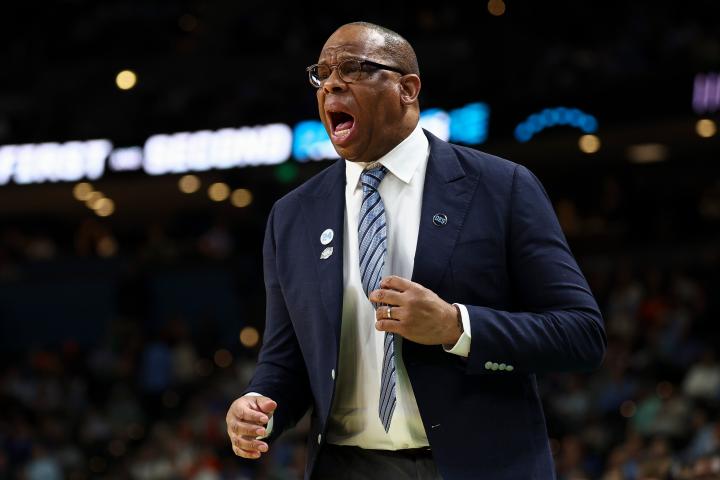
The noise isn’t just growing — it’s exploding. After a collapse that left fans stunned and critics unleashed, Hubert Davis finds himself at the center of a storm that refuses to quiet down. Now, with voices like Adam Schein turning up the heat, one uncomfortable question is suddenly impossible to ignore: has North Carolina Tar Heels men’s basketball reached its breaking point?
The noise surrounding Hubert Davis isn’t just growing — it’s reaching a fever pitch that feels impossible to ignore. What was once quiet concern has now turned into full-blown national debate, fueled by a stunning collapse, back-to-back early tournament exits, and a wave of criticism led loudly by Adam Schein. When Schein declared on his show that North Carolina Tar Heels men’s basketball is “an A-plus program with a C-minus coach,” it wasn’t just another hot take — it was a spark that lit a conversation many fans had been quietly having for months. Now, that conversation has burst into the open, and the implications for one of college basketball’s most iconic programs feel more serious than ever.
To understand why the reaction has been so intense, you have to start with the collapse itself — a moment that instantly shifted the tone of North Carolina’s season. Holding a comfortable 70–56 lead with just over seven minutes remaining against VCU, the Tar Heels looked firmly in control. It felt routine, expected, almost inevitable that they would advance. Then, everything unraveled. Possession after possession slipped away, defensive intensity faded, and confidence turned into hesitation. VCU stormed back, outscoring North Carolina down the stretch and sealing an 82–78 upset that stunned fans, analysts, and players alike. For a program built on poise, discipline, and championship pedigree, it wasn’t just a loss — it was a collapse that felt out of character, and that’s what made it so alarming.
Moments like that don’t exist in isolation. They connect to patterns, narratives, and expectations — and that’s where the scrutiny on Hubert Davis intensifies. This wasn’t just about one game; it was about what that game seemed to represent. North Carolina has now suffered early exits in consecutive NCAA tournaments, a reality that clashes sharply with the program’s identity. This is a school that measures success in Final Fours and national championships, not first-round exits and what-ifs. When a team repeatedly falls short on the biggest stage, questions inevitably shift from players to leadership. Fair or not, that’s the burden of coaching at a place like North Carolina.
And yet, the story of Hubert Davis is far from simple. In fact, it’s layered with both undeniable highs and frustrating inconsistencies. In his very first season, Davis delivered something remarkable — a 29–10 record and a run to the national championship game. It was a journey that reignited belief, silenced early doubts, and suggested that North Carolina had found a worthy successor to the legendary Roy Williams. That run wasn’t supposed to happen, and that’s precisely why it meant so much. It created a sense of momentum, a belief that Davis could carry the program forward while honoring its traditions.
But success, especially at a place like North Carolina, can be both a blessing and a burden. That early achievement didn’t just raise expectations — it skyrocketed them. Suddenly, anything less than deep tournament runs felt like underachievement. The margin for error disappeared. Every loss became magnified, every inconsistency scrutinized. And when the results didn’t match the standard, the conversation shifted quickly from optimism to concern.
What makes the current situation even more complicated is Davis’s historical consistency in one specific area. He became the only coach in program history to win 20 or more games in each of his first four seasons — a remarkable accomplishment that speaks to stability and competitiveness. On paper, that’s the kind of record most programs would celebrate. But North Carolina isn’t most programs. Here, success isn’t just about winning games; it’s about winning the right games, at the right time, on the biggest stage. And that’s where the criticism finds its footing.
Schein’s comments, while harsh, tap into a deeper frustration that extends beyond one analyst’s opinion. When he questioned how a program with North Carolina’s resources, brand power, and NIL capabilities could settle for anything less than elite coaching, he was voicing a sentiment that resonates with a growing portion of the fan base. North Carolina isn’t just a college basketball team — it’s a global brand, amplified by its connection to the Jordan Brand, its history of producing NBA talent, and its reputation as one of the sport’s true blue bloods. With that kind of platform comes an expectation to compete not just nationally, but dominantly.
That’s why the comparison to NBA jobs, as Schein suggested, doesn’t feel entirely outrageous. In many ways, coaching North Carolina comes with more visibility, more tradition, and arguably more pressure than some professional roles. The spotlight is constant, the expectations unrelenting. And when results fall short, the reaction is swift and unforgiving.
Still, it’s important to recognize the human element in all of this. Hubert Davis isn’t an outsider parachuting into a historic program — he’s deeply connected to it. A former player, a longtime assistant, and someone who understands the culture from the inside out, Davis represents continuity and loyalty. He’s not just coaching North Carolina; he’s living it. That connection has earned him support, patience, and goodwill — but it also raises the stakes. When things go wrong, it feels more personal, more emotional, more complicated.
His postgame press conference following the VCU loss only added fuel to the fire. When Davis pushed back on a reporter’s question about what went wrong, it created a moment that quickly went viral. For critics, it was seen as defensiveness, a lack of accountability, or even a sign of frustration boiling over. For supporters, it was a coach protecting his team, reacting emotionally in the aftermath of a devastating loss. Either way, it became part of the narrative, reinforcing the idea that the pressure is starting to show.
The broader question now isn’t just about one loss or one season — it’s about direction. Where is North Carolina headed under Hubert Davis? Is this a program on the verge of rediscovering its dominance, or one that’s slowly drifting away from its elite status? The answer isn’t clear, and that uncertainty is what makes the conversation so intense.
There are arguments on both sides. Supporters point to Davis’s early success, his recruiting efforts, and his ability to maintain a competitive baseline. They argue that building sustained excellence takes time, especially in an era defined by the transfer portal, NIL dynamics, and constant roster turnover. They believe that stability, not reactionary decisions, is the key to long-term success.
Critics, on the other hand, see missed opportunities. They point to in-game decisions, late-game collapses, and a perceived lack of adjustments in critical moments. They argue that North Carolina’s resources should translate into consistent elite performance, not inconsistency. For them, patience has limits — and those limits may be approaching.
What makes this situation particularly fascinating is how quickly narratives can change in college basketball. One deep tournament run can silence critics and reshape perceptions overnight. One strong recruiting class can reignite optimism. Conversely, another early exit could intensify calls for change to a level that becomes impossible to ignore. The margin between stability and upheaval is razor-thin.
And that’s where the coming months become crucial. The offseason will bring decisions — roster changes, transfer portal moves, recruiting battles — that could define the next chapter of Hubert Davis’s tenure. Every move will be analyzed, every decision scrutinized. The pressure isn’t going away; if anything, it’s only going to increase.
For North Carolina, the stakes couldn’t be higher. This is a program built on legacy, sustained by excellence, and judged by championships. The standard isn’t just high — it’s historic. And living up to that standard requires more than potential; it demands results.
As the debate continues, one thing is certain: the conversation around Hubert Davis isn’t fading anytime soon. Whether he ultimately proves his critics wrong or whether the pressure leads to a dramatic turning point remains to be seen. But right now, the spotlight is brighter than ever, the expectations louder than ever, and the questions more urgent than ever.
And in Chapel Hill, where basketball isn’t just a sport but a tradition, those questions carry weight. Because at a place like North Carolina, every season matters, every moment counts — and every decision shapes the legacy of one of college basketball’s most storied programs.




