


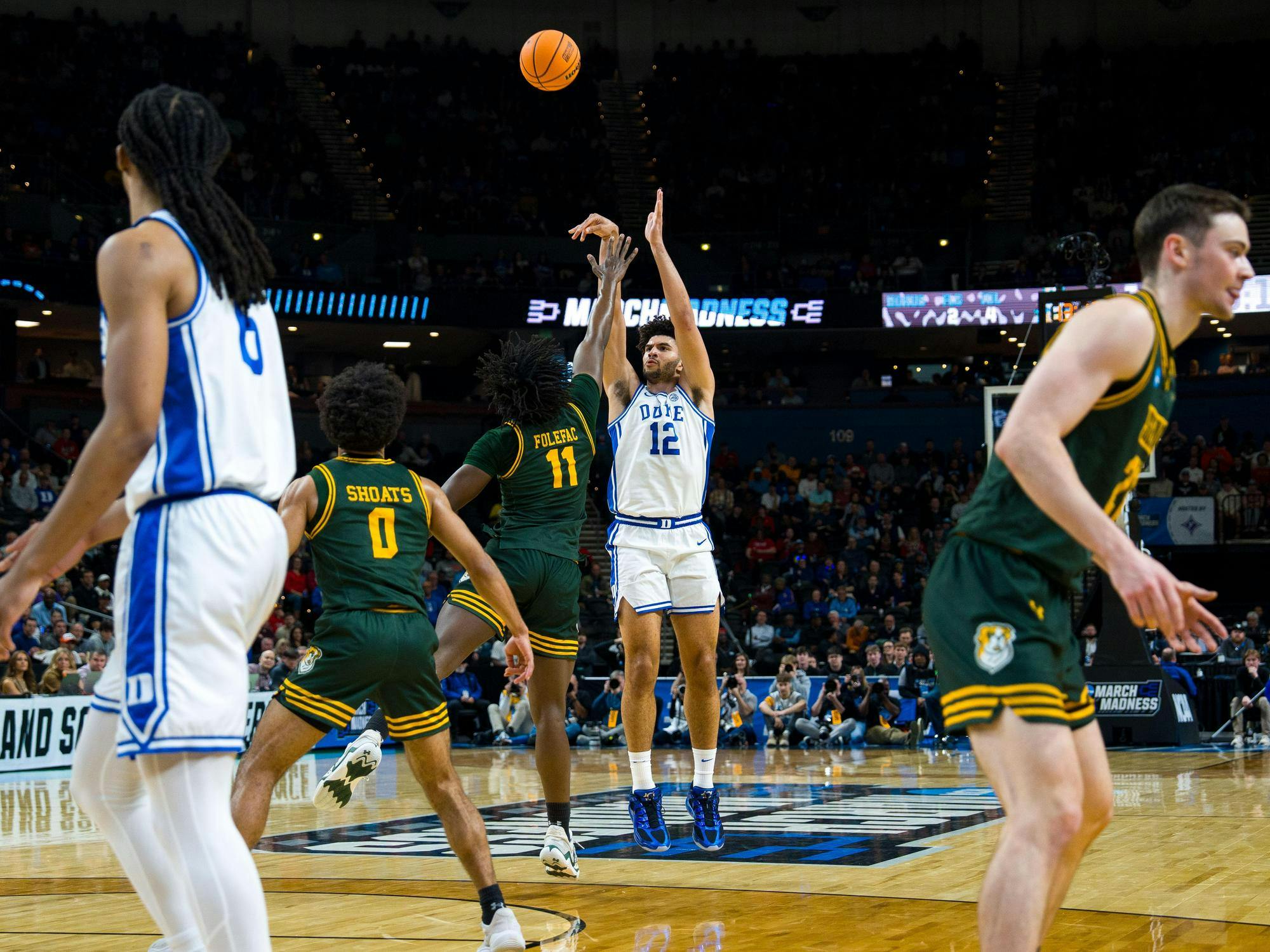
After escaping with a narrow first-round victory over Siena, Duke Blue Devils men’s basketball now turns its attention to a far more dangerous challenge: a Round of 32 showdown with the resilient TCU Horned Frogs men’s basketball. With a spot in the Sweet 16 at stake, this matchup promises intensity, physicality, and the unpredictable chaos that defines March Madness.
Overview
TCU enters the contest with a 23–11 record, including an 11–7 mark in the Big 12 under head coach Jamie Dixon. While the Horned Frogs may not carry the same national spotlight as Duke, they have quietly built a reputation as a tough, disciplined unit capable of upsetting higher-seeded teams.
Their opening-round victory over Ohio State showcased exactly that. Despite struggling with shooting consistency, TCU controlled stretches of the game through hustle and physical play. The Horned Frogs built a commanding early lead and, even as Ohio State clawed back, showed composure late. Junior forward Xavier Edmonds sealed the win with a clutch basket in the final seconds, highlighting his importance as both a scorer and a relentless rebounder.
Edmonds has been a cornerstone of TCU’s offense all season, combining efficiency with effort on the glass. His ability to generate second-chance opportunities makes him one of the most dangerous players Duke will face. Alongside him, sophomore David Punch brings defensive intensity, leading the team in combined steals and blocks while also finishing effectively around the rim.
For Duke, the Siena game served as a warning. The Blue Devils survived, but not convincingly. Against a deeper and more physical opponent like TCU, a similar performance could end their tournament run.
The Deciding Factor: Rebounding Dominance
If there is one statistic that defines TCU’s success, it is offensive rebounding. The Horned Frogs are undefeated when their offensive rebounding rate exceeds 36%, and significantly less effective when they fail to reach that mark. Their ability to extend possessions often compensates for inconsistent shooting and allows them to control the tempo.
Against Ohio State, that formula was on full display. TCU grabbed 12 offensive rebounds, creating multiple second-chance scoring opportunities that ultimately tilted the game in their favor.
However, Duke presents a unique challenge. The Blue Devils rank among the nation’s best in both offensive and defensive rebounding percentage. Their physicality and discipline in closing out possessions could neutralize TCU’s greatest strength. Even in their shaky performance against Siena, Duke managed to regain control through dominance on the boards.
With Patrick Ngongba II potentially sidelined again, rebounding becomes even more critical. Duke cannot rely on one player to control the paint; it must be a collective effort. If the Blue Devils can limit TCU’s second-chance opportunities, they effectively remove the Horned Frogs’ most reliable path to victory.
Key Storylines
1. Ngongba’s Availability
The possible return of Ngongba could dramatically shift the game. His absence has been felt on both ends of the floor. Offensively, Duke loses a lob threat that forces defenses to collapse. Defensively, his rim protection is irreplaceable.
Without him, opposing teams have attacked the paint more aggressively and forced Duke’s forwards into uncomfortable positions on the perimeter. Players like Cameron Boozer have faced increased defensive pressure, with opponents willing to crowd the lane and challenge Duke’s outside shooting.
Even if Ngongba plays limited minutes, his presence alone could alter TCU’s strategy, making him one of the most important variables in this matchup.
2. Perimeter Shooting Must Improve
Duke’s three-point shooting against Siena was a major concern. The team shot just 19.2% from beyond the arc, with key shooters struggling to find rhythm. Isaiah Evans and Dame Sarr, both known for their perimeter ability, failed to deliver when needed.
In a single-elimination tournament, shooting variance can decide games. If TCU collapses defensively to limit interior scoring, Duke must punish them from outside. Another poor shooting performance could open the door for an upset.
The Blue Devils do not need to be perfect from three-point range, but they must be reliable enough to keep TCU’s defense honest.
3. Depth and Bench Production
Injuries have shortened Duke’s rotation significantly. With Caleb Foster also sidelined, the Blue Devils are relying heavily on a small core of players. Bench contributors like Nikolas Khamenia and Darren Harris have yet to make a consistent impact.
Against Siena, the bench combined for minimal production, raising concerns about fatigue and sustainability. While Duke benefited from Siena’s extreme reliance on its starters, TCU is unlikely to follow that script. The Horned Frogs will test Duke’s depth, pushing the pace and forcing rotations.
For Duke to advance, it cannot rely solely on its starters. Even modest contributions from the bench—defensive stops, rebounds, or timely scoring—could prove decisive in a tightly contested game.
Final Outlook
This matchup embodies what makes the NCAA Tournament so compelling: contrasting styles, high stakes, and no margin for error. Duke enters as the higher seed, but TCU’s physicality, rebounding, and late-game composure make them a legitimate threat.
The formula for Duke is clear: control the glass, improve perimeter shooting, and find contributions beyond its starting lineup. If the Blue Devils execute in these areas, they have the talent and structure to advance.
But if TCU imposes its will on the boards and turns the game into a gritty, possession-by-possession battle, the Horned Frogs could very well extend their tournament run—and end Duke’s season.
In March, nothing is guaranteed. Survival is everything.




