


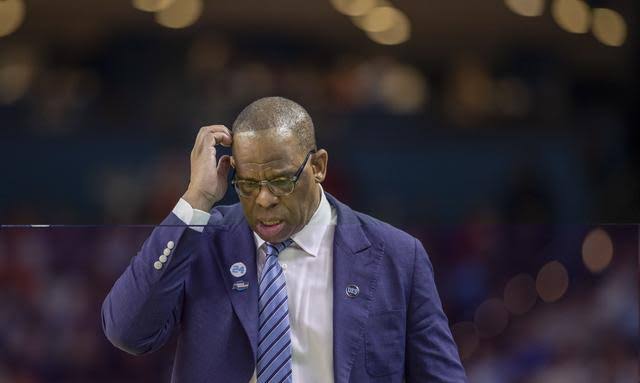
As pressure quietly reaches a breaking point around Hubert Davis in Chapel Hill, sources hint that a stunning decision could be looming—one that might not only end an era at North Carolina Tar Heels men’s basketball but send shockwaves through all of college basketball.
The tension surrounding North Carolina’s storied basketball program has rarely felt this intense, this uncertain, or this consequential. What began as a disappointing end to a turbulent season has rapidly evolved into something far more dramatic—a moment of reckoning that could redefine not only the future of Hubert Davis but also the identity of one of the most iconic programs in the history of the sport. Inside Chapel Hill, behind closed doors and away from the roaring crowds and bright lights, conversations are unfolding that may ultimately determine whether Davis remains the face of the program or becomes the latest chapter in a legacy that has spanned more than seven decades.
The catalyst for this unfolding drama was nothing short of historic—and not in the way anyone associated with North Carolina would have hoped. A 19-point lead, seemingly safe with just over 14 minutes remaining, evaporated in stunning fashion against VCU in the first round of the NCAA Tournament. It wasn’t just a loss; it was a collapse of unprecedented proportions, the largest blown lead in a first-round game in tournament history. For a program built on excellence, discipline, and composure, the manner of defeat struck at something deeper than the scoreboard. It raised questions—serious, unavoidable questions—about leadership, preparation, and direction.
In the immediate aftermath, the silence was almost as loud as the criticism. Davis reportedly had no contact with his staff for nearly 24 hours, a detail that only intensified speculation and concern. In a high-stakes environment like North Carolina, where expectations are not just high but relentless, even small signs of uncertainty can quickly grow into major storylines. And this was far from small. It felt, to many observers, like the calm before a storm.
Yet publicly, the program has maintained a measured tone. Athletic director Bubba Cunningham emphasized that no final decision has been made, framing the current moment as part of the routine end-of-season evaluation process. It’s the kind of statement that offers reassurance on the surface but leaves plenty of room for interpretation underneath. Because at a place like North Carolina, “evaluation” often carries far greater weight—it can signal change, transition, or even upheaval.
To fully understand the gravity of this moment, one must consider the history that looms over every decision in Chapel Hill. North Carolina is not just another basketball program; it is a blue-blood institution, a cornerstone of college basketball tradition. From Dean Smith to Roy Williams, the program has been defined by continuity, excellence, and a unique sense of family. For more than 70 years, every head coach has been connected, directly or indirectly, to the Carolina lineage. It is a tradition that sets North Carolina apart—and one that makes the possibility of change all the more significant.
If Davis were to be replaced, it would mark a historic departure from that tradition. For the first time in generations, the program would likely look outside its own family tree for leadership. Such a move would not just be a coaching change; it would be a philosophical shift, a signal that North Carolina is willing to break from its past in pursuit of a different future. And that is why the stakes feel so extraordinarily high.
Davis’s tenure has been anything but straightforward. When he was hired in 2021 following Roy Williams’ retirement, the reaction was overwhelmingly positive. A former Tar Heel player with deep ties to the program, Davis embodied the values and culture that North Carolina prides itself on. His early success only reinforced that optimism. In his first season, he guided the team to a remarkable run to the national championship game, including a historic victory over Duke in the Final Four—an achievement that instantly etched his name into program lore.
But in college basketball, momentum can be fleeting. The seasons that followed have been marked by inconsistency and unmet expectations. The 2022–23 campaign was particularly jarring, as North Carolina became the first preseason No. 1 team in history to miss the NCAA Tournament entirely. While the following season showed signs of recovery, including a Sweet 16 appearance, the inability to sustain elite performance has continued to raise concerns.
This past season only intensified those concerns. Despite significant investment in the roster and the addition of high-profile talent, the results fell short. Injuries played a role, particularly the absence of star freshman Caleb Wilson, whose projected top-10 NBA draft status made him a central piece of the team’s plans. His absence for the final stretch of the season undeniably impacted the team’s performance. But in a program like North Carolina, context rarely softens criticism. Expectations remain constant, regardless of circumstances.
Behind the scenes, the financial aspect of the program has added another layer of complexity. Reports suggest that key boosters have grown increasingly hesitant to invest heavily in the current direction of the team. In today’s era of college athletics, where NIL (Name, Image, and Likeness) deals and transfer portal spending play a critical role in roster construction, financial backing is more important than ever. A lack of confidence from donors could significantly limit the program’s ability to compete at the highest level.
And yet, in a fascinating twist, those same boosters are reportedly willing to come together to fund a potential buyout and support the hiring of a new coach if a change is made. It’s a paradox that underscores the urgency of the situation: while faith in the current leadership may be wavering, belief in the program’s potential remains as strong as ever.
The coming days are expected to be pivotal. Meetings between Davis and university leadership are already underway, and while no immediate decision is anticipated, the direction seems to be taking shape. Whether that direction leads to continuity or change remains to be seen, but the sense of inevitability surrounding the situation is difficult to ignore.
For the players, the uncertainty adds an emotional dimension to an already challenging moment. College athletes often form deep bonds with their coaches, and the possibility of a leadership change can be both unsettling and transformative. It raises questions about the future, about roles, and about the identity of the team moving forward.
For fans, the situation is equally complex. North Carolina’s fanbase is among the most passionate and knowledgeable in all of sports. They understand the program’s history, they appreciate its traditions, and they expect excellence. But they are also faced with a difficult reality: balancing loyalty to a coach who represents the Carolina family with the desire to see the program return to consistent championship contention.
And then there is the broader college basketball landscape. A change at North Carolina would not happen in isolation. It would ripple across the sport, influencing coaching searches, recruiting battles, and competitive dynamics. When a program of this magnitude makes a move, the effects are felt everywhere—from rival schools to rising programs looking to capitalize on the shifting landscape.
In many ways, this moment feels like a crossroads—not just for Hubert Davis, but for North Carolina basketball as a whole. It is a test of identity, of values, and of vision. Does the program stay the course, trusting in continuity and internal growth? Or does it take a bold step into the unknown, embracing change in pursuit of a new era?
There are no easy answers. Only difficult decisions, each carrying its own set of risks and rewards.
What is certain, however, is that the next move will matter—a lot. It will shape recruiting, define expectations, and influence the program’s trajectory for years to come. It will also send a message, both internally and externally, about what North Carolina stands for in this evolving era of college basketball.
As the situation continues to unfold, one thing remains clear: this is more than just a coaching decision. It is a defining moment for a program that has long been a standard-bearer in the sport. And whatever happens next, it will not go unnoticed.
Because when North Carolina moves, the entire basketball world pays attention.
And right now, all eyes are on Chapel Hill.




