


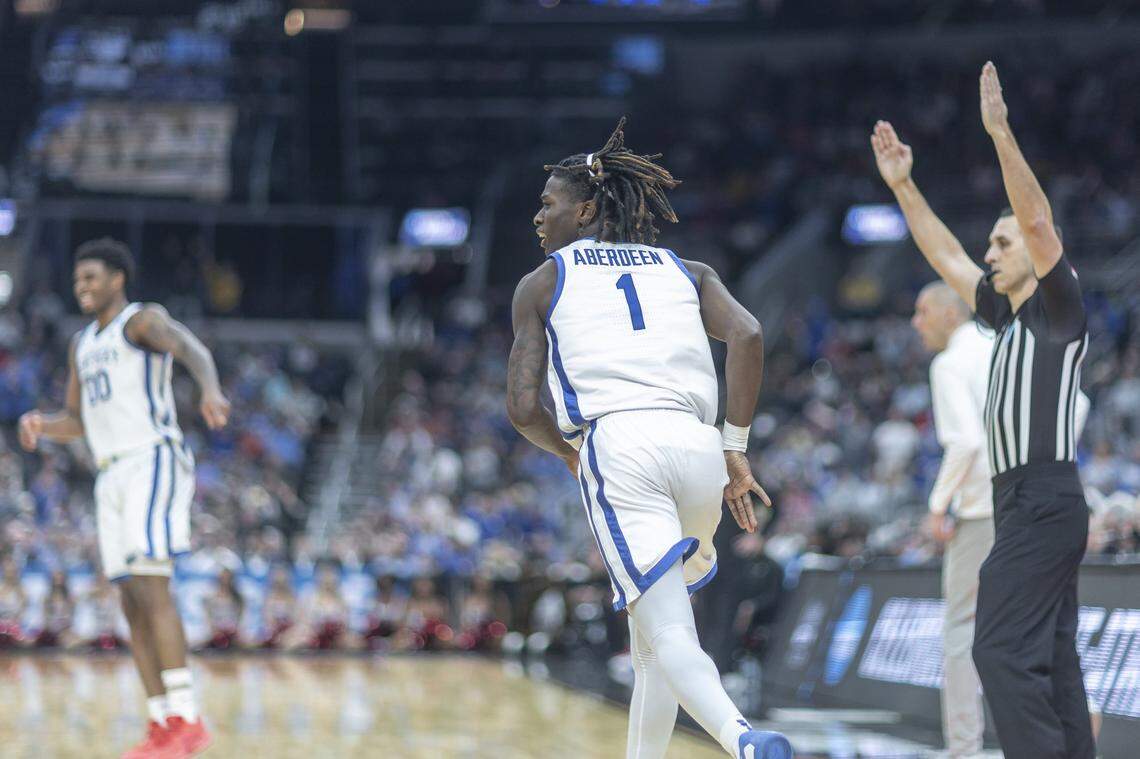
It looked like the end of the road for Kentucky. With just 2.4 seconds left on the clock at Enterprise Center, Allen Graves drilled a clutch three-pointer to give Santa Clara a 73–70 lead. In that instant, the momentum shifted, and Kentucky’s season appeared all but over. The Wildcats were staring at elimination, and for Denzel Aberdeen, it seemed like his college basketball journey had reached its final chapter.
But March Madness thrives on chaos, miracles, and moments of brilliance—and Kentucky found all three in a matter of seconds.
What followed will be remembered as one of the most electrifying sequences in tournament history. While Otega Oweh became the face of the moment with his unbelievable 40-foot buzzer-beater to force overtime, the play would have never existed without Aberdeen’s split-second awareness and decision-making.
As Graves’ shot dropped through the net, most players might have frozen under pressure. Not Aberdeen. Instead, he immediately recognized the situation unfolding around him. He knew Santa Clara’s bench, led by coach Herb Sendek, would likely attempt to call a timeout to organize their defense. That single realization triggered a chain reaction.
Without hesitation, Aberdeen grabbed the ball and stepped out of bounds to inbound it as quickly as possible. That decision proved to be the turning point. According to NCAA rules, once the throw-in motion begins, the opposing team cannot be granted a timeout. By acting instantly, Aberdeen eliminated Santa Clara’s opportunity to reset defensively.
Timing was everything.
Sendek later explained that he had indeed attempted to call a timeout, expecting officials to acknowledge him. However, by the time he signaled, Aberdeen had already initiated the inbound play. In a game decided by fractions of a second, Aberdeen’s awareness left no room for interruption.
But his job wasn’t done yet.
He still had to deliver the ball to the right player—under immense pressure—with the season hanging in the balance.
Aberdeen quickly scanned the floor and locked onto Oweh. There was no drawn-up play, no huddle, no instruction—just instinct and trust. In that fleeting moment, the two teammates connected with an unspoken understanding: go.
Aberdeen fired a perfectly timed pass ahead, leading Oweh like a quarterback leading a receiver downfield. That subtle detail made all the difference. By placing the ball in front of Oweh, he allowed him to build momentum and cover more ground before touching it—buying precious tenths of a second.
Those fractions mattered.
Oweh gathered the ball, pushed forward, and launched a desperate shot from nearly half-court as time expired. The ball soared through the air, kissed the backboard, and dropped in.
Game tied. Season saved.
The arena erupted.
Overtime belonged to Kentucky, who rode that emotional wave to an 89–84 victory, advancing to face Iowa State Cyclones men’s basketball in the next round.
After the game, Oweh received the spotlight—and deservedly so. His shot will be replayed for years, a defining March Madness highlight. But even he acknowledged the brilliance behind the scenes.
Aberdeen’s composure under pressure turned chaos into opportunity.
Interestingly, Aberdeen credited part of his awareness to a prior experience during his time with the Florida program under Todd Golden. During a rules session with referees, this exact scenario had been discussed—how quickly initiating a throw-in could prevent the opposing team from calling a timeout.
That knowledge resurfaced at the perfect moment.
It wasn’t luck. It was preparation meeting opportunity.
Despite not earning an official assist on the stat sheet, Aberdeen’s impact on the play was undeniable. Without his quick thinking, Santa Clara likely would have set up their defense, forcing a far more difficult shot—or preventing one entirely.
Instead, he created the moment.
As Oweh sprinted down the court, Aberdeen trailed behind, knowing the outcome was no longer in his control. All he could do was watch and hope.
Mid-flight, even he sensed something special.
The shot went in cleanly.
One of the wildest moments in tournament history was complete.
While the headlines will forever feature Oweh’s heroics, those who truly understand the game will recognize the hidden brilliance behind it. Aberdeen didn’t just make a play—he made the play that made everything else possible.
In a tournament built on unforgettable moments, this one had two heroes: one who took the shot, and one who made sure it could happen at all.




