


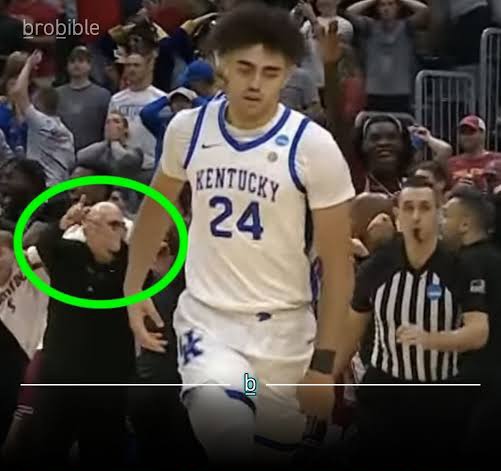
The Ref Who Denied Santa Clara’s Timeout Was Public Enemy #1. Then the Rule Book Spoke—and What It Revealed About Oweh’s Miracle Shot Will Make You Rethink Everything
For a few chaotic seconds, everything pointed in one direction: outrage.
Fans were on their feet, players were gesturing in disbelief, and the bench erupted in frustration. The moment seemed obvious—Santa Clara Broncos men’s basketball wanted a timeout, and they didn’t get it.
In real time, the blame fell squarely on the official.
But as the dust settled and the rule book came into focus, the narrative took a dramatic turn—one that would not only shift the conversation but also redefine how the game’s most pivotal moment is remembered.
At the center of it all? A sequence that ended with Oweh’s miracle shot—and a decision that suddenly looked far more complicated than it first appeared.
The Moment That Sparked Chaos
Late in the game, with tension at its peak, Santa Clara appeared poised to regain control. A player signaled for a timeout, the bench echoed the call, and for a split second, it seemed inevitable that play would stop.
It didn’t.
Instead, the game continued—fast, unrelenting, and unforgiving.
Within seconds, the ball had changed hands, the defense scrambled, and the possession ended with a stunning, high-pressure shot from Oweh that flipped the outcome in dramatic fashion.
What should have been a reset turned into a defining play.
And immediately, the reaction was fierce.
“How Do You Miss That?”
The initial response from fans and commentators was swift and emotional.
How could the referee ignore such a clear request?
Why wasn’t the game stopped?
Was this a missed call—or something worse?
Social media lit up. Slow-motion clips circulated. Every angle was dissected.
The referee, in that moment, became the focal point of frustration—the perceived reason a team lost control of its fate.
But then came the deeper look.
The Rule That Changed Everything
As analysts revisited the sequence, attention turned to the official NCAA rulebook—the often-overlooked authority in moments like this.
And what it revealed complicated everything.
Under NCAA rules, a timeout is not automatically granted simply because it is requested. The player or coach must have clear, established control of the ball and must make the request in a manner that is both visible and recognized by the official.
In this case, replays suggested something subtle but crucial:
The moment Santa Clara attempted to call timeout… control may not have been fully secured.
Whether it was a loose dribble, defensive pressure, or a split-second loss of possession, the criteria for granting that timeout may not have been met.
Which meant one thing:
The referee may not have ignored the request—
He may have correctly denied it.
The Play That Followed
What happened next is what transformed controversy into legend.
With no whistle to stop play, the possession remained live. The defense hesitated, the offense reacted, and within seconds, the ball found its way to Oweh.
What followed was the kind of shot players dream about—and defenses dread.
Under pressure, with the clock winding down, Oweh delivered a clutch, game-altering basket that instantly became the defining highlight of the game.
But now, that shot carries a different layer of meaning.
Because without the denied timeout, it never happens.
From Villain to… Just Doing His Job?
The shift in perspective has been dramatic.
What began as a narrative of officiating failure has evolved into something far more nuanced—a reminder of how thin the margin is between controversy and correctness.
The referee, once labeled “public enemy #1,” is now being reassessed through a more informed lens.
Did he miss the call?
Or did he follow the rule precisely, in a moment where milliseconds mattered?
The Thin Line Between Chaos and Clarity
Moments like this highlight the complexity of basketball at its highest levels.
Games aren’t just decided by talent—they’re shaped by rules, interpretations, and split-second decisions that rarely leave room for hesitation.
To fans, the game moves fast.
To officials, it moves even faster—and every decision must align with rules that don’t bend for emotion or expectation.
A Moment That Will Be Debated for Years
Even with the rule clarified, the debate isn’t likely to fade anytime soon.
Some will argue that the spirit of the game should have led to a timeout being granted. Others will point to the letter of the law and defend the decision.
But one thing is certain:
The sequence—timeout request, no whistle, Oweh’s shot—has already cemented itself as one of the most talked-about moments of the season.
The Bigger Picture
In the end, what this moment reveals goes beyond one game.
It’s a reminder that in sports, perception often arrives before understanding. That what looks obvious in real time can become far more complex upon review.
And that sometimes, the most controversial decisions… aren’t mistakes at all.
For Santa Clara Broncos men’s basketball, it’s a painful “what if.”
For Oweh, it’s a defining moment.
And for everyone watching, it’s a lesson that might just change how we see the game the next time chaos unfolds in those final seconds.




