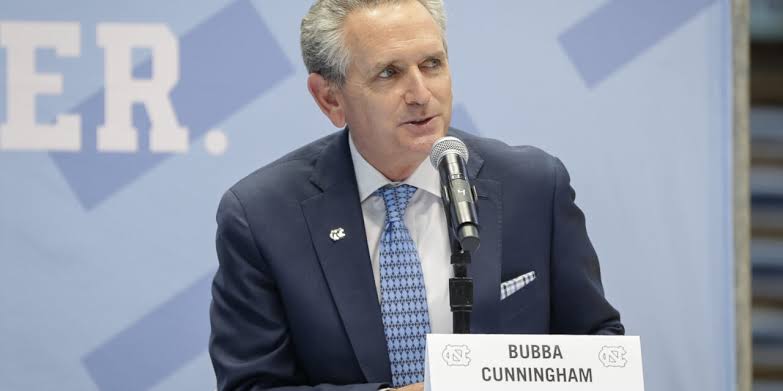
As pressure rapidly builds around Hubert Davis in Chapel Hill, Bubba Cunningham has finally broken his silence—and what he revealed only deepens the mystery surrounding the future of North Carolina Tar Heels men’s basketball.
The situation unfolding at North Carolina has quickly transformed from routine postseason disappointment into one of the most closely watched and potentially seismic storylines in all of college basketball. What once seemed like a stable leadership structure anchored by a beloved alumnus is now clouded by uncertainty, speculation, and growing pressure from nearly every corner of the program. At the center of it all stands Hubert Davis, a figure deeply woven into the fabric of Carolina basketball, now facing perhaps the most defining moment of his coaching career.
The immediate trigger for this wave of speculation was North Carolina’s stunning early exit from the NCAA Tournament, a loss that not only ended the Tar Heels’ season but also amplified existing concerns about the program’s trajectory under Davis. Entering the tournament as a No. 6 seed, North Carolina appeared poised to make a statement against No. 11 seed VCU. For much of the game, that expectation seemed justified. The Tar Heels controlled the tempo, executed effectively, and built a commanding lead that at one point stretched to 19 points. With under 15 minutes remaining, the outcome felt all but decided.
But March Madness has a way of rewriting scripts in the most unforgiving fashion.
What followed was a collapse that will linger in the minds of players, coaches, and fans alike. VCU mounted a relentless comeback, chipping away at the deficit with urgency and confidence. Meanwhile, North Carolina struggled to respond, its earlier rhythm giving way to hesitation and missed opportunities. By the time the game reached its closing moments, the momentum had completely shifted. The Tar Heels, who had led for more than 34 minutes of game time, suddenly found themselves in a battle they could no longer control. The second half and overtime told the story plainly—VCU outscored North Carolina 54-39, turning what had been a comfortable lead into a heartbreaking defeat.
Losses happen in sports, even to the most prestigious programs. But the manner of this loss—its scale, its timing, and its implications—elevated it beyond a typical postseason disappointment. It became a defining moment, one that forced difficult questions about leadership, preparation, and the program’s overall direction. For a school with the history and expectations of North Carolina, back-to-back first-round tournament exits are not just setbacks; they are warning signs.
That is why Bubba Cunningham’s response carried so much weight. In moments like these, silence can often speak louder than words, but when the athletic director does speak, every phrase is analyzed, every implication dissected. Cunningham’s statement—that the administration is evaluating all aspects of the basketball program and will continue discussions in the coming days—was measured and professional, yet it did little to quiet the growing speculation. If anything, it reinforced the idea that significant decisions are on the horizon.
Behind the scenes, multiple reports suggest that the future of Hubert Davis is “squarely in flux,” a phrase that captures both the uncertainty and the seriousness of the situation. While there is no expectation of an abrupt or disrespectful dismissal, the possibility of a “synchronized” departure—one that allows both Davis and the university to part ways on mutually agreeable terms—has emerged as a realistic scenario. Such an outcome would reflect both the program’s respect for Davis’s legacy and its recognition of the need for change.

To understand why this moment feels so consequential, one must consider what Hubert Davis represents to North Carolina. He is not an outsider brought in to rebuild the program; he is a former player, a longtime assistant, and a direct link to the Carolina tradition that has defined the program for decades. Since taking over in 2021 following the retirement of Roy Williams, Davis has been seen as a steward of that tradition, someone capable of maintaining continuity while guiding the program into a new era.
And for a time, it appeared he was doing exactly that. His first season as head coach was nothing short of remarkable, culminating in a run to the national championship game and a historic victory over Duke in the Final Four—the final game of Mike Krzyzewski’s legendary career. That moment alone secured Davis a place in North Carolina lore, endearing him to fans and establishing him as a worthy successor to the program’s coaching lineage.
But sustaining success at a place like North Carolina requires more than memorable moments; it demands consistency at the highest level. The seasons that followed have been marked by uneven performances, missed opportunities, and growing frustration. The 2022–23 season was particularly jarring, as the Tar Heels became the first preseason No. 1 team in history to miss the NCAA Tournament. While there were signs of recovery in subsequent seasons, including a Sweet 16 appearance, the inability to build sustained momentum has remained a concern.
This past season only intensified those concerns. Despite a talented roster and significant investment in player acquisition, the results fell short of expectations. Injuries, including the absence of key contributors, certainly played a role, but in a program accustomed to competing for championships, explanations often take a back seat to results. The narrative shifted from one of patience and development to one of urgency and accountability.
Complicating matters further is the evolving landscape of college athletics. The rise of NIL opportunities and the transfer portal has fundamentally changed how programs build and maintain competitive rosters. Success now depends not only on coaching and development but also on financial resources and donor support. Reports indicating that some boosters have grown hesitant to invest under the current leadership add another layer of pressure. At the same time, those same stakeholders appear willing to support a transition if it means revitalizing the program.
This duality—uncertainty about the present but optimism about the future—captures the essence of North Carolina’s current predicament. It is not a program in decline, but one at a crossroads, grappling with how best to align its rich history with the demands of modern college basketball.
The coming days are expected to be critical. Meetings between Davis and university leadership are ongoing, and while no immediate decision has been announced, the timeline suggests that clarity could emerge soon. Whether that clarity comes in the form of renewed commitment or a transition to new leadership remains to be seen.
For the players, the uncertainty creates a challenging environment. College athletes rely on stability and trust, and the possibility of a coaching change can disrupt both. It raises questions about roles, development, and the overall direction of the program. For recruits and transfers, it introduces an element of unpredictability that could influence decisions at a crucial time in the offseason.
For fans, the situation is deeply emotional. Hubert Davis is not just a coach; he is part of the Carolina family. His connection to the program runs deep, and any potential departure would be felt on a personal level by many supporters. At the same time, the desire to see North Carolina return to consistent national prominence is equally strong, creating a tension between loyalty and expectation.
And then there is the broader impact on college basketball. A change at North Carolina would not occur in isolation. It would send ripples throughout the sport, influencing coaching searches, recruiting battles, and competitive dynamics. Few programs carry the weight and visibility of North Carolina, and any major decision made in Chapel Hill inevitably becomes a national story.
Ultimately, this moment represents more than just speculation about a coaching position. It is a reflection of the pressures and complexities that define modern college athletics, particularly at programs with rich histories and high expectations. It is about balancing tradition with innovation, loyalty with performance, and patience with urgency.
As the situation continues to unfold, one thing is clear: the decisions made in the coming days will have lasting implications. They will shape not only the future of Hubert Davis but also the direction of North Carolina basketball for years to come.
Because when a program of this magnitude faces uncertainty, the stakes are never small.
And right now, in Chapel Hill, those stakes could not be higher.