


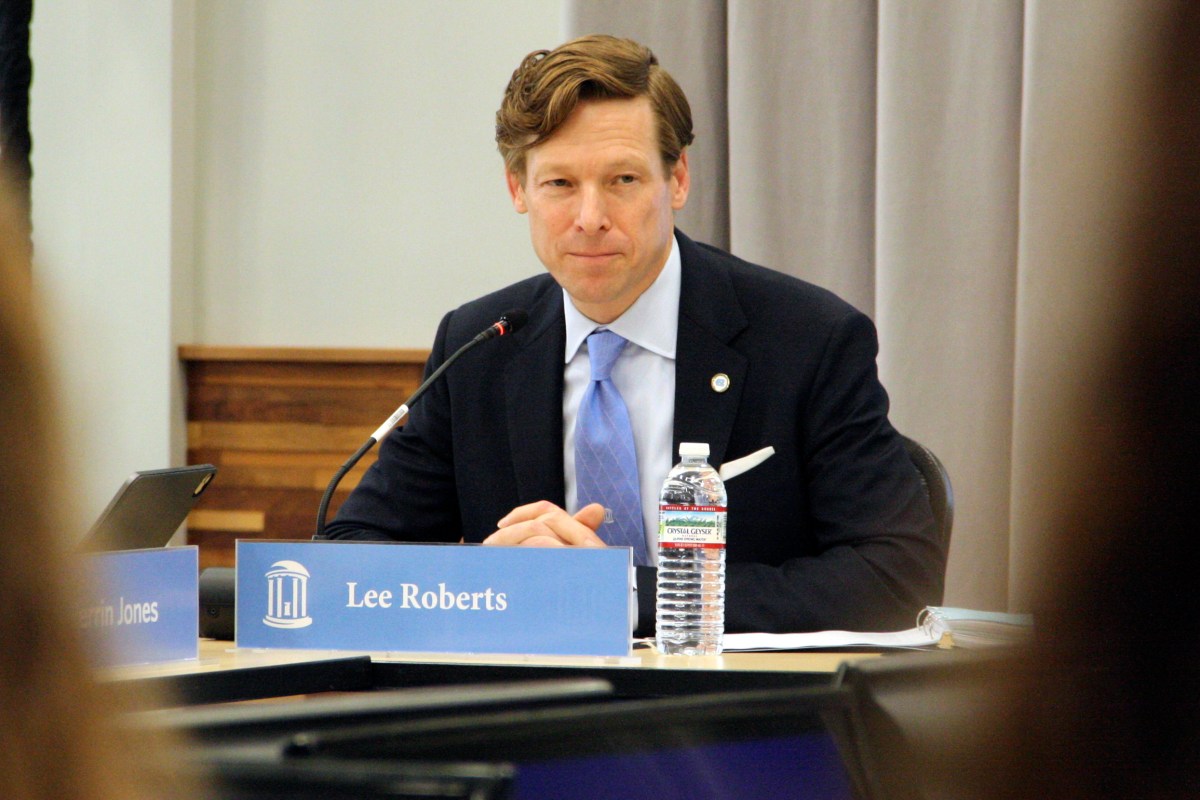
As silence and carefully chosen words from Lee Roberts begin to speak louder than any official statement, the uncertainty surrounding Hubert Davis is reaching a boiling point—fueling a growing belief that a major decision in Chapel Hill may already be closer than anyone is being told.
The situation unfolding around North Carolina Tar Heels men’s basketball has quickly evolved from postgame frustration into a full-blown moment of reckoning—one that could redefine the future of one of college basketball’s most historic programs. What initially appeared to be a routine end-of-season evaluation has now taken on a far more serious tone, as uncertainty, pressure, and speculation collide behind the scenes in Chapel Hill. And at the center of it all is a single, unavoidable question: is Hubert Davis’ time as head coach nearing its end?
The answer, at least for now, remains just out of reach. But sometimes, what isn’t said can be just as revealing as what is—and that is exactly why Chancellor Lee Roberts’ recent comments have drawn so much attention. When asked directly about Davis’ future, Roberts offered a familiar but carefully measured response, emphasizing that the university evaluates “everything” at the end of each season. On the surface, it sounded routine. Beneath the surface, however, it felt anything but ordinary.
Because in moments like this, language matters. Tone matters. Timing matters.
And right now, everything about this situation suggests that something significant is unfolding.
The catalyst for this growing uncertainty was North Carolina’s stunning collapse against VCU in the first round of the NCAA Tournament—a loss that has quickly become one of the most talked-about moments of the postseason. Leading by 19 points in the second half, the Tar Heels appeared to be in complete control, poised to advance and potentially build momentum for a deeper tournament run. Instead, what followed was a dramatic unraveling that left fans, analysts, and even those within the program searching for answers.
VCU’s comeback was relentless, methodical, and ultimately overwhelming. Possession by possession, the lead disappeared, and with it, the sense of control that North Carolina had maintained for much of the game. By the time the final buzzer sounded, the Tar Heels were not just eliminated—they were left grappling with a loss that felt symbolic of deeper issues.
For a program with the history and expectations of North Carolina, such a collapse carries weight far beyond a single game. It becomes a defining moment, one that forces difficult conversations about leadership, consistency, and direction. And in this case, those conversations have extended all the way to the top levels of the university.
Hubert Davis, now in his fifth season as head coach, finds himself at the center of those discussions. His tenure has been marked by both remarkable highs and frustrating lows—a combination that has made evaluating his performance anything but straightforward. On one hand, he led the Tar Heels to a national championship game appearance in his first season, a remarkable achievement that included a historic victory over Duke in the Final Four. On the other hand, the seasons that followed have been inconsistent, with missed opportunities and underwhelming finishes raising questions about the program’s trajectory.
This inconsistency is perhaps the most challenging aspect of Davis’ tenure to assess. At times, his teams have shown flashes of brilliance—moments that suggest the potential for sustained success at the highest level. At other times, however, those flashes have been overshadowed by struggles that are difficult to ignore. The inability to maintain momentum, particularly in critical moments, has become a recurring theme, one that has only intensified scrutiny as expectations continue to rise.
And those expectations, at North Carolina, are not negotiable.
This is a program built on excellence, tradition, and a standard that has been upheld for decades by legendary figures such as Dean Smith and Roy Williams. Success is not measured solely by wins and losses, but by consistency, competitiveness, and the ability to contend for championships year after year. Anything less inevitably leads to questions—and right now, those questions are growing louder.
One of the key points of contention among fans and analysts has been the overall trajectory of the program under Davis. While his initial success provided a strong foundation, the seasons that followed have not consistently built upon that momentum. The Tar Heels have experienced early tournament exits, missed opportunities, and periods of inconsistency that have made it difficult to establish a clear identity.
Compounding these concerns are issues related to roster construction and player retention. In today’s college basketball landscape, where the transfer portal and NIL opportunities play a significant role, maintaining continuity within a roster is more important than ever. For North Carolina, this has been a challenge. Several talented players have departed the program, finding success elsewhere and raising questions about development, fit, and long-term planning.
At the same time, it would be unfair to ignore the challenges Davis has faced. Injuries have played a significant role in shaping the team’s performance, particularly the loss of key contributors at critical moments. The absence of star freshman Caleb Wilson late in the season, for example, had a noticeable impact on the team’s ability to compete at its highest level. In a sport where depth and timing are crucial, such setbacks can be difficult to overcome.
Still, at a program like North Carolina, adversity is expected—and overcoming it is part of the job.
That is why the current moment feels so pivotal. It is not just about evaluating past performance, but about determining the best path forward. Does the program continue with Davis, trusting that stability and continuity will lead to future success? Or does it make a bold move, seeking a new direction in hopes of reigniting its championship aspirations?
The answer to that question will have far-reaching implications.
For the players, it could mean uncertainty about their roles, their development, and their future within the program. For recruits, it could influence decisions about where to commit, particularly as North Carolina continues to pursue top-tier talent. And for the broader college basketball landscape, it could trigger a chain reaction of changes, as one of the sport’s most prominent programs potentially enters the coaching market.
Within the locker room, however, there remains a sense of loyalty and belief in Davis. Players have spoken openly about the impact he has had on their development, both on and off the court. Senior guard Seth Trimble’s comments, in particular, highlight the respect and appreciation that exists within the team. In an era where relationships between players and coaches can be fleeting, that kind of support carries significant weight.
But in college basketball, support from within is only one part of the equation.
Ultimately, decisions at this level are driven by a combination of factors—performance, expectations, resources, and long-term vision. And right now, all of those factors are being carefully weighed by North Carolina’s leadership.
The involvement of Chancellor Lee Roberts adds another layer of significance to the situation. His role in the evaluation process underscores the importance of the decision at hand, highlighting that this is not just an athletic matter, but an institutional one. When leadership at that level is engaged, it signals that the outcome will have implications that extend beyond the basketball court.
And that is why the silence feels so loud.
Because in the absence of a definitive statement, speculation fills the void. Every comment is analyzed. Every delay is interpreted. Every moment without clarity adds to the sense that something major is on the horizon.
As the days pass and discussions continue, the anticipation only grows. Will North Carolina choose continuity, standing by a coach who has shown flashes of greatness and remains deeply connected to the program’s identity? Or will it take a different path, embracing change in pursuit of a new chapter?
For now, those questions remain unanswered.
But one thing is certain: whatever decision is made will not come quietly. It will be scrutinized, debated, and felt across the entire college basketball landscape. Because when a program like North Carolina faces a moment like this, it is never just about one coach or one season.
It is about legacy.
It is about identity.
And it is about the future.
Right now, in Chapel Hill, that future hangs in the balance—and the next move could define everything that comes next.




