


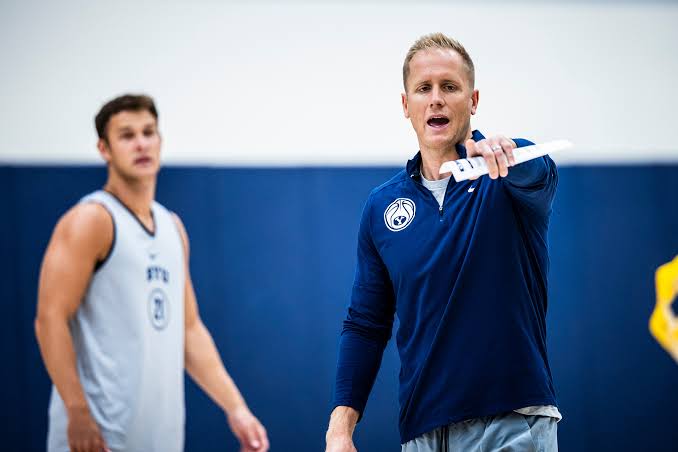
Kevin Young must confront a hard truth after BYU Cougars men’s basketball suffered yet another frustrating early exit from the NCAA Tournament.
What once looked like a promising season ultimately unraveled, exposing a roster flaw that can no longer be ignored if the Cougars hope to compete at the highest level.
Despite entering the tournament with confidence and expectations, BYU’s campaign ended abruptly with a deflating loss to Texas Longhorns men’s basketball. The defeat was not just disappointing—it was revealing. It showed exactly where the Cougars fell short and what must change moving forward.
There are, of course, several factors that contributed to the early exit. Injuries played a devastating role in derailing the team’s rhythm and depth. The absence of key players forced constant adjustments, leaving the squad struggling to maintain consistency when it mattered most.
The loss of Richie Saunders was particularly damaging. As an All-Big 12 guard, his presence on both ends of the floor was crucial. Without him, BYU lacked leadership, scoring, and defensive stability in the backcourt.
Similarly, the absence of Dawson Baker robbed the team of its bench firepower. His ability to change games with quick scoring bursts was sorely missed, especially in high-pressure moments during the tournament.
Compounding these issues were the unavailable contributors—Brody Kozlowski, Nate Pickens, and KJ Perry—who never suited up. Their absence further thinned an already stretched roster, forcing Young to rely heavily on limited options.
However, beyond injuries and absences, one glaring weakness stood out above all: BYU’s lack of size in the frontcourt. This issue has lingered for years, but against Texas, it was brutally exposed.
At the center of BYU’s downfall was Matas Vokietaitis, the Longhorns’ dominant seven-footer who completely controlled the paint. His performance was nothing short of overwhelming, leaving the Cougars scrambling for answers they simply did not have.
Vokietaitis delivered a masterclass performance, finishing with 23 points and an astonishing 16 rebounds. His ability to dominate both offensively and defensively shifted the entire game, giving Texas multiple second-chance opportunities while limiting BYU’s possessions.
What made his performance even more striking was how far it exceeded his usual production. Averaging 15.7 points and 7.1 rebounds on the season, he elevated his game to another level—resembling legends like Wilt Chamberlain—against a BYU team ill-equipped to contain him.
The root of the problem lies in BYU’s overreliance on undersized big men. Players like Keba Keita and Khadim Mboup bring energy and versatility, but at 6-foot-8 and 6-foot-9 respectively, they struggle against true centers with size and strength.
This has been a recurring theme for the Cougars. Even their past frontcourt options, including Fousseyni Traore, lacked the height and physical presence to consistently battle dominant seven-footers in the paint.
Attempts to address this issue have not yielded the desired results. The addition of Abdullah Ahmed was meant to provide size and rim protection, but his limited production highlighted the difficulty of finding an immediate solution midseason.
While players like Mihailo Boskovic, Noah Waterman, and Aly Khalifa have added height in recent years, they function more as stretch forwards than traditional centers. Their skill sets do not match up well against physically imposing post players.
There is some hope on the horizon with Xavion Staton, a highly regarded 6-foot-11 prospect. However, his development will take time, and his injury-shortened freshman season showed he is not yet ready to anchor the frontcourt.
If this season proved anything, it’s that BYU’s current approach in the paint is unsustainable. To compete deep into March, the Cougars must evolve and adapt to the physical demands of elite college basketball.
For Kevin Young, the path forward is clear. When the transfer portal opens, securing a true seven-foot center must be the top priority. Without a dominant presence in the paint, BYU risks repeating the same mistakes—and the same early exits—year after year.




