


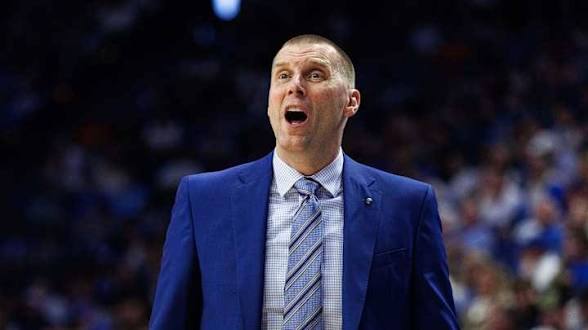
There are moments in college basketball when emotion collides with reality—when frustration meets facts, and the noise of a passionate fanbase is suddenly silenced by something far more powerful: numbers. Right now, that moment has arrived for the Kentucky Wildcats men’s basketball. After another painful March ending, the questions are louder than ever. But buried beneath the disappointment and the heated debates is a truth that changes everything. A truth measured not in wins or losses—but in millions. And that number? It’s roughly $13.5 million… the price tag that could determine the future of Mark Pope in Lexington.
The Moment That Sparked the Conversation
March Madness has always been unforgiving. It doesn’t care about rankings, hype, or history. It exposes flaws. It magnifies weaknesses. And for Kentucky, this latest tournament exit didn’t just end a season—it reignited a conversation that has been quietly building.
A program built on dominance, championships, and deep tournament runs now finds itself searching for answers. And when answers don’t come easily, attention shifts. First to the players. Then to the system. And eventually, to the man leading it all.
Mark Pope.
A name that once brought excitement, hope, and a sense of homecoming is now at the center of one of the most complicated discussions in college basketball today.
From Hope to Heat: The Weight of Expectations
When Kentucky brought Mark Pope in, it wasn’t just about hiring a coach. It was about restoring identity. Reconnecting with tradition. Reigniting a culture that once made the Wildcats the most feared program in the NCAA Division I Men’s Basketball Tournament.
Pope wasn’t an outsider. He understood Kentucky. He was Kentucky.
And that made the expectations even higher.
Because this isn’t just any job. This is one of the most demanding roles in all of sports. At Kentucky, success isn’t measured in improvement—it’s measured in banners. Final Fours. Championships. Legacy.
Anything less?
It invites pressure.
And right now, that pressure is building.
The Contract That Changed the Equation
Here’s where the story takes a dramatic turn.
While fans debate performance, effort, and results, there’s another factor quietly shaping everything behind the scenes: Mark Pope’s contract.
A multi-year deal worth tens of millions wasn’t just a commitment—it was a declaration. Kentucky wasn’t just hiring Pope to stabilize the program. They were investing in him to lead it into the future.
But contracts in college basketball come with something else.
Protection.
And in this case, that protection comes in the form of a buyout clause that has suddenly become the most important number in the conversation.
Breaking Down the $13.5 Million Reality
Let’s get straight to it.
If Kentucky were to move on from Mark Pope right now, they would owe approximately $13.5 million.
That’s not speculation. That’s not rumor.
That’s the financial reality.
The structure of his deal guarantees a significant percentage of his remaining salary, meaning that any decision to part ways early comes at a massive cost. And when you add in the expenses of hiring a new staff, launching a coaching search, and resetting the program, the total financial impact climbs even higher.
This isn’t just a coaching decision anymore.
It’s a business decision.
Why This Changes Everything
Fans often think in terms of wins and losses. And rightfully so. That’s what sports are built on.
But programs—especially elite ones like Kentucky—have to think bigger.
They have to think long-term.
And right now, that $13.5 million figure is forcing Kentucky to ask a difficult question:
Is it worth it?
Because moving on from a coach isn’t just about dissatisfaction. It’s about timing. It’s about financial flexibility. It’s about risk versus reward.
And at this moment, the cost of change might outweigh the urgency for it.
The Illusion of Immediate Solutions
In the heat of disappointment, it’s easy to believe that one move can fix everything.
Fire the coach. Start fresh. Reset the culture.
But reality isn’t that simple.
College basketball has evolved. The transfer portal, NIL deals, and constant roster turnover have made stability more valuable than ever. Building a winning program now takes time—time to recruit, time to develop, time to establish identity.
And that’s exactly what makes this situation so complicated.
Because while the results haven’t met expectations, the process isn’t always as broken as it feels in the moment.
Big Blue Nation: Passion Meets Patience
There is no fanbase in college basketball quite like Kentucky’s.
Big Blue Nation is passionate, loyal, and deeply invested. They don’t just watch games—they live them.
And that passion is both a strength and a challenge.
Because when expectations aren’t met, frustration builds quickly. Calls for change grow louder. And the demand for immediate results becomes overwhelming.
But now, fans are being confronted with something they don’t often consider:
Patience.
Not because they want it.
But because the situation demands it.
The Psychological Toll of Repeated March Disappointment
Every program goes through ups and downs. That’s part of sports.
But at Kentucky, the standard is different.
Repeated early exits in March don’t just hurt—they linger. They shape perception. They create doubt.
And over time, that doubt becomes dangerous.
Because once a program starts to lose its aura—once opponents stop fearing that jersey—it becomes harder to reclaim that dominance.
That’s where Kentucky finds itself now.
Not irrelevant.
But no longer untouchable.
Is This a Temporary Phase… or Something More?
This is the question that defines everything moving forward.
Is Kentucky simply going through a transitional period under Mark Pope?
Or is this a sign of a deeper issue?
The answer isn’t clear.
There are flashes of brilliance. Moments that suggest the potential is still there. But those moments haven’t translated into consistent success when it matters most.
And in March, consistency is everything.
The Financial Clock Is Ticking
Here’s an important detail that many fans overlook:
Buyouts decrease over time.
That $13.5 million number? It won’t stay that high forever.
As years pass and contracts progress, the financial burden of making a change becomes more manageable. And that means Kentucky’s options could expand in the future.
But that also creates a waiting game.
A delicate balance between patience and pressure.
The Risk of Waiting Too Long
While waiting may make financial sense, it comes with its own risks.
If results don’t improve, the frustration will only grow.
Recruiting could be affected.
Fan support could shift.
And the program’s national perception could continue to decline.
So while patience may be necessary, it isn’t without consequences.
What Must Change Moving Forward
Regardless of the financial situation, one thing is clear:
Improvement is non-negotiable.
Kentucky doesn’t need perfection.
But it does need progress.
Stronger identity on the court
Better execution in high-pressure moments
Consistency from game to game
Leadership that rises when it matters most
Because while money can delay decisions, it can’t hide results.
Mark Pope’s Defining Moment
Every coach faces a defining stretch—a period where everything is evaluated, questioned, and ultimately decided.
For Mark Pope, that moment may be approaching.
Not because of one loss.
But because of what those losses represent.
A gap between expectation and reality.
And closing that gap is now the challenge that will define his tenure.
The Truth That Fans Can’t Ignore
Here it is.
The truth behind the headlines.
The reality behind the frustration.
Kentucky may want answers.
Fans may want change.
But right now, the program is facing a situation where neither comes easily.
Because $13.5 million isn’t just a number.
It’s a barrier.
A delay.
A reason to pause.
Final Thought: More Than Just a Number
In the end, this isn’t just about Mark Pope.
It’s about Kentucky basketball.
It’s about identity, expectations, and the future of one of the sport’s most iconic programs.
The $13.5 million buyout doesn’t guarantee Pope stays forever.
But it does guarantee one thing:
Any decision Kentucky makes moving forward will be carefully calculated, deeply analyzed, and heavily influenced by more than just wins and losses.
Because in today’s college basketball world…
The game isn’t just played on the court.
It’s played in contracts, in boardrooms, and in decisions that shape the future long before the next tip-off.
And right now, Kentucky is right in the middle of that game.
With everything on the line.




