


Did the Refs Miss It… or Did Something Happen First? The Moment Before the Shot That Changes Everything
A Timeout Was Called—So Why Wasn’t It Given? The Answer Lies in a Blink-and-You-Miss-It Moment
In a tournament built on chaos, miracles, and moments that live forever, one sequence has managed to do all three—spark debate, confusion, and ultimately, clarity.
It began with a shot that electrified the arena. But what happened just before that shot is what now has the entire college basketball world talking.
Because in the seconds leading up to the game-tying three-pointer by Otega Oweh, there was something else—something far less visible, but just as decisive.
A timeout was called.
So why wasn’t it granted?
The Sequence That Sparked the Storm
With Santa Clara clinging to a 73–70 lead late in regulation, the tension inside the arena was already at a boiling point.
Then came the moment that should have sealed it.
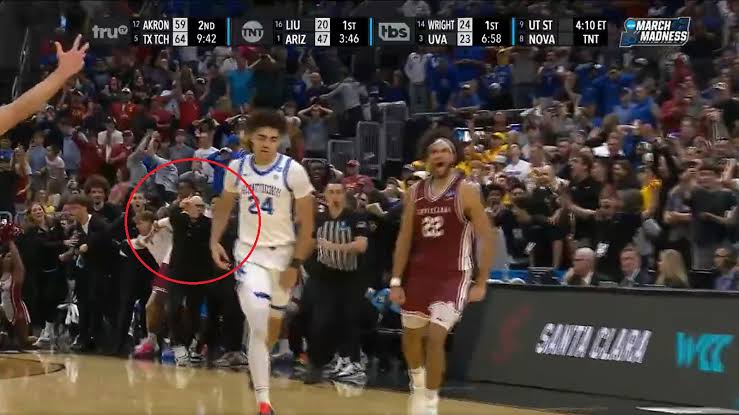
Allen Graves knocked down a clutch three-pointer, pushing Santa Clara ahead and seemingly putting them in control. On the sideline, head coach Herb Sendek reacted instantly—turning toward the officials, emphatically signaling for a timeout.
To him, it was obvious.
To many watching, it looked unmistakable.
But the whistle never came.
What followed was chaos.
The Shot That Changed Everything
Instead of a stoppage, the game flowed on.
In one fluid motion, Kentucky’s Denzel Aberdeen grabbed the ball as it came through the net, stepped out of bounds, and initiated the inbound.
Within seconds, the ball found its way to Oweh.
From well beyond the arc—32 feet out—he rose and fired.
Nothing but net.
Tie game.
Pandemonium.
And suddenly, what should have been a routine timeout became the most controversial non-call of the night.
“I Unequivocally Called a Timeout”
After the game, Sendek didn’t mince words.
“I unequivocally called a timeout,” he said, frustration evident. “But they didn’t grant it.”
For fans, the reaction was immediate:
Did the referees miss it?
Was Santa Clara denied a critical opportunity to reset defensively?
In a tournament where every possession matters, the moment felt enormous.
But as replays rolled and explanations surfaced, the story began to shift.
The Rule That Changes Everything
At the heart of the controversy lies a deceptively simple rule:
A timeout can only be granted when a team has clear possession of the basketball.
It sounds straightforward.
But in real time, during a made basket, possession is anything but simple.
When the ball is passing through the net after a made shot, neither team officially controls it. It’s a transitional moment—a gray area measured in fractions of a second.
And that’s exactly where this game turned.
The Blink-and-You-Miss-It Detail
As Graves’ shot dropped, Sendek was already signaling.
But almost simultaneously, Aberdeen made his move.
The instant he secured the ball for Kentucky, possession changed hands.
In that split second, everything flipped:
- Before Aberdeen touched the ball → Santa Clara could request a timeout
- After Aberdeen touched it → possession belonged to Kentucky
By the time Sendek’s request registered, the window had closed.
Not by seconds.
By fractions of a second.
Not a Missed Call—A Perfectly Timed Play
What initially looked like a glaring officiating error now appears to be something else entirely:
A textbook application of the rulebook.
Even seasoned observers noted how razor-thin the margin was. Had the timeout been signaled just a heartbeat earlier—before Aberdeen’s touch—it likely would have been granted.
But Kentucky’s awareness erased that possibility instantly.
It wasn’t hesitation.
It was execution.
The Hidden Brilliance in the Chaos
Lost in the outrage was a subtle but crucial detail: Kentucky didn’t just get lucky—they reacted faster.
Aberdeen’s instinct to grab the ball immediately and initiate play wasn’t accidental. It was awareness, drilled and deliberate.
And in March, where games often turn on the smallest edges, that awareness becomes everything.
Instead of allowing Santa Clara to set its defense, Kentucky created motion, pressure, and opportunity.
Seconds later, Oweh delivered the moment everyone will remember.
But it was the moment before that made it possible.
Why This Moment Will Be Debated for Years
Even with the rule clarified, the debate isn’t going away anytime soon.
Because this play sits at the intersection of two truths:
- Emotionally, it feels like a missed call
- Technically, it was executed exactly as the rules demand
That tension is what makes sports—and moments like this—so compelling.
Fans saw a coach calling for a timeout and didn’t hear a whistle.
But officials saw a change of possession that made that request invalid.
Both perspectives exist.
Only one aligns with the rulebook.
The Bottom Line
In the end, this wasn’t a story about referees failing under pressure.
It was a story about timing.
About how a fraction of a second can separate control from chaos.
And about how one team’s quick thinking can erase another’s opportunity in the blink of an eye.
The shot by Otega Oweh will live on as a March Madness classic.
But the truth is, the game may have been decided before he ever released the ball.
Not by a whistle.
Not by a mistake.
But by a moment so small, most people never saw it happen.




