


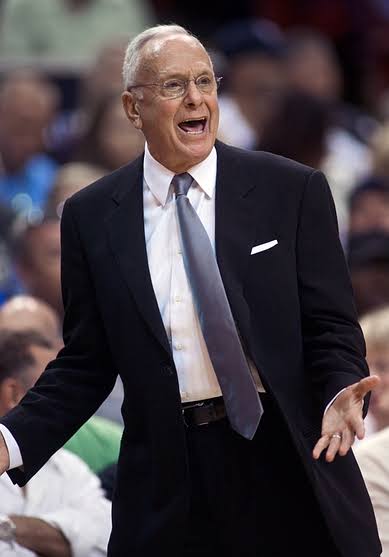
As pressure quietly builds around Hubert Davis and doubts begin to swirl about his future with the North Carolina Tar Heels, a legendary voice has suddenly stepped in—and what Larry Brown just revealed isn’t just a defense… it’s a powerful statement that could completely reshape the narrative and leave fans questioning everything they thought they knew.
In the world of college basketball, few programs carry the weight, tradition, and expectations of North Carolina. From championship banners to iconic alumni, the Tar Heels have long been a symbol of excellence. But with greatness comes pressure—and in recent seasons, that pressure has been steadily mounting on head coach Hubert Davis.
Now, at a moment when speculation about his future is intensifying, Hall of Fame coach Larry Brown has stepped forward with a passionate and highly public defense of Davis. And in doing so, he has sparked a conversation that goes far beyond wins and losses.
A Voice That Commands Respect
Larry Brown is not just another commentator offering an opinion. He is one of the most respected figures in basketball history—a coach whose resume spans college and professional success, including an NCAA championship at Kansas and an NBA title with the Detroit Pistons.
But perhaps even more importantly in this context, Brown is deeply connected to North Carolina. As a former All-ACC guard under the legendary Dean Smith, Brown understands the culture, expectations, and identity of the Tar Heels in a way few others do.
So when he speaks, people listen.
And what he said about Hubert Davis was both direct and emphatic.
Brown didn’t just suggest patience—he made a case for belief.
The Core of Brown’s Argument
At the heart of Brown’s defense is context—something he believes has been overlooked in the rush to judge Davis’ tenure.
He pointed to one of the most significant factors impacting North Carolina’s recent struggles: the injury to key player Caleb Wilson. According to Brown, that single development altered the trajectory of the entire season.
Before the injury, North Carolina had demonstrated its potential, securing impressive wins over top-tier programs like Ohio State, Kansas, Duke, Virginia, and Kentucky—many of them on the road.
Those victories weren’t flukes. They were evidence of what the team could be when fully healthy and functioning at its highest level.
Brown’s argument is simple but powerful: you cannot evaluate a team—or a coach—without considering the circumstances they faced.
And in his view, those circumstances deserve more weight than they’ve been given.
The Roller Coaster of the Hubert Davis Era
To understand why Brown’s comments carry so much significance, it’s important to look at the broader arc of Hubert Davis’ tenure at North Carolina.
When Davis took over the program, he faced the enormous challenge of succeeding a legend. Replacing a figure tied to the legacy of Dean Smith is no easy task, and expectations were high from the very beginning.
In his first season, Davis exceeded those expectations in dramatic fashion. The Tar Heels made a stunning run to the national championship game, capturing the imagination of fans and establishing Davis as a coach capable of leading at the highest level.
But what followed has been far less consistent.
The very next season, North Carolina entered the year ranked No. 1 in the preseason polls—a rare and prestigious position. Yet, despite returning key players, the team failed to make the NCAA Tournament entirely, marking one of the most disappointing campaigns in program history.
They rebounded in the 2023–24 season with an ACC regular-season title and a Sweet 16 appearance, suggesting that the program was back on track.
However, the past two tournaments have once again raised concerns.
Early exits—including the recent overtime loss to VCU after blowing a 19-point second-half lead—have reignited doubts about the team’s direction and Davis’ leadership.
The VCU Collapse: A Defining Moment
The loss to VCU Rams was more than just a defeat—it was a moment that crystallized the frustrations of many fans.
Holding a massive lead with just 14 minutes remaining, North Carolina appeared to be in complete control. But what followed was a stunning collapse—one that ended in an 82–78 overtime loss.
It was historic for all the wrong reasons.
The largest blown lead in a first-round game in NCAA Tournament history.
For a program like North Carolina, that kind of result is difficult to accept.
And it has become a central point in the criticism of Davis.
Fans vs. Patience: A Growing Divide
As is often the case in high-profile programs, fan reaction has been swift and intense.
Some believe that the inconsistency under Davis is unacceptable. They point to the missed tournament, the early exits, and the inability to maintain momentum as signs that change may be necessary.
Others, however, see a more nuanced picture.
They recognize the challenges Davis has faced, including injuries, roster turnover, and the evolving landscape of college basketball.
And now, with Larry Brown’s comments entering the conversation, that second perspective is gaining new credibility.
The Importance of Player Support
One of the most compelling elements of Brown’s argument is his emphasis on player loyalty.
He noted that many current players want to remain in the program specifically to play for Hubert Davis—a detail that speaks volumes about the culture within the team.
In today’s era of the transfer portal, player retention is a key indicator of a coach’s impact.
If players believe in their coach, they stay.
If they don’t, they leave.
The fact that North Carolina players are choosing to stay—and publicly supporting Davis—suggests that there is a strong foundation being built behind the scenes.
Recruiting: A Reason for Optimism
Beyond the current roster, Brown also highlighted another critical factor: the incoming recruiting class.
Recruiting is the lifeblood of any college basketball program, and North Carolina appears to be in a strong position moving forward.
A talented class has the potential to reshape the team’s identity, address weaknesses, and elevate performance.
But for that potential to be realized, stability is key.
Frequent coaching changes can disrupt recruiting pipelines, create uncertainty, and set programs back.
Brown’s message, in part, is about protecting that future.
Is North Carolina Losing Its Edge?
Despite the optimism in some areas, there is an underlying concern that cannot be ignored: the idea that North Carolina may be slipping from its status as a true “blue blood.”
This is not a conclusion—it’s a question.
And it’s one that fuels much of the urgency surrounding Davis’ situation.
In a sport where programs like Kansas, Duke, and Kentucky continue to set high standards, North Carolina’s recent inconsistency has raised eyebrows.
But Brown’s defense suggests that it may be too early to make definitive judgments.
Leadership in the Face of Adversity
At its core, this debate is about leadership.
What does it mean to lead a program through difficult times?
Is it about immediate results, or long-term vision?
Hubert Davis has shown flashes of brilliance—most notably in that first-season championship run.
But he has also faced setbacks that have tested both his strategy and resilience.
Larry Brown’s endorsement is a reminder that leadership should not be judged solely on outcomes, but also on character, effort, and the ability to build something sustainable.
The Decision Ahead
Ultimately, the future of Hubert Davis at North Carolina will be determined by the administration.
They must weigh multiple factors:
Performance on the court
Player development
Recruiting success
Program culture
Fan expectations
It is not an easy decision.
And it is one that will have long-lasting implications.
A Narrative That’s Still Being Written
What makes this moment so compelling is that the story is not finished.
Hubert Davis’ tenure is still unfolding.
The challenges he has faced are real—but so is the potential for growth.
Larry Brown’s comments have added a new dimension to the conversation, reminding everyone that success in college basketball is rarely linear.
Sometimes, the path forward requires patience.
Sometimes, it requires belief.
Final Thoughts: More Than Just a Defense
Larry Brown didn’t just defend Hubert Davis—he challenged the narrative.
He asked fans, analysts, and decision-makers to look deeper, to consider context, and to recognize the complexities of building a successful program.
In doing so, he has shifted the conversation.
Now, the question is not just whether Hubert Davis should stay.
It’s whether North Carolina is willing to trust the process, embrace the bigger picture, and give a coach the time he may need to bring the program back to its full potential.
Because if Brown is right—if the pieces are already in place—then what comes next might not just justify that patience…
It might redefine everything.




