


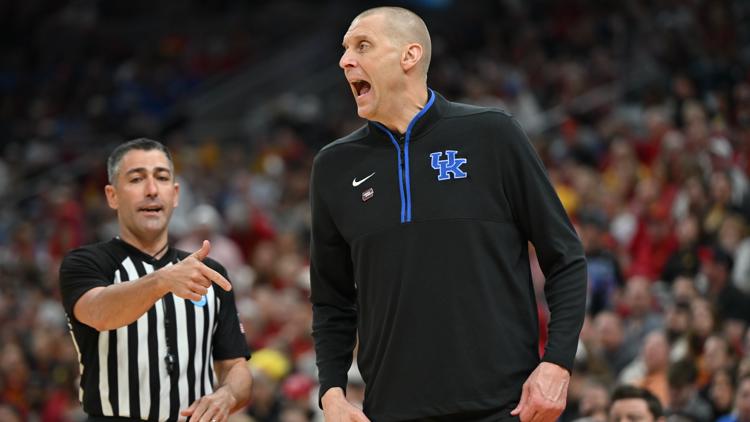
The ending was not just disappointing — it was jarring.
For the Kentucky Wildcats men’s basketball, a season that began with optimism, hype, and a top-10 national ranking came crashing down in a way few expected. An 82–63 blowout loss to Iowa State Cyclones men’s basketball in the second round of the NCAA Tournament didn’t just eliminate Kentucky — it ignited a wave of scrutiny that is now squarely centered on head coach Mark Pope.
Because at Kentucky, it’s never just about losing.
It’s about how you lose, why you lose — and whether the direction of the program still matches the standard that has defined it for generations.
A Season That Started With Promise
When Kentucky entered the season ranked No. 9 in the AP Poll, expectations were clear. This wasn’t supposed to be a rebuilding year. It wasn’t supposed to be a transitional phase. It was supposed to be a statement.
Adding to the pressure was the reported investment in the roster — estimated around $20 million. In the modern era of college basketball, where NIL (Name, Image, and Likeness) opportunities have transformed roster building, Kentucky leaned all the way in. The expectation wasn’t just competitiveness.
It was dominance.
Instead, the Wildcats finished the season 22–14 — a record that, while respectable in many programs, falls short of what is expected in Lexington.
And it wasn’t just the record.
It was the inconsistency. The lack of identity. The inability to string together sustained momentum.
At times, Kentucky looked like a contender. At others, they looked completely out of sync.
That contrast ultimately defined their season.
The Loss That Changed the Conversation
The defeat to Iowa State Cyclones men’s basketball didn’t just end Kentucky’s season — it reframed it.
Losing is one thing. Getting overwhelmed is another.
Iowa State, even while missing key pieces, controlled the game. Kentucky never found rhythm, never established control, and never truly threatened to shift momentum. By the time the final buzzer sounded, the gap on the scoreboard reflected a deeper issue — a team that never fully came together.
And that’s where the criticism began to intensify.
Gary Parrish: “Good Isn’t Good Enough”
Few voices captured the situation more directly than Gary Parrish of CBS Sports.
Parrish pointed out a reality that defines Kentucky basketball: success is relative.
“Mark Pope has been to two straight NCAA tournaments and won games in both. That is good at most schools. It’s not good enough at Kentucky.”
That statement cuts to the core of the issue.
At many programs, consistent tournament appearances would be celebrated. At Kentucky, they’re expected. Advancement is the benchmark. Deep runs are the standard.
Parrish also emphasized roster construction — a theme that appeared repeatedly in post-season analysis. With significant financial investment, expectations for cohesion and fit increase dramatically.
And if next season’s roster doesn’t immediately look like a contender?
The pressure on Mark Pope will intensify quickly.
Dan Wolken: “The Clock Is Ticking”
If Parrish highlighted expectations, Dan Wolken of Yahoo! Sports raised the stakes even higher.
“Make no mistake: Pope is now on the clock. He has one year to fix this.”
That’s not speculation — that’s a warning.
In college basketball, timelines can shift rapidly, especially at elite programs. A single underwhelming season can be explained. Two? That becomes a trend.
Wolken’s perspective also introduced another layer: leadership changes.
With a new athletic director potentially entering the picture in the near future, the evaluation process could take on a different tone. New leadership often brings new expectations — and less attachment to existing decisions.
In that context, next season isn’t just important.
It’s defining.
Matt Jones: A System Without Fit
Perhaps the most pointed criticism came from Matt Jones of Kentucky Sports Radio.
“This team was ultimately poorly constructed with pieces that didn’t really fit Pope’s system.”
That observation goes beyond results — it questions the foundation.
Basketball isn’t just about talent. It’s about fit, roles, and identity. Teams that succeed in March often have a clear understanding of who they are and how they play.
Kentucky, according to Jones, never found that clarity.
“Pope never found a consistent style of play and went through too many stretches where he was out-coached.”
That’s a significant claim — especially at a program where coaching excellence is part of the legacy.
Pat Forde: A “Fitting Epitaph”
For Pat Forde of Sports Illustrated, the loss to Iowa State symbolized something larger.
“Getting absolutely drilled by a team missing its best player is not a great look, and serves as a fitting epitaph for a team that was poorly constructed.”
The word “epitaph” stands out.
It suggests finality — a summary of everything that went wrong.
And in this case, it reinforces a growing consensus: Kentucky’s issues weren’t isolated.
They were systemic.
Sam Vecenie: No Excuses
In modern college basketball, injuries are often used to explain underperformance.
But Sam Vecenie of The Athletic pushed back on that narrative.
“It’s really hard to hear people give the ‘if their two best players didn’t get hurt’ excuse for Kentucky.”
Vecenie pointed out a critical detail: roster decisions are strategic.
Bringing in a player recovering from a torn ACL isn’t bad luck — it’s a calculated risk. And when that risk doesn’t pay off, it becomes part of the evaluation.
“That’s a roster choice, not bad luck.”
That distinction matters.
Because it shifts responsibility from circumstance to decision-making.
The Standard That Never Changes
At the heart of all this criticism is one simple truth:
Kentucky basketball operates under a different standard.
This is a program that has been shaped by legends, championships, and decades of dominance. The expectations aren’t flexible. They don’t adjust based on circumstance.
They remain constant.
And that’s what makes this moment so significant.
Because the conversation isn’t just about one season.
It’s about whether the program is still aligned with its identity.
What Comes Next for Mark Pope?
Despite the noise, one thing is clear: Mark Pope is not without support.
He has shown the ability to recruit. He has led the team to consecutive NCAA Tournament appearances. And he understands the culture of Kentucky basketball.
But understanding the culture isn’t enough.
Meeting the standard is what matters.
And right now, there are questions about whether that’s happening.
Next season will be critical.
Roster construction will be under the microscope. Player development will be closely watched. In-game adjustments, late-game execution, and overall identity will all be evaluated in real time.
There won’t be much room for error.
The Pressure of the Modern Era
College basketball has changed.
With NIL, transfer portals, and increased financial investment, expectations have accelerated. Programs can rebuild quickly — but they’re also judged more quickly.
For Kentucky, that means every decision matters more than ever.
Spending $20 million on a roster isn’t just a headline — it’s a statement of intent.
And when the results don’t match that investment, scrutiny follows.
A Defining Year Ahead
As the dust settles, the focus shifts to the future.
Will Kentucky regroup and return to form?
Will Mark Pope adjust, adapt, and elevate the program?
Or will the concerns raised by analysts and fans continue to grow?
The answer will come over the next 12 months.
And in a program like Kentucky, 12 months can feel like everything.
Final Thoughts
The Kentucky Wildcats men’s basketball are not far from relevance.
They’re not lacking talent.
They’re not lacking resources.
But right now, they’re lacking something that has always defined them:
Certainty.
Certainty in identity.
Certainty in execution.
Certainty in direction.
And until that returns, the questions won’t stop.
Because at Kentucky, “good” is never the goal.
Greatness is.
And anything less will always feel like falling short.




