


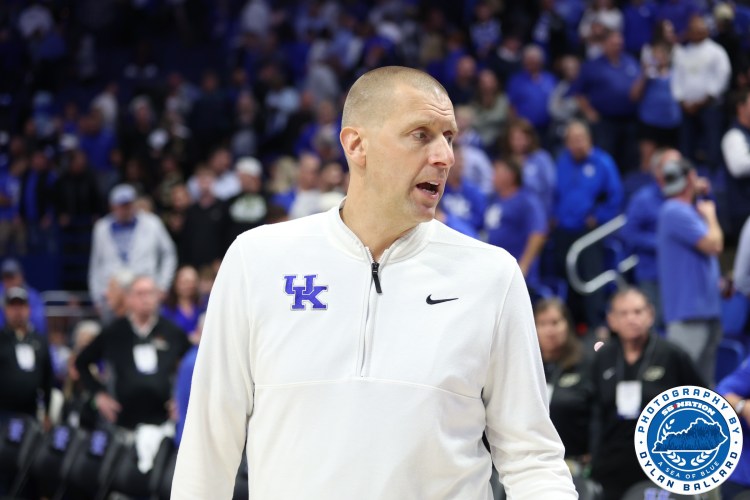
The conversation surrounding Kentucky Wildcats basketball is never quiet for long. It’s a program built on banners, expectations, and a relentless standard of excellence that few others in college basketball can match. So when head coach Mark Pope stepped forward during his radio show to defend the program’s trajectory, it was always going to spark debate. His message was clear: Kentucky is making progress since the end of the John Calipari era. But the timing—coming off a 14-loss season and another early exit from the NCAA Tournament—has left fans and analysts divided.
For the sixth straight year, Kentucky failed to reach the Elite Eight, a drought that feels almost unthinkable for a program of its stature. The latest disappointment came in the Round of 32, where the Wildcats were convincingly beaten by Iowa State Cyclones. It wasn’t just the loss itself, but the manner of it—decisive, deflating, and raising familiar questions about the program’s ability to compete deep into March. For a fanbase accustomed to championship aspirations, anything short of a Final Four run often feels like falling short.
Yet, in the aftermath of that defeat, Pope chose not to dwell solely on the negatives. Instead, he leaned into a broader view of the program’s recent history, contrasting his first two seasons with the final four years under Calipari. His argument wasn’t that Kentucky has already returned to its peak, but that it is, at the very least, moving in the right direction.
“I’m not talking about meeting the standard of where we’re trying to get,” Pope said. “Clearly, we did not do that, but we are making progress.”
That statement, simple on the surface, carries layers of meaning. It acknowledges failure while also attempting to reframe the narrative. And in doing so, it invites a deeper question: what does “progress” actually look like for a program like Kentucky?
To understand Pope’s perspective, it’s important to revisit the closing chapter of the Calipari era. While Calipari remains one of the most accomplished coaches in modern college basketball, his final years in Lexington were marked by inconsistency and, at times, outright disappointment. There was the shocking first-round loss to 15-seed Saint Peter’s, a result that sent shockwaves through the sport. There was another early exit against 14-seed Oakland. And perhaps most concerning was the 9–16 season during the COVID-affected campaign—a low point that few could have imagined for Kentucky.
During that four-year stretch, postseason success was scarce. The Wildcats managed just one NCAA Tournament win and struggled to make meaningful runs in the SEC Tournament. For a program that measures itself in championships, not just appearances, that stretch represented a significant departure from the norm.
By the time Calipari moved on—eventually finding new life with the Arkansas Razorbacks—it was clear that a reset was needed. That reset came in the form of Mark Pope, a former Kentucky player who understood the weight of the jersey and the expectations that come with it.
From the outset, Pope’s challenge was immense. He wasn’t just tasked with winning games; he was tasked with restoring belief. And in his first two seasons, there have been signs—however modest—that the program is stabilizing.
Pope pointed to several key metrics to support his argument. In the SEC Tournament, Kentucky has shown improved competitiveness, winning more games in Nashville over the past two years than in the previous four combined. In NCAA Tournament play, the Wildcats have also seen an uptick in success, securing more wins under Pope than they managed during the latter part of Calipari’s tenure.
On paper, those improvements are real. They provide a measurable way to track progress, even if they fall short of the ultimate goal. But numbers alone rarely tell the full story, especially in a place like Kentucky where expectations are shaped as much by history as by statistics.
And that’s where the tension lies.
Because while Pope’s data-driven defense of his tenure has merit, it exists alongside undeniable shortcomings. Two seasons, two double-digit loss campaigns. Another year without an Elite Eight appearance. And a growing sense among some fans that the program, while perhaps improved, is still far from where it needs to be.
This duality has fueled the debate: is Pope right to highlight progress, or does doing so risk lowering the standard?
For some supporters, Pope’s comments are a welcome dose of realism. They recognize that rebuilding a program—even one as storied as Kentucky—takes time. They see value in incremental improvement and believe that laying a solid foundation is essential for long-term success.
For others, however, the idea of celebrating relative progress feels out of place. Kentucky isn’t just any program; it’s a blue blood, a perennial contender, a school where banners hang as reminders of what’s possible. From that perspective, pointing to modest gains can feel like an excuse rather than an achievement.
The truth likely lies somewhere in between.
Pope’s tenure so far can be viewed as a transition period—a bridge between a declining era and whatever comes next. The roster has shown flashes of potential, including notable wins against top-15 opponents and a long-awaited return to the Sweet 16 last season. Those moments suggest that the ceiling remains high.
At the same time, consistency has been elusive. The Wildcats have struggled to maintain momentum, often following impressive performances with puzzling setbacks. That inconsistency has made it difficult to fully buy into the idea of sustained progress.
Adding another layer to the conversation is the evolving landscape of college basketball. With the rise of NIL deals and the transfer portal, building and maintaining a roster has become more complex than ever. Kentucky, like many programs, has had to adapt to these changes while still meeting sky-high expectations.
In that context, Pope’s emphasis on progress can be seen as an attempt to navigate a new reality. Success is no longer defined solely by recruiting rankings or one-and-done stars. It requires cohesion, development, and the ability to manage a constantly shifting roster.
Still, none of that diminishes the importance of results.
At Kentucky, progress isn’t just about being better than before; it’s about being among the best, period. And until the Wildcats consistently make deep tournament runs, questions will persist.
That’s why the timing of Pope’s comments is so significant. Coming immediately after another disappointing postseason exit, they risk being interpreted as tone-deaf, even if the underlying message is valid. In moments like these, perception matters just as much as reality.
And yet, there’s also something to be said for transparency.
Pope didn’t claim that Kentucky has arrived. He didn’t declare the program a finished product. Instead, he acknowledged the gap between where the Wildcats are and where they want to be, while also pointing out that the gap may be narrowing.
Whether that message resonates will depend largely on what happens next.
Because ultimately, talk of progress must be backed up by tangible results. Another season of incremental improvement might not be enough to satisfy a fanbase hungry for championships. At some point, the conversation has to shift from “getting better” to “being great.”
As the Wildcats look ahead, the pressure will only intensify. Every game, every decision, every result will be scrutinized through the lens of both history and expectation. Pope knows this. He understands that coaching at Kentucky means living under a microscope, where even well-intentioned comments can become headlines.
But he also understands something else: that building something meaningful takes time.
The question is whether Kentucky fans—and the broader college basketball world—are willing to give him that time.
For now, the debate continues. Is Kentucky truly on the rise, or are the signs of progress being overstated? Is Pope the right man to lead the program back to national prominence, or is the jury still out?
What’s clear is that the conversation isn’t going away anytime soon.
And maybe that’s exactly the point.
Because at Kentucky, expectations don’t just drive performance—they define it.




