


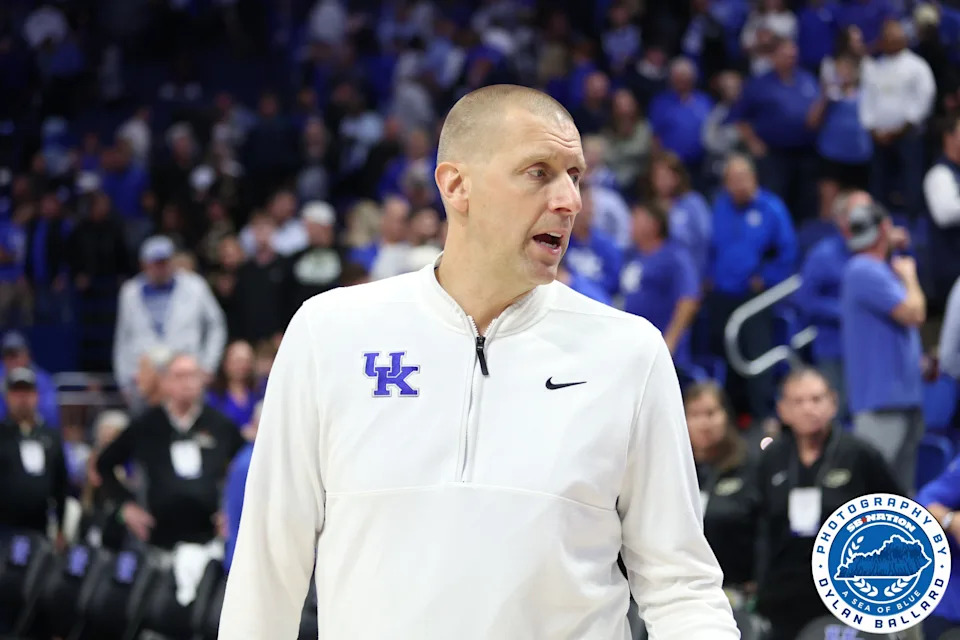
Kentucky basketball is not a program built on patience—it is built on banners, brilliance, and March glory. And as Mark Pope enters a defining phase of his tenure, the message from Big Blue Nation is loud and unmistakable: progress is not enough. Only championships matter.
During a recent radio show, Pope reflected on his first two seasons compared to the previous four under John Calipari. Statistically, there were areas of improvement. Efficiency metrics, defensive rankings, and structural changes all suggested a program attempting to evolve. But in Lexington, numbers don’t hang in rafters—titles do. And after another disappointing NCAA Tournament exit, fans are no longer interested in incremental gains. They want results when it matters most.
March Madness is the ultimate measuring stick at Kentucky. It defines legacies, validates strategies, and separates good seasons from great ones. Pope himself acknowledged this when he took the job, boldly declaring his intention to deliver banner No. 9. That promise now looms large as he begins the crucial task of reshaping his roster.
The core issue this past season was not effort or even talent—it was fit. The roster, though expensive and filled with potential, never fully came together. Kentucky reportedly had one of the highest payrolls in college basketball, yet that financial investment did not translate into postseason success. The disconnect between talent and cohesion became evident as the season progressed.
Offensively, the Wildcats regressed. In Pope’s first season, the team ranked among the top 10 in offensive efficiency. This year, they slipped significantly, falling outside the elite tier. That decline is especially concerning given Pope’s offensive philosophy, which emphasizes spacing, tempo, and a heavy reliance on three-point shooting.
At BYU, Pope’s system thrived on volume perimeter shooting, with half of the team’s attempts coming from beyond the arc. When he arrived at Kentucky, he made it clear he wanted a similar identity—aiming for more than 30 three-point attempts per game. Instead, the Wildcats moved in the opposite direction. Their three-point attempt rate dropped, and the offense lost the rhythm and spacing that defines Pope’s style.
Part of this regression can be traced to injuries. The loss of starting point guard Jaland Lowe early in the season was a major blow. His absence disrupted the team’s flow and exposed a glaring weakness: the lack of a reliable backup at the position. This was not an unforeseeable issue. Pope had dealt with similar challenges in his first season, yet the roster was not adequately prepared to handle it again.
Another miscalculation involved Jayden Quaintance. The talented forward was expected to contribute despite recovering from a serious knee injury. In reality, he played only a handful of games, providing minimal impact. While the gamble may have seemed worthwhile at the time, it ultimately highlighted the risks of relying on players who are not fully healthy.
To their credit, the Wildcats did improve defensively. Their ranking climbed significantly, showing a greater commitment to that end of the floor. But the tradeoff was clear: the defensive gains did not compensate for the offensive drop-off. In a program where scoring and explosiveness have traditionally been strengths, that imbalance proved costly.
Looking ahead, the path forward is both clear and challenging. Roster construction must become a priority. Pope has resisted hiring a traditional general manager, but he has taken steps to address the issue by creating a player development role with expanded responsibilities. This position will be tasked with identifying players who not only fit Pope’s system but also align with the program’s financial structure.
That role will be critical as the transfer portal opens. In today’s college basketball landscape, success often hinges on the ability to quickly assemble a cohesive roster through transfers. Kentucky cannot afford another year of mismatched pieces and unrealized potential.
Recruiting also remains a concern. The program has yet to secure commitments for the 2026 class, raising questions about its long-term pipeline. There is still hope, however, with top prospect Tyran Stokes reportedly considering Kentucky. Landing a player of his caliber would provide a significant boost, both in talent and momentum.
But even with potential additions, the pressure on Pope is undeniable. Kentucky’s expectations are unforgiving, and history offers little margin for error. The comparison no coach wants to face is already being whispered—short tenures and unmet expectations. To avoid that narrative, Pope must deliver a team that is not only talented but cohesive, resilient, and built for March.
This offseason represents more than just a chance to reload—it is an opportunity to reset. Every decision, from roster composition to playing style, must be aligned with one goal: winning a national championship.
Because at Kentucky, anything less is simply not enough.




