


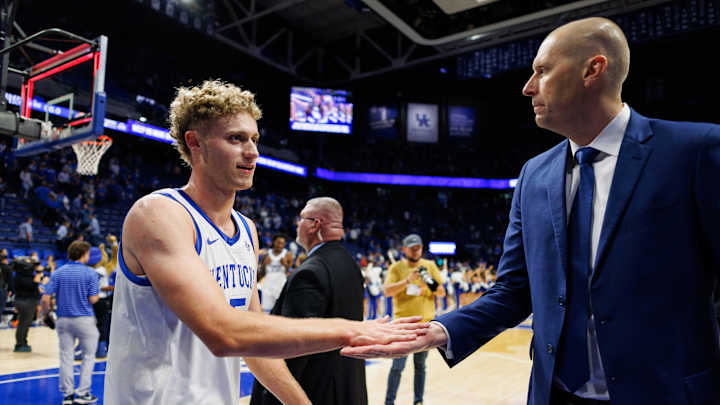
In the aftermath of a season that fell short of expectations, few voices inside the Kentucky Wildcats men’s basketball locker room carried as much weight—or as much intrigue—as that of Collin Chandler. At a time when frustration among fans continues to grow and questions surrounding Mark Pope are becoming louder, Chandler’s public and unwavering belief in his head coach has become one of the most talked-about storylines emerging from the program. His words, delivered in the immediate aftermath of Kentucky’s season-ending loss, did more than defend a coach—they revealed a deeper layer of loyalty, trust, and long-term vision that may ultimately shape the direction of the program moving forward.
To fully understand the impact of Chandler’s statement, it is important to first revisit the context surrounding Kentucky’s 2025–26 season. Entering the year, expectations were sky-high. There was widespread excitement about the roster, fueled by recruiting success, perceived talent depth, and discussions about the financial investment behind assembling the team. Analysts and fans alike believed that Kentucky had the pieces to contend at the highest level of NCAA Division I men’s basketball. But as the season unfolded, reality painted a different picture.
Despite flashes of promise, the Wildcats struggled with consistency. They finished the regular season without establishing themselves as a dominant force and ultimately entered the NCAA Tournament as a No. 7 seed—far below what many had anticipated. Their tournament journey was short-lived, ending in the Round of 32 with a loss to the Iowa State Cyclones men’s basketball. That defeat not only closed the chapter on a disappointing season but also intensified scrutiny around the program. For a school with Kentucky’s history, early tournament exits are not just setbacks—they are defining failures.
The disappointment extended beyond March Madness. For the first time in program history, Kentucky found itself playing on Wednesday in the SEC Tournament, a detail that may seem minor on the surface but carries significant symbolic weight within the program. Competing earlier than expected in the conference tournament signaled a step backward, reinforcing the perception that Kentucky was not operating at its usual elite level. Although the Wildcats managed to secure a couple of wins in Nashville, it did little to erase the broader concerns that had already taken root.
As the losses accumulated and expectations went unmet, frustration among the fan base became increasingly visible. Questions began to emerge about coaching decisions, in-game adjustments, and overall team identity. While injuries undoubtedly played a role in the team’s struggles, many observers pointed to strategic inconsistencies and missed opportunities as contributing factors. In a program where success is not only expected but demanded, such issues rarely go unnoticed—or uncriticized.
It is within this environment of doubt and uncertainty that Collin Chandler’s comments carry such significance. Following the loss to Iowa State, Chandler was asked about his perspective on Coach Pope. His response was both direct and deeply personal: he has believed in Pope since he was 15 years old. He spoke not just about Pope’s abilities as a coach but about his character, emphasizing that “a type of person like that finds success.” Perhaps most notably, Chandler concluded with a clear declaration: “I’m riding with Coach Pope.”
Those words resonate far beyond a typical postgame quote. They reflect a relationship that predates their time at Kentucky, rooted in Pope’s recruitment of Chandler during his tenure at BYU. This longstanding connection adds credibility to Chandler’s belief, suggesting that his support is not based on circumstance but on years of firsthand experience. In an era where player-coach relationships can often feel transactional, Chandler’s loyalty stands out as both rare and impactful.
For Kentucky fans, the reaction to Chandler’s statement has been mixed—but undeniably strong. On one hand, there is appreciation for a player publicly supporting his coach during a challenging period. Leadership, after all, is often defined by how individuals respond in moments of adversity. Chandler’s willingness to stand firm in his belief sends a message of unity within the locker room, a signal that not all is fractured behind the scenes. On the other hand, some fans view such statements with skepticism, questioning whether loyalty alone is enough to address the program’s shortcomings.
This tension highlights a broader truth about Kentucky basketball: belief must eventually translate into results. While Chandler’s confidence in Pope is meaningful, it does not change the expectations facing the program. The upcoming season will be critical, not just for Pope’s job security but for the overall direction of Kentucky basketball. The margin for error is small, and the pressure to perform is immense.
Chandler himself is expected to play a pivotal role in that equation. As he prepares for the next stage of his college career, there is a strong belief that he can take a significant leap in production. The expectation that he could develop into a 15-points-per-game scorer underscores his importance to the team’s future. If he is able to make that jump, it would not only elevate Kentucky’s offensive capabilities but also validate the developmental system under Pope—a key factor in shaping perceptions of the coaching staff.
Beyond individual performance, Chandler’s comments also carry implications for team culture. In times of adversity, locker rooms can either fracture or strengthen. Public expressions of belief from players can help reinforce trust, maintain morale, and create a foundation for growth. If Chandler’s mindset reflects a broader sentiment within the team, it could serve as a stabilizing force as Kentucky looks to regroup and move forward.
However, the reality remains that belief alone cannot shield a program from accountability. The expectations surrounding Kentucky are rooted in decades of success, and those expectations are unlikely to change. Competing at the highest level of the Southeastern Conference and making deep runs in the NCAA Tournament are not optional goals—they are baseline requirements. For Coach Pope, the challenge is to align the internal belief expressed by players like Chandler with the external results demanded by fans and stakeholders.
The upcoming season, therefore, represents a critical juncture. It is an opportunity for redemption, a chance to address the issues that plagued the previous campaign, and a moment to redefine the narrative surrounding the program. Success would not only validate Chandler’s confidence but also restore faith among a fan base eager for a return to prominence. Failure, on the other hand, would likely intensify criticism and bring questions about leadership to the forefront.
What makes this situation particularly compelling is the contrast between perception and potential. On one side, there is growing doubt fueled by recent results. On the other, there is a belief—embodied by Chandler—that the foundation for success still exists. Bridging that gap will require more than optimism; it will demand tangible improvement in performance, consistency, and execution.
In many ways, Chandler’s statement serves as a reminder of the human element within college basketball. Behind the statistics, rankings, and headlines are relationships built on trust and shared experiences. For Chandler, his belief in Mark Pope is not abstract—it is personal. It is shaped by years of interaction, mentorship, and understanding. That perspective offers a counterpoint to the often harsh and immediate judgments that define the sport.
As Kentucky looks ahead, the interplay between belief and expectation will continue to shape the narrative. Chandler’s voice has added a new dimension to that conversation, one that emphasizes loyalty and confidence at a time when both are being tested. Whether that belief proves to be justified will ultimately depend on what happens on the court.
For now, one thing is clear: Collin Chandler has made his stance known, and in doing so, he has sparked a conversation that extends far beyond a single game or season. His words have turned heads, challenged assumptions, and provided a glimpse into the mindset of a player who sees something in his coach that others may not fully recognize.
In a program defined by its pursuit of excellence, that belief will now be put to the test. And as the next season approaches, all eyes will be on Kentucky—not just to see how they perform, but to determine whether the confidence expressed by one of their own can translate into the success that everyone is waiting for.




