


It looked like the end. With just 2.4 seconds left on the clock and Kentucky trailing 73–70, the atmosphere inside the arena shifted from hopeful to stunned. Santa Clara had just drained a clutch three-pointer, and for a brief moment, it seemed like Kentucky’s season—and for some players, their entire college careers—had come to a crushing halt.
But March basketball has a way of rewriting endings.
What happened next wasn’t just luck. It was awareness, instinct, and composure under extreme pressure. And at the center of it all was a decision made in a fraction of a second—one that changed everything.
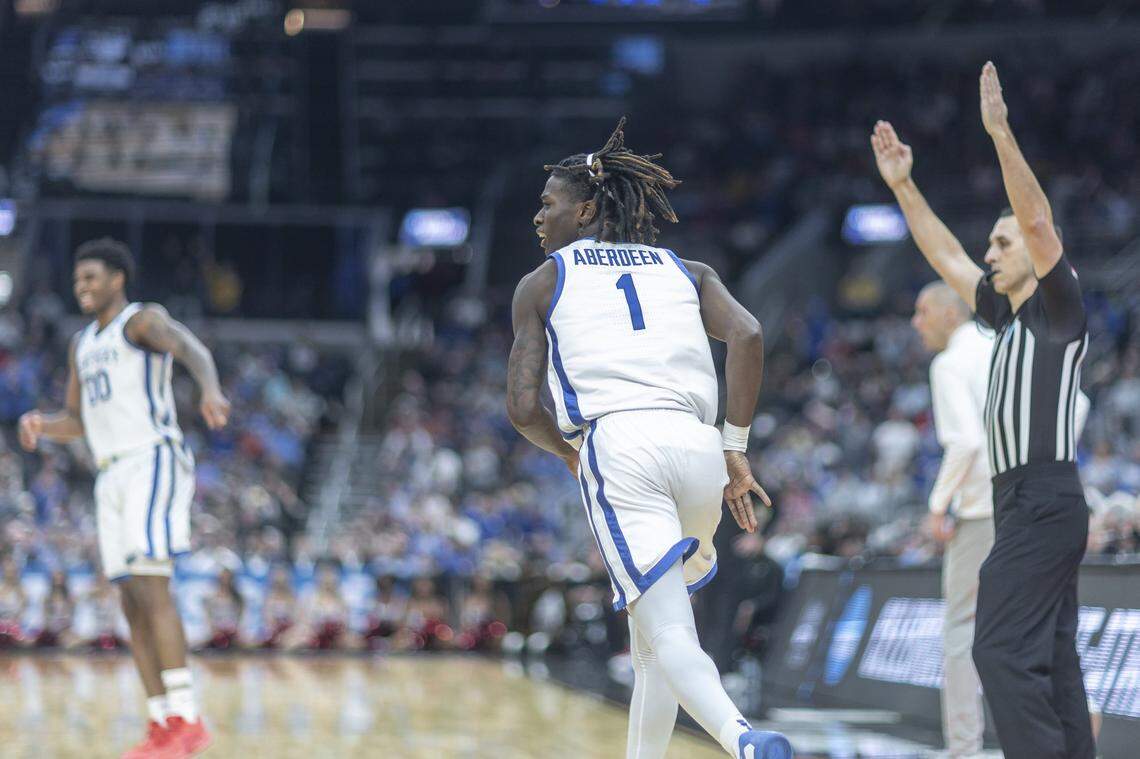
As the ball dropped through the net to give Santa Clara the lead, most players might have frozen, panicked, or hesitated. But Kentucky’s Denzel Aberdeen didn’t. Instead, he reacted immediately, recognizing a critical detail that many would overlook in such a chaotic moment.
He knew the opposing team would likely try to call a timeout.
That single realization triggered a chain of events that would ultimately save Kentucky’s season.
Without wasting even a heartbeat, Aberdeen grabbed the ball and stepped out of bounds to inbound it. His urgency wasn’t random—it was strategic. By initiating the throw-in quickly, he effectively removed Santa Clara’s opportunity to stop play and set up their defense. In a situation where every millisecond mattered, Aberdeen’s awareness gave Kentucky its only real chance.
Had he hesitated—even slightly—the outcome might have been entirely different.
Instead, the play continued.
With the clock ticking down, Aberdeen scanned the court and made another crucial decision: he found Otega Oweh. There was no time for a structured play, no time for overthinking. Just instinct and trust.
The two players locked in—whether through eye contact or sheer understanding—and Aberdeen delivered a perfectly timed pass. Not just a pass, but a leading one, giving Oweh momentum and precious space to operate.
That small detail made a massive difference.
By leading Oweh forward, Aberdeen allowed him to gather speed and position himself for a cleaner shot. It also bought just enough time for the play to develop naturally, rather than forcing a rushed, off-balance attempt.
Then came the moment that will be replayed for years.
Oweh launched a deep shot as time expired—a desperate, high-pressure attempt that carried the weight of the entire season. The ball soared through the air, kissed the backboard, and dropped through the net.
Tie game.
What had seemed impossible just seconds earlier had become reality.
The arena erupted. Kentucky had been given new life.
That shot didn’t just force overtime—it shifted momentum entirely. Riding the emotional high of the buzzer-beater, Kentucky went on to secure an 89–84 victory, completing one of the most dramatic turnarounds of the tournament.
Naturally, the spotlight fell on Oweh. His shot was the defining moment, the kind that becomes part of March Madness history. But behind that highlight was a quieter, equally important contribution—Aberdeen’s presence of mind.
He didn’t get an assist on the stat sheet. There was no official recognition for his role in the play. But those who understood the game knew the truth: without him, the shot never happens.
Interestingly, Aberdeen later revealed that his awareness wasn’t purely instinctive—it had been sharpened by prior experience. During his earlier college years, he had been part of a rules session where referees explained situations just like this one. That knowledge stayed with him, and in this defining moment, it resurfaced exactly when it was needed.
Preparation met opportunity.
Even after making the pass, Aberdeen could only watch. As Oweh raced down the court, the outcome was out of his hands. All he could do was hope.
And then, as the ball hung in the air, he had a feeling.
It might go in.
When it did, the reaction was instant—disbelief, excitement, and pure adrenaline. It was the kind of moment athletes dream about but rarely experience.
For Kentucky, it was more than just a win. It was a reminder of what makes tournament basketball so special: unpredictability, resilience, and the power of a single decision.
In the end, the buzzer-beater will live on in highlight reels and fan memories. But the play behind the play—the quick thinking, the urgency, the awareness—deserves just as much recognition.
Because sometimes, the biggest moments aren’t just about the shot that goes in.
They’re about everything that made it possible.




