


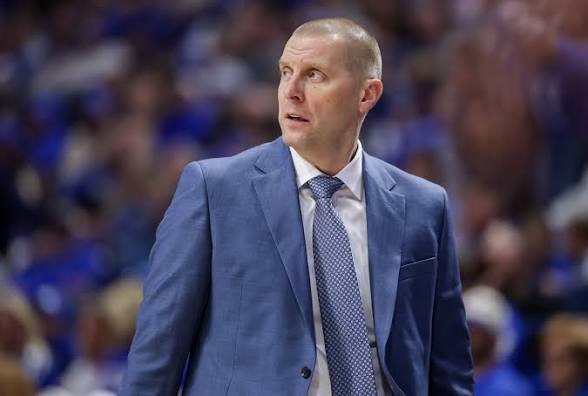
The conversation around Kentucky basketball has taken a dramatic turn in recent weeks, shifting from postseason disappointment to offseason intrigue. At the center of it all is Mark Pope, a head coach now facing one of the most defining stretches of his tenure with the Kentucky Wildcats. With speculation swirling, roster uncertainty growing, and the transfer portal window approaching, one thing is becoming increasingly clear: Kentucky’s offseason strategy could determine not just next season—but the entire trajectory of the program.
And now, fresh insight from insider Jack Pilgrim has pulled back the curtain on what may be a bold, calculated, and potentially transformative plan.
A Program at a Crossroads
Kentucky’s early exit from the NCAA Tournament still lingers like a shadow over the program. The loss to the Iowa State Cyclones didn’t just end a season—it exposed underlying issues that now demand immediate attention. For a program accustomed to deep March runs and national contention, falling short in the early rounds is never acceptable.
In the aftermath, attention quickly turned to what comes next. And what comes next may be one of the most aggressive and strategic offseasons in recent Kentucky history.
Mark Pope, now firmly in charge after succeeding John Calipari—who departed for the Arkansas Razorbacks—understands the magnitude of the moment. This isn’t just about tweaking the roster. It’s about recalibrating an entire system in a rapidly evolving college basketball landscape.
The Modern Game: Money, Movement, and Opportunity
College basketball has changed. Dramatically.
The introduction of NIL (Name, Image, and Likeness) opportunities, combined with the freedom of the transfer portal, has turned the offseason into a high-stakes marketplace. Players now move more freely, weigh financial opportunities more heavily, and expect programs to match their value.
Kentucky, like many elite programs, has had to adapt quickly.
But according to Jack Pilgrim, the Wildcats aren’t just reacting—they’re planning.
Rather than engaging in unchecked spending, Kentucky appears to be taking a more disciplined approach. The goal? Align financial investment with production, ensuring that every dollar spent translates into on-court impact.
It’s a strategy that could pay off—but also one that carries risk in a market where other programs may be willing to outbid for top talent.
Keeping the War Chest Ready
One of the most fascinating revelations from Pilgrim’s report is Kentucky’s decision to keep significant financial flexibility heading into the offseason. Instead of committing funds early, the Wildcats are preserving their resources for specific, high-impact targets.
Among those targets is Tyran Stokes, widely regarded as the No. 1 recruit in the 2026 high school class.
Landing a player of Stokes’ caliber would be a statement—not just for the future, but for the present direction of the program. It would signal that Kentucky remains a premier destination for elite talent, capable of competing with any program in the country.
But Stokes isn’t the only name on the radar.
The Dink Pate Factor
Another intriguing possibility is Dink Pate, a standout talent from the G-League pathway. Players like Pate represent a new frontier in college basketball recruiting—experienced, physically developed, and already tested against high-level competition.
If Kentucky can secure a player like Pate, it would add immediate impact and maturity to a roster that may soon be in flux.
And that’s the key word: flux.
The Transfer Portal Gamble
Perhaps the most critical element of Kentucky’s offseason plan is its approach to the transfer portal.
According to Pilgrim, Mark Pope is expected to go “big-game hunting”—particularly at the starting point guard position. This isn’t about filling gaps. It’s about securing elite talent capable of leading the team from day one.
In today’s game, the point guard is everything. Leadership, tempo, decision-making—it all flows from that position. For Kentucky, finding the right player could be the difference between another disappointing season and a return to national prominence.
But the portal is unpredictable. For every success story, there are cautionary tales. Chemistry issues, mismatched systems, and inflated expectations can all derail even the most talented additions.
That’s why Pope’s evaluation process will be crucial.
Balancing Present and Future
What makes Kentucky’s situation particularly complex is the need to balance immediate competitiveness with long-term sustainability.
On one hand, the Wildcats need to win—now. The pressure from fans, alumni, and the broader college basketball world demands it.
On the other hand, building a sustainable program requires patience, smart investments, and a clear vision.
By targeting players like Tyran Stokes while also exploring the transfer portal, Kentucky appears to be attempting both. It’s a delicate balancing act, one that will require precision and adaptability.
The Shadow of Departures
Of course, all of this planning is happening against the backdrop of potential departures.
As previously reported, several Kentucky players may be exploring their options in the transfer portal. The combination of financial considerations, playing time, and personal goals has created an environment where roster turnover is almost inevitable.
And that’s where things get tricky.
Every outgoing player creates a new need. Every new need requires a solution. And every solution comes with its own set of risks.
For Mark Pope, managing this cycle will be one of the biggest challenges of his coaching career.
The Pressure Cooker of Lexington
There’s no place quite like Lexington when it comes to college basketball.
The expectations are sky-high. The scrutiny is constant. And the margin for error is razor-thin.
Mark Pope knew this when he accepted the job. But knowing it and living it are two very different things.
Now, as he navigates a pivotal offseason, every decision will be analyzed, debated, and judged.
Can he deliver?
That’s the question on everyone’s mind.
A Defining Offseason
As the transfer portal opens and recruiting battles intensify, Kentucky’s strategy will come into sharper focus.
Will they land a marquee recruit like Tyran Stokes?
Will they secure a game-changing transfer at point guard?
Will they retain enough of their current roster to maintain continuity?
Or will the fears of a mass exodus become reality?
The answers to these questions will shape not just the next season, but the future of Kentucky basketball under Mark Pope.
The Bigger Picture
What’s happening at Kentucky is part of a larger trend in college athletics. Programs are evolving, adapting, and redefining what success looks like in a new era.
For Kentucky, the challenge is maintaining its identity while embracing change.
It’s not an easy task.
But it’s a necessary one.
Final Thoughts
Jack Pilgrim’s insights have provided a glimpse into a strategy that is both ambitious and calculated. Kentucky isn’t panicking. They’re planning.
They’re identifying targets.
They’re managing resources.
They’re preparing for a pivotal moment.
But planning alone isn’t enough.
Execution will determine everything.
And as the offseason unfolds, one thing is certain: all eyes will be on Mark Pope and the Kentucky Wildcats.
Because in a world where rosters can change overnight and fortunes can shift in an instant, this may be the offseason that defines an era.
Will Kentucky rise again—or face a deeper rebuild than anyone expected?
The answer is coming.




