


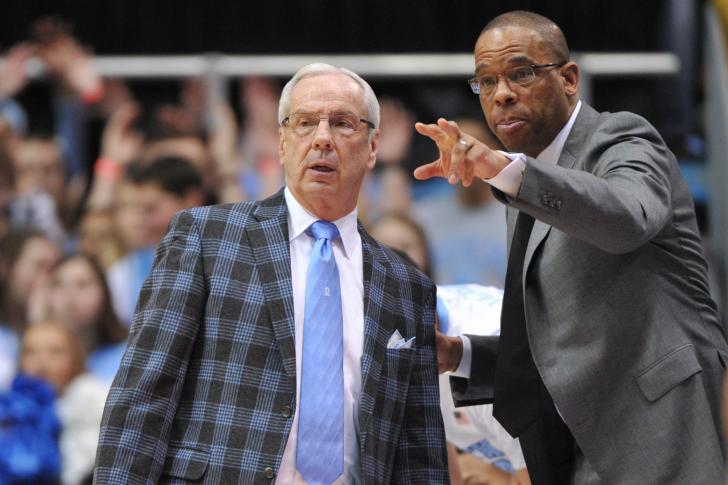
In the world of college basketball—where passion runs deep, expectations are sky-high, and every decision is magnified under a national spotlight—sometimes the loudest message isn’t delivered through words at all. Sometimes, it comes in the form of silence. And in Chapel Hill, that silence may have spoken louder than any press conference ever could.
For days, tension had been building around the future of Hubert Davis as head coach of the University of North Carolina men’s basketball program. Rumors swirled. Fans speculated. Analysts debated. The Tar Heels, one of the most storied programs in NCAA history, seemed to be at a crossroads. And in the middle of it all stood one man whose voice carries immense weight in Chapel Hill—Roy Williams.
Williams is not just a former coach. He is a symbol of North Carolina basketball excellence. A Hall of Famer. A national champion. A mentor to generations of players and coaches—including Davis himself. When Williams speaks, people listen. Which is precisely why his decision not to speak became the story.
When approached for comment during the height of the speculation surrounding Davis’ future, Williams declined. Not partially. Not cautiously. Completely. He made it clear he would talk about anything else—but not about Hubert Davis, not about the coaching situation, and not about the direction of the program.
At first glance, that might seem like a respectful move—an effort to avoid interfering in an active decision-making process. But in a place like North Carolina, where relationships run deep and loyalty is often publicly displayed, the absence of support can feel just as powerful as open criticism.
And then came the decision.
Hubert Davis was out.
Suddenly, Roy Williams’ silence didn’t feel neutral anymore. It felt loaded. Intentional. Perhaps even revealing.
The connection between Williams and Davis makes this moment even more significant. Davis was not just a successor—he was a handpicked successor. Williams trusted him enough to pass on one of the most prestigious jobs in college basketball. Their relationship spanned years, built on mutual respect, shared values, and a deep understanding of what it means to wear Carolina blue.
So when speculation began to swirl about Davis’ job security, many assumed Williams would step in. A public show of support from him could have shifted the narrative. It could have calmed the noise. It might have even influenced decision-makers behind the scenes.
But that support never came.
Instead, there was silence.
And in hindsight, that silence may have been the clearest signal of all.
Because Roy Williams understands the program better than almost anyone alive. He understands the expectations. The pressures. The standard that has been set over decades—from Dean Smith to himself and beyond. He knows what it takes to lead North Carolina. And perhaps more importantly, he knows when something isn’t working.
Was his silence a quiet acknowledgment that change was inevitable?
Was it a sign that he agreed—at least in part—with the direction the program was heading?
Or was it simply a calculated decision to stay out of a complicated and sensitive situation?
Those questions are now at the center of the conversation.
Hubert Davis’ tenure at North Carolina was anything but simple. He experienced incredible highs, including a remarkable run to the national championship game in his first season. That run reignited belief in the program and seemed to validate Williams’ decision to hand him the reins.
But sustaining success at North Carolina is a different challenge entirely.
In the seasons that followed, inconsistency became a recurring theme. There were flashes of brilliance—big wins, strong performances, moments that reminded fans of the program’s elite potential. But there were also frustrating losses, early tournament exits, and missed opportunities that gradually chipped away at confidence.
At a program like North Carolina, the margin for error is razor-thin. Success is not just expected—it is demanded. Competing for championships is not a goal; it is the standard.
And when that standard isn’t consistently met, questions begin to surface.
Those questions grew louder with each passing game, each unexpected loss, each sign that the program might not be where it needed to be. By the time speculation about Davis’ future reached its peak, the pressure had become impossible to ignore.
Still, the silence from Roy Williams stood out.
In many ways, it created a vacuum—one that fans and analysts rushed to fill with their own interpretations. Some saw it as a sign of disappointment. Others viewed it as respect for the process. A few even believed it was a subtle endorsement of the decision that was ultimately made.
What makes the situation even more intriguing is the timing.
Williams didn’t speak before the decision. He didn’t intervene publicly. And by the time the news broke, his silence had already done its work. It had shaped the narrative. It had fueled speculation. It had, in a way, prepared the basketball world for what was coming.
In leadership, timing is everything. And Roy Williams has always been a master of timing.
Throughout his career, he built a reputation not just for winning games, but for understanding moments. Knowing when to speak. Knowing when to act. And perhaps most importantly, knowing when to step back.
This may have been one of those moments.
By choosing silence, Williams avoided complicating an already delicate situation. He didn’t undermine Davis publicly. He didn’t challenge the administration. He didn’t create additional headlines that could have distracted from the program itself.
But at the same time, he didn’t provide the one thing many were expecting—support.
And that absence is what continues to resonate.
For fans, it raises uncomfortable questions. If Roy Williams—arguably the most influential figure in modern North Carolina basketball—chose not to defend Hubert Davis, what does that say about the situation behind the scenes?
Was there more going on than the public realized?
Were there concerns that never made it into headlines?
Or was this simply the reality of high-level college basketball, where even the strongest relationships can’t outweigh the demands of performance?
As North Carolina begins the process of moving forward, those questions will linger.
The program now faces a critical transition. Finding the right coach is not just about X’s and O’s—it’s about identity. It’s about culture. It’s about restoring the consistency and excellence that fans expect.
And looming over that process is the quiet presence of Roy Williams.
Even in retirement, his influence remains undeniable. His opinions matter. His perspective carries weight. And whether he chooses to share those opinions publicly or keep them private, they will shape the future of the program in ways both seen and unseen.
For Hubert Davis, the story is more complicated. Coaching at North Carolina is one of the toughest jobs in sports—not because of the lack of resources or support, but because of the expectations that come with it. Every decision is scrutinized. Every result is analyzed. Every season is measured against a legacy that includes some of the greatest moments in college basketball history.
Davis experienced both the thrill of success and the sting of criticism during his tenure. He showed flashes of brilliance and moments of vulnerability. And in the end, he became the latest example of how unforgiving the job can be.
But as the dust settles, it is Roy Williams’ silence that continues to capture attention.
Because in a world filled with noise—press conferences, social media reactions, endless analysis—silence stands out.
It forces people to think. To question. To interpret.
And in this case, it has become one of the most compelling parts of the entire story.
Did Roy Williams know something before everyone else?
Was his silence a reflection of that knowledge?
Or was it simply the choice of a seasoned leader who understood that sometimes, the best thing you can say… is nothing at all?
Whatever the answer may be, one thing is clear:
In Chapel Hill, silence doesn’t go unnoticed.
And this time, it may have said everything.




