


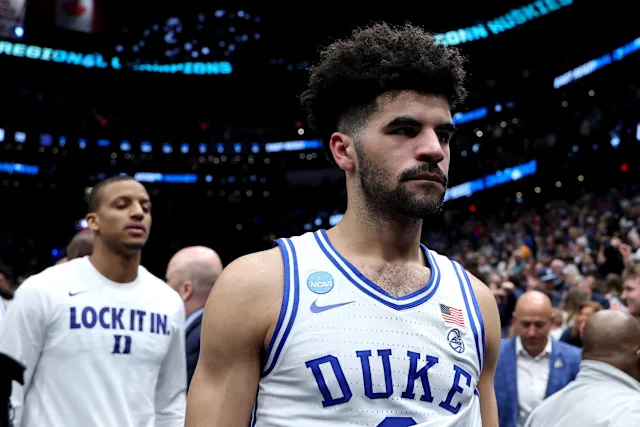
For 39 minutes and 59.6 seconds, Duke looked untouchable. The Blue Devils had survived every storm, built a commanding 19-point lead, and stood just one heartbeat away from another Final Four banner. Cameron Indoor dreams were already beginning to form in the minds of fans. Social media was preparing the celebration. The path to a national title suddenly felt real. Then, in a blink so cruel it barely feels believable, everything shattered. One tipped pass. One desperate heave. One shot that hung in the air forever before crashing through the net with 0.4 seconds left, turning Duke’s championship vision into one of the most savage March nightmares the sport has ever seen.
For Duke basketball, this was not just another tournament loss.
This was a collapse that may live forever.
A Final Four Ticket That Felt Already Punched
That is what makes this heartbreak different.
Duke did not simply lose a close game. The Blue Devils controlled it for long stretches, dictated the tempo, and forced UConn to play from behind nearly the entire night. At one point, Duke’s lead swelled to 19 points in the first half, and every possession felt like another step toward Indianapolis.
The ball movement was sharp.
The defense was locked in.
The stars were delivering.
Cameron Boozer looked every bit like the future NBA lottery pick everyone believes he is, carrying the offense whenever Duke needed stability. His supporting cast delivered key moments too, and for most of the night, the Blue Devils appeared mentally tougher, physically fresher, and strategically sharper.
For Duke fans, it felt less like survival and more like destiny.
A trip to the Final Four was right there.
So close you could almost touch it.
The Slow Collapse Nobody Saw Coming
But March Madness never warns you when the nightmare is coming.
It simply arrives.
UConn never fully disappeared. That is the terrifying thing about championship-caliber teams: they stay alive just long enough to make one final push.
The comeback slowly began to build momentum.
The 19-point lead became 14.
Then 10.
Then six.
And suddenly every Duke possession felt heavy.
The smooth offensive flow that built the lead started turning into hesitation. Passes took longer. The spacing narrowed. The urgency that had once fueled Duke now seemed to belong entirely to UConn.
This is how collapses happen.
Not all at once.
But inch by inch.
Possession by possession.
Fear by fear.
The Final Sequence That Changed Everything
Then came the final ten seconds.
The sequence Duke fans may replay in their minds for years.
UConn trailed by two and intentionally fouled, forcing Duke into a late-game possession that should have sealed the win. One clean inbound, a few free throws, and the Blue Devils were headed to the Final Four.
Instead, disaster struck.
The pass was tipped.
The loose ball bounced directly into UConn’s hands.
In one instant, control vanished.
Then came the shot.
A 30-foot prayer.
A moment that felt suspended outside time.
Then the ball splashed through the net with 0.4 seconds remaining, giving UConn its first lead since the opening basket and a shocking 73-72 victory.
Just like that, Duke’s season was over.
No overtime.
No recovery.
No second chance.
Just silence.
Why This Loss Feels Bigger Than One Game
Duke has suffered painful March exits before.
South Carolina in 2017.
Michigan State in 2019.
UNC ending Coach K’s career in 2022.
But this one carries a different kind of pain.
Because Duke did not get beaten by the better team for 40 minutes.
They got beaten by the final 0.4 seconds.
That distinction matters.
This loss will be remembered less as UConn’s miracle and more as the moment Duke stopped finishing.
The Blue Devils had every ingredient of a title team:
elite star power
defensive toughness
size
composure
momentum
coaching continuity
And still, when the pressure reached its highest point, the ending slipped away.
That is the kind of loss that lingers into offseason workouts, recruiting conversations, preseason rankings, and every late-game huddle next March.
Jon Scheyer’s Biggest March Question Yet
Fair or not, the spotlight now turns to Jon Scheyer.
This defeat denied Scheyer what would have been another Final Four appearance, and it intensifies the biggest question surrounding Duke’s modern era:
Can this program close in the biggest moments?
Scheyer has kept Duke elite.
The recruiting remains loaded.
The roster talent is obvious.
The Blue Devils continue to look like title contenders.
But at Duke, almost isn’t the standard.
The standard is banners.
And losses like this one create pressure fast.
Especially when the collapse becomes instantly historic.
The Shot That Will Haunt Duke Forever
Some March moments become immortal because of joy.
Others live forever because of pain.
For UConn, that final three is now part of tournament legend.
For Duke, it is something else.
It is the image of a season disappearing in midair.
A ball floating above thousands of hopes.
A fan base frozen between certainty and disbelief.
A Final Four dream erased before anyone could even process what happened.
The cruel beauty of March Madness is that it only takes one shot to rewrite everything.
And for Duke, that shot may echo for years.
Final Word
Duke was not just close.
They were 0.4 seconds away.
That is what makes this feel so brutal.
Not the loss alone.
But the certainty that the Final Four was already within reach.
Then one tipped pass and one impossible heave turned a championship chase into one of the most unforgettable collapses in Duke basketball history.
For Blue Devils fans, the scoreboard will always say 73-72.
But the real wound is simpler:
They were already there.
Until they weren’t.




