


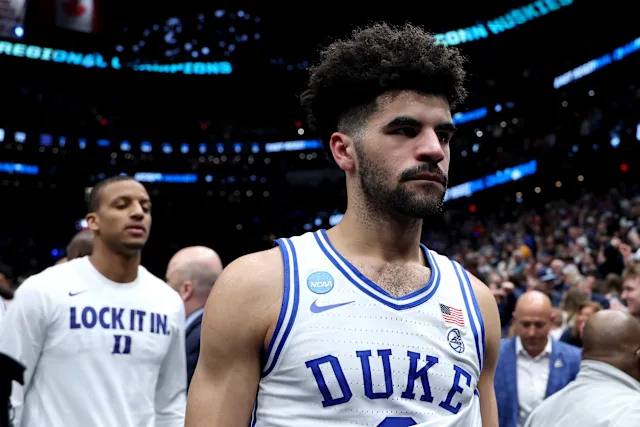
For one breathtaking moment, it looked like Cameron Boozer had committed the kind of mistake that can live forever in March Madness history.
The arena froze. The crowd gasped. Duke fans everywhere held their breath.
A free throw in the closing moments of a high-stakes NCAA tournament game is supposed to be the easiest part of the possession. Step to the line, knock it down, stretch the lead, and force the opponent into desperation mode.
But what happened in this moment didn’t follow the script.
Instead, the ball struck the rim in a way that felt almost too strange to be random. It bounced long, fast, and at a sharp angle that instantly created chaos in the lane. For a split second, panic swept through Blue Devils fans who thought they had just watched the freshman star make a devastating error.
Then the replay started making the rounds.
What first looked like a miss suddenly began to feel like something far more calculated.
The angle. The timing. The rebound lane. The positioning of Duke’s players.
Everything about it looked strangely perfect.
And within minutes, the entire college basketball world was asking one wild question:
Did Cam Boozer just turn a missed free throw into one of the smartest plays of the tournament?
That question is exactly why this moment exploded into one of Duke’s most talked-about March sequences.
The Miss That Instantly Changed the Mood
Late-game free throws usually come with one expectation: make the simple play.
Protect the lead. Drain the clock. Force the other team to play from behind.
That’s why the initial reaction was pure disbelief.
As Boozer released the shot, everything looked routine. His body language was calm, the motion smooth, and the mechanics familiar. But when the ball came off the rim, it carried with it a kind of bounce that immediately felt unusual.
It wasn’t soft. It wasn’t friendly. It didn’t even look close to the type of miss players accidentally make under pressure.
Instead, it flew off the iron with purpose, sending the rebound into a zone where Duke had a sudden advantage.
For a moment, confusion took over.
Had he simply missed badly? Did the pressure get to him? Was this the turning point that would flip the game?
Those were the first reactions.
But as the possession unfolded, the tone changed completely.
Duke was in position. The defense was caught flat-footed. The rebound lane seemed almost engineered.
And suddenly, what looked like a blunder became something much more fascinating.
Why The Replay Made It Feel Like Genius
The first watch created panic.
The second watch created curiosity.
The third watch created obsession.
That’s when this moment truly became viral.
On replay, the miss seemed too exact to ignore. The ball’s path off the rim appeared to create the perfect long rebound opportunity, one that gave Duke a split-second edge in a possession that could decide everything.
Basketball fans love moments that reward slow-motion analysis, and this was exactly that kind of play.
Every frame seemed to add fuel to the theory.
Boozer’s release didn’t look rushed. The miss didn’t drift randomly. Duke’s crash timing to the glass felt synchronized. The defenders reacted just a beat late.
The more fans studied it, the more it looked intentional.
That’s why social media exploded.
Some fans insisted it was nothing more than a lucky bounce. Others argued it was an elite-level awareness play from one of the smartest young players in college basketball.
The debate itself became the story.
Because whether intentional or accidental, the sequence was so perfectly timed that it forced people to keep coming back.
And that’s the secret behind legendary March moments.
They don’t just entertain. They invite investigation.
The Basketball IQ Behind The Sequence
What makes this play so compelling is what it suggests about Boozer’s feel for the game.
Most players in that moment are thinking about one thing only:
make the free throw.
But elite players often process the possession two or three steps ahead.
That’s what separates stars from future pros.
If the miss was intentional, it required a remarkable combination of awareness:
understanding the clock
reading rebound positioning
recognizing teammate angles
anticipating defensive movement
controlling pace under pressure
trusting instinct in chaos
That level of decision-making in a pressure-cooker tournament environment is rare.
It’s not just skill. It’s feel.
And feel is often what translates best to winning basketball.
Boozer’s biggest gift may not simply be his talent, size, or scoring package. It may be the speed at which he sees the next play before everyone else does.
That’s what this moment captured.
The game appeared to slow down for him while everyone else was still reacting.
For Duke fans, that’s the most exciting part.
It’s the type of instinct that makes championship runs possible.
Why Duke Fans Couldn’t Stop Talking About It
The emotional reaction from Duke supporters was immediate.
At first, it was fear.
Then came disbelief.
Then admiration.
That emotional swing is exactly what made the moment unforgettable.
Fans went from thinking Boozer had made a potentially fatal mistake to wondering if they had just witnessed a freshman making one of the smartest split-second plays of the tournament.
That’s a powerful shift.
Moments like this energize fan bases because they create belief.
Not just belief in one possession.
Belief in what a player represents.
For many Duke fans, this wasn’t simply about a free throw. It was about proof that Boozer thrives in pressure moments where others panic.
He didn’t just survive the sequence. He appeared to manipulate it.
That’s why the clip kept getting replayed.
Every rewatch made the possibility of intention feel more believable.
And every debate made the legend grow.
A March Madness Moment That Could Define His Rise
Every great tournament star eventually gets a signature sequence.
Sometimes it’s a buzzer-beater. Sometimes it’s a block. Sometimes it’s a game-saving steal.
For Cameron Boozer, this may become the moment fans remember as the first clear sign that his basketball mind operates on a different level.
This wasn’t flashy. It wasn’t loud. It wasn’t built for highlight reels in the traditional sense.
But it was deeply revealing.
It showcased poise. Patience. Awareness. And the ability to create opportunity from apparent disaster.
Those are qualities that matter deeply in tournament basketball.
March is built on tiny details. A strange bounce. A loose ball. A rebound angle. A half-second advantage.
Championship teams win those margins.
And Boozer seems to understand those margins instinctively.
That’s why this single free throw miss now feels bigger than the box score.
It told a story about his mind.
What This Says About Duke’s Championship Ceiling
The bigger takeaway may be what this moment says about Duke as a whole.
Championship teams almost always have one player capable of creating edges where nobody else sees one.
A weird angle. A broken possession. A rebound opportunity. A timing window too small for most players to recognize.
Those are the hidden plays that decide titles.
And Boozer continues to show signs that he thrives in those hidden spaces.
That’s what makes Duke fans so energized.
It’s not just about the free throw itself.
It’s what the moment suggests about the team’s ceiling.
When a young star can create value even in a miss, it changes how people see the entire roster.
It suggests Duke has a player who can manufacture solutions under extreme pressure.
That’s a championship trait.
Not every tournament possession will be clean. Not every shot will fall. Not every set will work perfectly.
But teams with elite problem-solvers survive the chaos.
This play felt like evidence that Duke may have exactly that kind of player.
Luck Or Brilliance? Why The Debate Makes It Better
The most fascinating part of this moment may be that nobody can say with complete certainty what Boozer intended.
And honestly, that uncertainty is what makes the story even stronger.
If it was planned, it was a masterclass in basketball IQ.
If it was accidental, it still revealed Duke’s ability to instantly capitalize on chaos.
Either way, the result remains unforgettable.
The possession changed. The momentum shifted. The crowd reacted. The internet erupted.
And people kept asking the same question over and over:
Did he really mean to do that?
That question is the engine behind every viral sports moment.
It turns a simple clip into a conversation. A conversation into a debate. A debate into a legend.
That’s exactly what happened here.
Final Word
At first glance, it looked like Cameron Boozer made the kind of mistake that could haunt a tournament run.
Then the replay hit.
Then the angle made people pause.
Then the debate exploded.
And suddenly Duke fans were no longer talking about a missed free throw.
They were talking about a moment that may have revealed the mind of a future superstar.
Whether it was genius by design or brilliance born from instinct, the result was the same:
a possession that turned panic into admiration and transformed a miss into one of the most talked-about Duke moments of the tournament.
For Blue Devils fans, the shock wasn’t the miss itself.
It was the possibility that the miss may have been the plan all along.
And if that’s true, then Cameron Boozer may already be showing the kind of basketball intelligence that defines March legends.




