


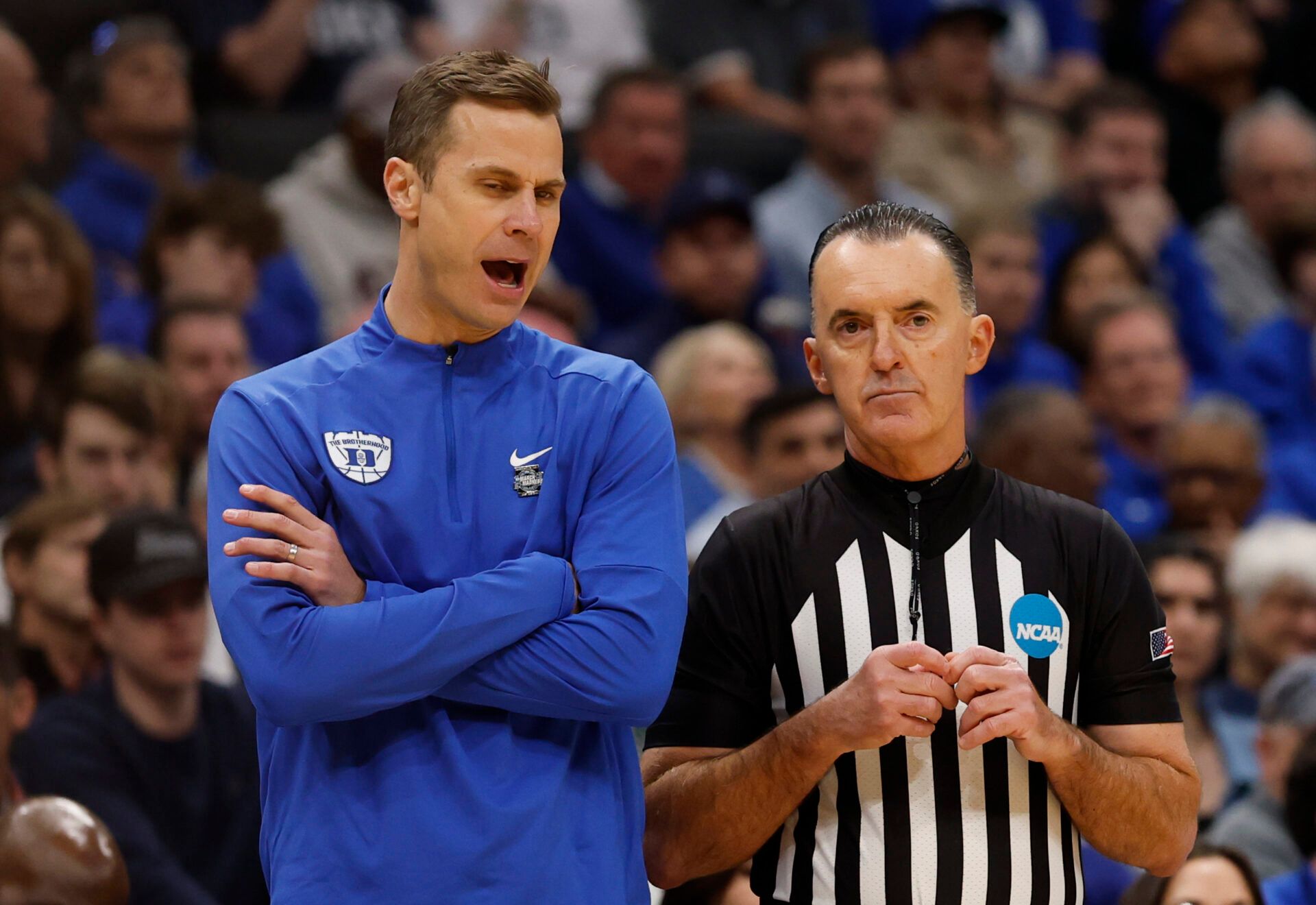
For nearly 39 minutes, it felt like Duke was marching right back to the Final Four. The Blue Devils had UConn on the ropes, the crowd could already taste another championship run, and Jon Scheyer looked poised to silence every remaining doubter in one unforgettable night. Then, in the blink of an eye, everything shattered. A careless turnover, a desperate heave from Braylon Mullins, and 0.3 seconds later Duke’s dream season was reduced to disbelief, outrage, and a tidal wave of criticism crashing directly onto Scheyer’s shoulders. What should have been a coronation instantly became a courtroom, and now the question echoing across college basketball is louder than ever: Is Jon Scheyer truly the man to carry Duke back to the throne—or is this collapse the moment that changed how he’ll be viewed forever?
Duke’s 73-72 Elite Eight loss to UConn will be remembered as one of the most painful collapses in modern March Madness history. The Blue Devils led by 19 in the first half and still appeared firmly in control late, only to watch the Huskies storm all the way back before Braylon Mullins buried a stunning 35-foot dagger at the buzzer. It was the kind of ending that instantly becomes tournament folklore—but for Duke fans, it became something else entirely: another scar in what critics are beginning to call an alarming Jon Scheyer trend.
The reaction online was immediate and ruthless.
Fans, analysts, and rival supporters flooded social media with disbelief, many focusing less on Mullins’ brilliance and more on how Duke even allowed the game to reach that moment. This wasn’t simply a loss. To many, it felt like a collapse that exposed deeper concerns about Duke’s late-game execution under Scheyer.
The criticism hit especially hard because this isn’t the first time Scheyer’s teams have watched a major March lead disappear. Just a year ago, Duke let a late Final Four lead slip away against Houston. Before that came the Elite Eight disappointment against NC State after holding a comfortable advantage. Now, this UConn defeat adds yet another painful chapter to the growing file critics keep pulling from whenever Scheyer’s postseason résumé comes up.
That pattern is what has fans truly rattled.
No one questions Scheyer’s ability to recruit. In fact, Duke remains arguably the nation’s most powerful talent magnet, continuing to land elite classes loaded with five-star prospects. Cameron Boozer and Cayden Boozer symbolize the latest wave of future stars expected to restore the program to championship glory. Yet for some fans, the frustration lies in the contrast between the talent Duke assembles and the lack of a title breakthrough.
The harshest critics are now asking whether Duke is collecting more headlines than hardware.
That’s what made this loss so combustible.
For most of the game, Scheyer looked in complete command. Duke’s size, length, and physicality overwhelmed UConn early. The Blue Devils defended with force, controlled the boards, and dictated tempo. The first-half lead ballooned to 19, and with every passing minute it felt less like a battle and more like a statement.
Then the game slowly changed.
UConn adjusted.
Dan Hurley pressed harder.
Duke’s turnovers began to pile up.
The offense tightened.
The pace got frantic.
What had once looked like control started to resemble survival.
By the final minute, the confidence inside Duke’s huddle had turned into visible tension. The crucial moment, of course, came on the late turnover that gave UConn one final chance. Instead of simply protecting possession and forcing fouls, Duke opened the door just enough for Mullins to produce March immortality.
That’s where much of the Scheyer criticism now lives.
Could Duke have called timeout?
Should the ball simply have been held?
Why wasn’t there a safer outlet?
Why did the Blue Devils allow pressure to dictate the final seconds?
These are the questions that now define the conversation.
To be fair, Scheyer himself did not hide from the pain afterward. His postgame comments revealed a coach still trying to process the emotional wreckage of what had happened. He admitted he didn’t have the words, emphasizing that the loss was not about one single play but a collection of mistakes that snowballed into disaster.
That honesty matters.
But honesty doesn’t quiet a furious fan base in the immediate aftermath of a historic collapse.
Some Duke supporters are still backing Scheyer strongly, pointing to the larger picture: back-to-back 35-win seasons, consistent top seeding, deep tournament runs, ACC success, and a program that has remained nationally elite despite the impossible task of following Mike Krzyzewski. Many fans argue the criticism is emotional overreaction driven by the cruelty of the tournament’s single-elimination format.
And that argument carries real weight.
Scheyer is only 38.
He has already reached a Final Four.
He continues to recruit at an absurd level.
Duke is still in the national title conversation every single season.
That is not failure by any normal standard.
The problem, however, is that Duke does not live by normal standards.
At Duke, greatness is measured in banners.
At Duke, Elite Eights can still feel incomplete.
At Duke, a 35-win season without a championship can somehow become ammunition.
That’s the burden Scheyer inherited.
And losses like this make that burden feel even heavier.
The cruel irony is that this may actually have been one of Scheyer’s best coaching seasons overall. Duke evolved stylistically, adapted to injuries, and once again looked like the most dangerous team in the field for long stretches. They were dominant enough to earn the tournament’s top overall seed and powerful enough to build a historically “safe” halftime lead over UConn.
But March doesn’t remember the first 38 minutes.
It remembers the last shot.
And Braylon Mullins made sure this one will haunt Durham for a very long time.
For Scheyer, the biggest challenge now is not just tactical growth—it is narrative management. Fair or unfair, every future March game will now carry the shadow of Houston, NC State, and now UConn. The next time Duke builds a double-digit lead in the second weekend, the conversation will begin immediately.
Can they finish this time?
That’s the shadow of repeated heartbreak.
Still, writing Scheyer off now would be wildly premature.
History is filled with great coaches who endured devastating tournament collapses before eventually breaking through. Even legends needed painful lessons before they learned exactly how to navigate the chaos of March’s final possessions.
Scheyer may simply be in that stage of his evolution.
And if that’s true, this crushing loss could become less of a condemnation and more of a turning point.
Because sometimes the shot that breaks a season becomes the shot that hardens a coach.
That possibility is why this story remains so fascinating.
Yes, the critics are louder than ever.
Yes, the mistakes were real.
Yes, the blown lead will live in tournament history.
But the deeper truth is that Duke is still close.
Painfully close.
Close enough that one different decision, one safer pass, one secured rebound, or one missed 35-footer changes this entire narrative from “collapse” to “Scheyer’s redemption.”
Instead, he now enters the offseason carrying the loudest scrutiny of his tenure.
The pressure won’t ease.
The expectations won’t soften.
The questions will only grow.
And that is exactly why next season may become the most important chapter of Jon Scheyer’s Duke career.
Because after a loss this devastating, the only response that truly silences the noise is cutting down the nets.




