


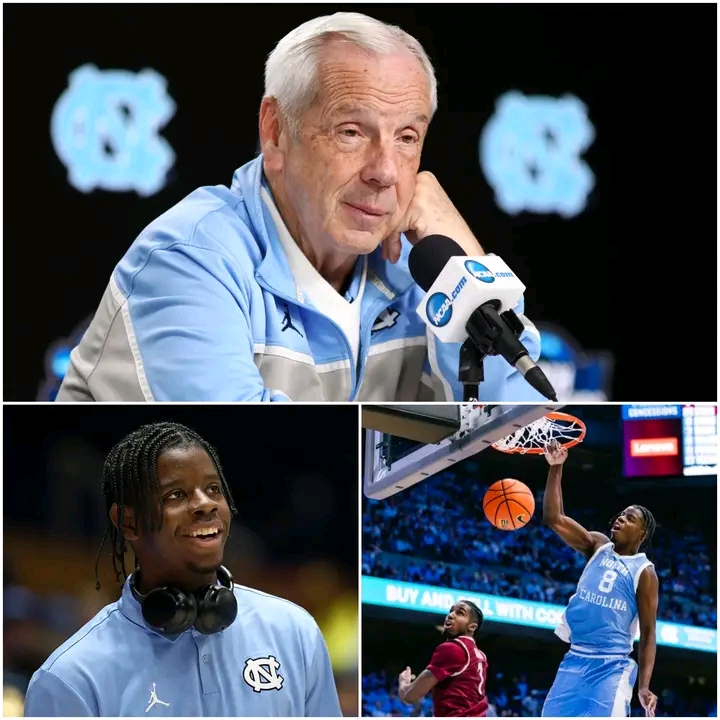
ROY WILLIAMS BREAKS THE SILENCE: With Tears in His Voice and Fire in His Words, the UNC Legend Delivers a Message That’s Shaking Chapel Hill—And For Caleb Wilson, Everything Just Changed
CHAPEL HILL, NC — For weeks, the noise had been building.
Frustration. Criticism. Questions without clear answers.
And in the middle of it all stood Caleb Wilson—a young player suddenly carrying the weight of a season that didn’t end the way anyone in Chapel Hill expected.
But on a night that felt different from the start, something shifted.
Because Roy Williams—a figure who rarely steps into the spotlight without purpose—decided he had seen enough.
And when he spoke, it wasn’t quiet.
It wasn’t cautious.
It was raw.
A Voice That Still Commands the Room
There are voices in college basketball that carry authority.
And then there’s Roy Williams.
A Hall of Fame coach. A national champion. A symbol of everything North Carolina Tar Heels men’s basketball has represented for decades.
So when he steps forward—especially in a moment of tension—people don’t just hear him.
They feel it.
And this time, what they felt was emotion.
Real emotion.
“How Can People Be So Cruel?”
It was the question that cut through everything.
Simple. Direct. Unfiltered.
Those who witnessed the moment say Williams’ voice carried both frustration and disbelief—not at the losses, not at the setbacks—but at the way the conversation had turned.
Because for him, the criticism surrounding Caleb Wilson had crossed a line.
Not into analysis.
But into something more personal.
The Backdrop Everyone Knows—But Few Are Talking About Correctly
The situation itself isn’t complicated.
Wilson was one of the most important players on the roster.
A 5-star talent expected to help lead North Carolina Tar Heels men’s basketball deep into March.
Then came the injuries.
A hand issue. A thumb setback. And suddenly, the Tar Heels were without their centerpiece at the worst possible time.
From there, everything unraveled.
Losses piled up.
Momentum disappeared.
And eventually, the season ended in a way that left fans searching for answers.
When Frustration Turns Into Targeting
In moments like that, frustration needs somewhere to go.
And too often, it lands on individuals.
For Wilson, that meant becoming a focal point—not because of what he did wrong, but because of what he couldn’t control.
His absence.
His timing.
His role in a season that slipped away.
But as Roy Williams made clear, there’s a difference between disappointment and blame.
And in his view, that line had been crossed.
A Defense That Felt Personal
This wasn’t a generic show of support.
It felt personal.
Williams didn’t just defend Wilson as a player—he defended him as a person.
A young athlete navigating pressure, expectation, and circumstances far beyond his control.
And in doing so, he reframed the conversation.
Because suddenly, this wasn’t about missed opportunities or what-ifs.
It was about perspective.
Why This Moment Is Going Viral
Part of what’s driving the reaction is how rare moments like this are.
In an era of carefully managed statements and controlled messaging, what Williams delivered felt different.
Authentic.
Unfiltered.
Real.
That authenticity has resonated—not just with fans of North Carolina Tar Heels men’s basketball, but across the broader college basketball community.
Because the message goes beyond one team.
Beyond one player.
It speaks to the culture of the sport itself.
The Bigger Issue Beneath the Surface
At its core, Williams’ message touches on something deeper:
How do we treat athletes in moments of failure or adversity?
In today’s world, criticism is instant.
Relentless.
Public.
And often, it lacks context.
For players like Caleb Wilson, that means navigating not just the game—but everything that comes with it.
Expectations.
Scrutiny.
And sometimes, unfair judgment.
A Program in Transition—And a Reminder of Its Identity
This all comes at a critical time for North Carolina Tar Heels men’s basketball.
A coaching change.
A roster in flux.
A future still being defined.
In moments like this, voices like Williams’ serve a different purpose.
They don’t solve problems.
But they remind people what the program stands for.
Respect.
Accountability.
And understanding.
What Happens Now?
It’s unlikely that one speech will silence every critic.
That’s not how sports—or conversations—work.
But something has changed.
The tone.
The perspective.
The awareness.
Because when someone like Roy Williams speaks with that level of conviction, it forces people to pause.
To reconsider.
To look at the situation differently.
The Final Takeaway
In the end, this wasn’t just about defending a player.
It was about challenging a mindset.
A reminder that behind every headline, every stat line, every moment of criticism, there’s a human being.
Still learning.
Still growing.
Still trying.
And sometimes, all it takes is one voice—powerful enough, honest enough—to bring that reality back into focus.
Right now, that voice belongs to Roy Williams.
And whether people agree or not, one thing is certain:
The conversation in Chapel Hill will never sound quite the same again.




