There are heartbreaking losses, and then there are the kind of defeats that leave an entire basketball world frozen in disbelief. Duke’s devastating Elite Eight collapse against UConn was not just another March Madness exit—it felt like the kind of moment that will be replayed, debated, and emotionally dissected for years to come. What made it even more powerful was the reaction from legendary former head coach Mike Krzyzewski, whose words after the game carried the weight of decades of championship battles, triumphs, and painful lessons.
For many fans, the shocking ending was already enough to spark endless conversation. Duke had control. The Blue Devils had the momentum, the confidence, and what looked like a clear path to the Final Four. Then, in a matter of moments, everything changed. A huge lead disappeared, the pressure intensified, and the final sequence unfolded in a way that felt almost too dramatic to believe. Yet what truly deepened the emotional impact was hearing Coach K describe just how much the loss affected him.
Krzyzewski admitted that the game was so heartbreaking he struggled to sleep afterward. That simple confession instantly reminded fans that while he may no longer be on the sideline, his emotional connection to Duke basketball remains as strong as ever. His words were not just those of a retired legend offering analysis—they sounded like the voice of someone still deeply invested in every possession, every mistake, and every dream tied to the Blue Devils.
The collapse itself was brutal in every sense. Duke once led by 19 points, a margin that normally suggests control, comfort, and near-certainty in a high-stakes NCAA Tournament battle. Against a team as dangerous as UConn, however, no lead is truly safe. The Huskies kept fighting, slowly chipping away possession by possession, turning defensive stops into confidence and missed Duke opportunities into momentum swings.
As the game tightened, the atmosphere changed completely. What once looked like a Duke celebration in waiting suddenly transformed into pure tension. Every missed shot became magnified. Every turnover carried enormous consequences. The Blue Devils, once playing loose and confident, began to look like a team feeling the crushing weight of expectation.
Coach K reportedly focused heavily on the emotional side of what happened, particularly for young star Cayden Boozer. The late turnover that directly led to Braylon Mullins’ dramatic game-winning shot instantly became the defining image of the night, but Krzyzewski’s perspective was far deeper than blaming one moment or one player. He emphasized that collapses of this magnitude are never created by a single possession alone.
That is what makes his reaction so compelling. Instead of reducing the loss to one heartbreaking mistake, he pointed toward the buildup—the live-ball turnovers, the missed chances to extend the lead, the inability to stop UConn’s growing rhythm, and the collective breakdown that allowed the game to even reach such a fragile point.
This is where the real painful truth may lie.
Duke did not lose solely because of the final play. The final shot was only the explosion at the end of a fuse that had already been burning for several minutes. UConn’s relentless pressure forced Duke into the kind of mistakes that championship teams simply cannot afford in the closing moments of an Elite Eight showdown.
Braylon Mullins’ game-winner with just fractions of a second remaining instantly entered tournament lore. It was the type of shot that transforms a player into a March legend overnight. For UConn, it was ecstasy. For Duke, it was devastation. And for Coach K, it was the kind of ending that stays in the mind long after the arena empties.
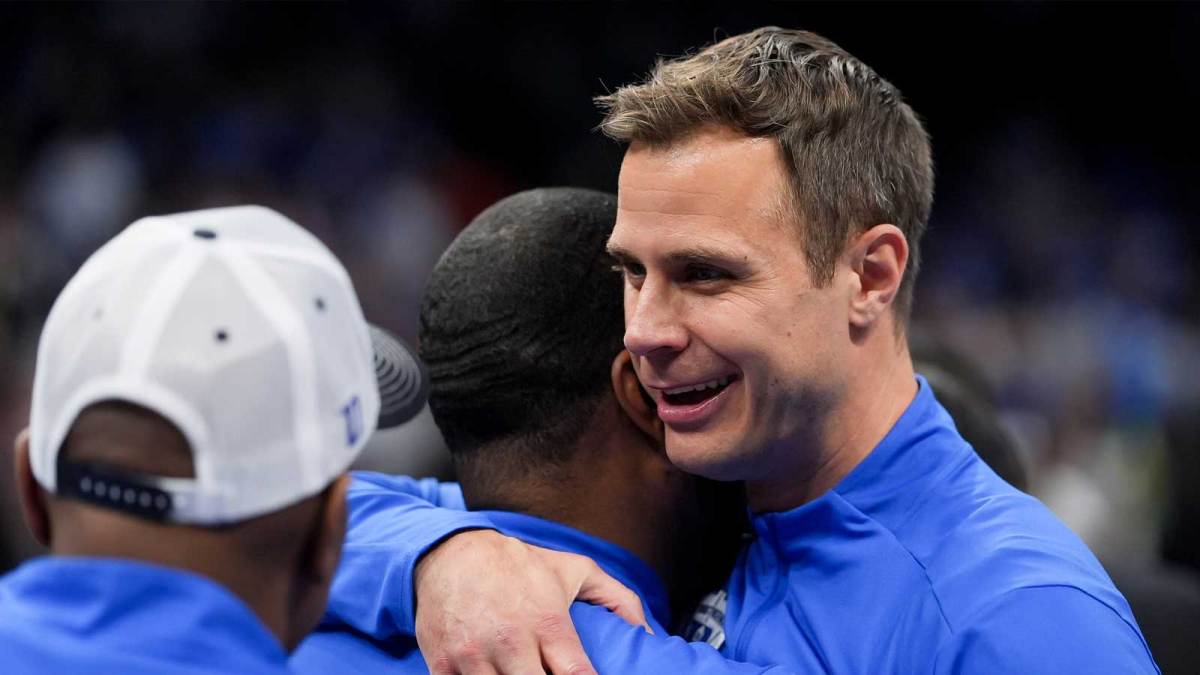
What makes this moment even more fascinating is what it may reveal about Duke’s future under Jon Scheyer. Krzyzewski openly praised Scheyer’s response, especially the way he prioritized supporting his players emotionally in the immediate aftermath. That detail matters because in college basketball, the mental recovery after a crushing tournament loss can shape the next season just as much as roster talent.
Scheyer now faces the difficult task of turning pain into fuel.
The Blue Devils were not supposed to go out this way. This season had all the signs of something special. The talent was undeniable, the chemistry looked strong, and many believed Duke had the perfect blend of youth, athleticism, and coaching to make a national title run. That is exactly why the collapse feels so enormous—it was not just a loss, but the sudden destruction of what seemed like a championship path.
For fans, the hardest part is replaying the “what ifs.”
What if Duke had slowed the pace and protected the ball better? What if one defensive stop had come a possession earlier? What if the Blue Devils had converted just one more key basket while the lead was shrinking? March Madness is built on moments like these, where a season’s worth of brilliance can be overshadowed by 30 seconds of chaos.
Krzyzewski understands that reality better than almost anyone in the sport. His legendary career was filled with both miraculous wins and devastating losses, which is why his words carried such credibility. When he described the game as “great” despite the pain, he was acknowledging the cruel beauty of tournament basketball itself—the very thing that makes it unforgettable.
A game can be brilliant and brutal at the same time.
That contradiction perfectly describes Duke’s night against UConn.
For much of the game, Duke looked every bit like a Final Four team. Their ball movement was sharp, their defensive energy was suffocating, and their confidence radiated through every run. But tournament basketball often punishes even the slightest lapse, and once UConn sensed vulnerability, the Huskies attacked with the urgency of a team refusing to let its season end.
The comeback did not happen by accident. UConn’s defensive pressure intensified, forcing Duke into rushed decisions and live-ball mistakes that turned into immediate transition chances. Those sequences were the real turning point. Every easy basket for UConn not only cut into the lead but also increased the emotional pressure on Duke’s young roster.
That pressure is where experience becomes everything.
The final minutes exposed just how thin the line is between control and collapse. One team tightened up, the other loosened into fearless execution. Suddenly, the game belonged to UConn, and Duke was left trying to survive the storm rather than dictate the outcome.
Then came the final dagger.
Mullins rose, released, and delivered the shot that shattered Duke’s season in an instant.
It was the kind of ending that no fan of the Blue Devils will ever forget.
Yet beyond the heartbreak, there may be a bigger story forming. Sometimes the most painful tournament losses become the foundation for future greatness. Coach K’s own career included devastating exits that later fueled championship runs. That is why his perspective on this collapse feels so important. Hidden inside the pain may be the exact lesson this Duke team needed.
For Cayden Boozer, the spotlight will naturally be intense because of the turnover that led to the final sequence. But if Krzyzewski’s reaction teaches anything, it is that great players are defined less by the mistake and more by what they become after surviving it. March heartbreak has a way of forging resilience, leadership, and hunger that can elevate stars to another level.
The same may be true for Jon Scheyer.
Moments like this test a coach’s long-term vision. It is easy to manage success. It is much harder to guide a program through devastation while preserving confidence, belief, and ambition. Scheyer’s response in the days ahead could determine whether this collapse becomes a scar or a spark.
For the Duke fanbase, emotions remain raw. Some see the collapse as a missed golden opportunity. Others view it as a painful but necessary stage in Scheyer’s growth as the leader of one of college basketball’s most demanding programs. Either way, the loss has already become one of the defining Duke tournament moments of this era.
And perhaps that is why Coach K’s words continue to resonate so strongly.
When a legend who has seen everything says he could not sleep after the game, it validates just how seismic the loss truly was. This was not ordinary disappointment. It was the kind of emotional earthquake that shakes players, coaches, alumni, and fans alike.
Still, buried inside the heartbreak is a lingering sense of unfinished business.
This Duke team proved it has championship-level stretches. The collapse against UConn does not erase the brilliance shown throughout the season. If anything, it amplifies the hunger that could define what comes next.
The cruel mystery of March is that one ending can rewrite the entire memory of a season. But sometimes that same ending becomes the opening chapter of a much bigger redemption story.
That may be the real reason Coach K’s reaction matters so much.
His heartbreak was genuine, but so was the hidden message inside it: devastating losses are not the end unless you allow them to be.
For Duke, the pain of this collapse may linger all offseason. The images of the blown lead, the turnover, and Mullins’ unforgettable three will remain impossible to escape. Yet if this team and coaching staff respond the right way, this exact night could become the spark that drives them back stronger, tougher, and more determined.
That is what makes this story so impossible to look away from.
It is not just about how Duke collapsed.
It is about what this collapse could create next.
And if Coach K’s emotional reaction is any indication, the next chapter may carry even more intensity, pressure, and purpose than anyone expects.