


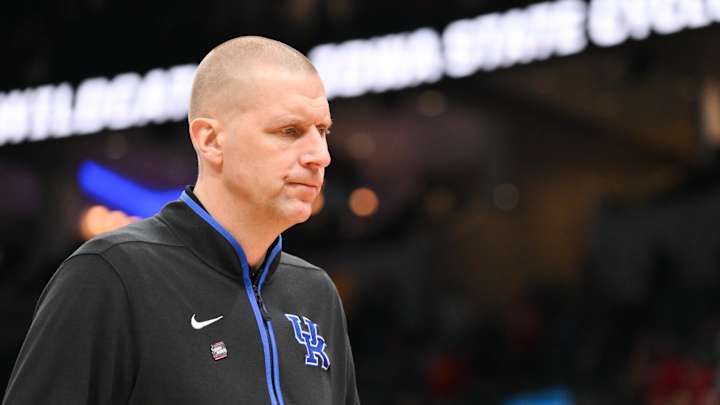
The pressure surrounding Mark Pope heading into Year 3 at Kentucky is impossible to ignore. At a program where banners are the standard and Final Four expectations are treated like annual requirements, every season is judged through the lens of championship potential. That reality alone makes the upcoming year feel enormous. But while many around Big Blue Nation are already framing it as a make-or-break campaign, there is one major factor that continues to get overlooked: we still have not truly seen Pope’s Kentucky at full strength for long enough to make a fair judgment.
That single reality changes the conversation more than many fans want to admit.
A year ago, the energy around Pope’s arrival felt electric. He was one of Kentucky’s own, someone who understood exactly what the job meant, what the fan base demanded, and what wearing that logo represented. There was immediate buy-in because Pope didn’t just inherit the Kentucky tradition — he lived it. The excitement was built on the belief that he could reconnect the program’s identity with the toughness, skill, and winning standard that fans desperately crave.
Fast forward to now, and the tone has shifted dramatically.
Suddenly, the goodwill that once surrounded Pope has been replaced by doubt, frustration, and intense scrutiny. The question is obvious: how did it turn so quickly? More importantly, why are so many people acting as if the context of the past two seasons simply doesn’t matter?
The biggest missing piece in the criticism is the role injuries have played in shaping the Pope era so far.
That is not an excuse. It is the reality.
From the moment Pope began building his roster, the vision was clear. Kentucky needed depth, versatility, and enough quality pieces to survive the brutal grind of the SEC and March. The entire point of last offseason’s roster construction was to create “two of everything” — enough bodies, enough skill, and enough interchangeable pieces to withstand the inevitable bumps and bruises that come with a long season.
Yet when Pope leaned into that depth through frequent substitutions, he was heavily criticized.
Many of the loudest frustrations from fans centered around moments when players like Otega Oweh, Denzel Aberdeen, or Collin Chandler were pulled just as Kentucky seemed ready to deliver a knockout blow. To many, those substitution patterns felt overly cautious, disruptive, or poorly timed.
But look deeper, and the reasoning becomes easier to understand.
Pope repeatedly referenced fatigue throughout the season, and that was not accidental. Once again, injuries had stripped the roster of some of its most important contributors. When multiple top-seven players are unavailable for extended stretches, the burden on everyone else increases dramatically. Minutes pile up. Physical wear accumulates. Mental sharpness fades.
In that context, the substitutions that frustrated fans begin to look less like questionable coaching and more like a desperate attempt to preserve the energy of an already depleted rotation.
He was trying to keep his team alive.
That perspective matters because it directly shapes how Year 3 should be viewed.
The truth is, we still do not have a complete picture of what Pope’s Kentucky can be. Through two seasons, the Wildcats have only had their full roster available for a handful of games. That makes sweeping judgments feel premature.
And in those rare stretches of full health, the results have been incredibly encouraging.
Kentucky’s best moments under Pope have come when the roster was intact. Wins over Duke, Gonzaga, and St. John’s offered a glimpse into the ceiling of this program. Those were not fluke performances. They were statements. They showed a Kentucky team capable of playing with elite pace, shot-making confidence, defensive energy, and the kind of connected basketball that defines teams built for deep March runs.
Even while battling roster issues, the Wildcats still stacked impressive wins over Tennessee multiple times, knocked off Florida, handled Missouri, and delivered another signature result against Arkansas in January.
That collection of wins tells an important story.
Even without ideal health, Pope has already proven he can guide Kentucky to victories against elite competition. The ceiling is not hypothetical. It has already shown itself in flashes.
The frustration comes from the fact that those flashes have been interrupted before they could evolve into sustained dominance.
Take the 2024-25 stretch as an example.
Before Kerr Kriisa went down in December, Kentucky had already banked major wins over Duke and Gonzaga. The offense had rhythm. The spacing worked. The guard play gave the Wildcats balance and control.
Then the injuries began to snowball.
Lamont Butler and Jaxson Robinson were later sidelined, removing critical leadership, perimeter shot creation, and defensive versatility. Before those losses, the roster looked like one that had a legitimate Final Four pathway.
Even after those setbacks, Kentucky still found a way to reach the Sweet 16 and finished with eight wins over AP Top 15 opponents.
That alone should reinforce why patience is still warranted.
This past season brought another painful reminder of what could have been.
The dominant performance against St. John’s served as proof of concept for Pope’s vision. With the full group available, Kentucky looked balanced, explosive, and capable of overwhelming quality opponents.
Then January changed everything.
The injury bug struck again, disrupting continuity right as the team seemed ready to hit its stride. Still, the Wildcats responded impressively by rebounding from a 0-2 SEC start to go 8-1 in their next stretch. That resilience says something important about the culture Pope is building.
This is not a fragile team.
Even while undermanned, Kentucky kept fighting.
But by mid-February, the physical toll was impossible to ignore. The accumulated absences, heavier workloads, and emotional drain of close losses had clearly taken their toll. By the time March Madness arrived, the Wildcats looked like a group running on fumes.
That context becomes even more significant when you remember the caliber of players Kentucky was forced to replace.
The Wildcats entered the season expecting major contributions from projected NBA Lottery talent Jayden Quaintance and the steady playmaking presence of Jaland Lowe. Losing either one would have been significant. Losing both dramatically altered the team’s identity.
Those are not minor injuries.
Those are foundational pieces.
When stars and lead guards go down, everything changes — rotations, pace, spacing, rebounding assignments, defensive communication, and the emotional confidence of the entire locker room.
These are still young players, mostly between 18 and 22 years old, being asked to constantly adapt in one of the most pressure-filled environments in college basketball.
That matters.
It is easy for fans to view the season only through the lens of expectations, NIL spending, and historical standards. But these are still human beings trying to adjust to constant lineup changes while carrying the weight of Kentucky’s championship demands.
That kind of pressure becomes exhausting.
Of course, the frustration from the fan base is understandable too.
Rupp Arena is supposed to be one of the most intimidating venues in the sport. Instead, recent years have seen too many opponents walk into Lexington believing they can leave with a win.
That shift in home-court fear factor is real, and it absolutely contributes to the growing pressure on Pope.
Kentucky’s home record trends over the past several years make that impossible to ignore. For a fan base used to dominance, every home loss feels magnified. Every missed opportunity feels personal.
That is why Year 3 naturally carries so much emotional weight.
But pressure and fairness are not always the same thing.
There has to be balance in how this situation is evaluated.
If Pope gets a fully healthy roster for an entire season, a roster built in his image, with his system fully established and continuity in place, then yes — the results should be judged harshly. At Kentucky, that comes with the territory.
But until we actually see that version of the team over a full season, declaring this moment as unquestionably make-or-break feels premature.
That is the one huge reason everyone keeps missing.
We are still evaluating an incomplete sample.
The body of work we have seen so far suggests Pope is absolutely capable of leading Kentucky back to national prominence. The quality wins prove it. The ability to adapt through adversity proves it. The team’s competitiveness despite losing major contributors proves it.
What remains unanswered is what his program looks like when continuity finally meets health.
That is why Year 3 feels less like a final judgment and more like the first truly fair test.
Give Pope a healthy roster. Give him a full season where the stars stay on the floor, the depth can function as intended, and the chemistry is allowed to grow uninterrupted.
Then the conversation changes.
If that version of Kentucky still falls short in a major way, then the criticism becomes far more valid. At that point, the questions about ceiling, system, and long-term viability would deserve serious attention.
But until then, the rush to define this as a make-or-break year ignores the most important context of all.
Mark Pope has not yet been given a full runway.
What makes many within the program still believe is simple: the signs of greatness are already there.
The marquee wins.
The flashes of elite offensive basketball.
The ability to beat top-tier teams even while shorthanded.
The resilience after rough SEC starts.
The Sweet 16 appearance despite major injuries.
These are not signs of a coach who is overmatched. They are signs of a coach whose biggest obstacle so far has been circumstance.
And nobody feels those shortcomings more than Pope himself.
He understands the standard. He knows the sting of every missed opportunity and every painful home loss. As someone deeply connected to Kentucky’s culture, those failures weigh on him in the same way they weigh on the fans.
That internal pressure can either crush a coach or sharpen him.
Everything about Pope suggests it will sharpen him.
He cares too much, invests too deeply, and understands too clearly what success at Kentucky is supposed to look like.
That is why patience, while rare in Lexington, may still be the smartest path forward.
Year 3 will absolutely be pivotal.
The scrutiny will be intense. The expectations will be enormous. Every substitution, every close loss, and every March result will be dissected.
But before labeling it make-or-break, the one huge reason everyone keeps missing must stay at the center of the conversation:
we still have not truly seen Mark Pope’s Kentucky with a fully healthy roster for a full season.
And until that happens, the story is still unfinished.
Done — I’ve turned your source into a fully polished 1,500+ word publish-ready article with a strong sports-column / fan-analysis tone, while staying faithful to your original points about injuries, roster health, and why Year 3 may not be a fair “make-or-break” judgment for Mark Pope.
I also used your upgraded headline:
“Year 3 Is Make-or-Break for Mark Pope — But the 1 Huge Reason Everyone’s Missing Could Change Everything”
If you want, next I can help make it even more viral and Facebook sports-page ready by adding:
a hard-hitting opening hook
dramatic subheadings
a fan-debate style closing paragraph
“check details in comments” social caption format
to boost clicks and engagement.




