


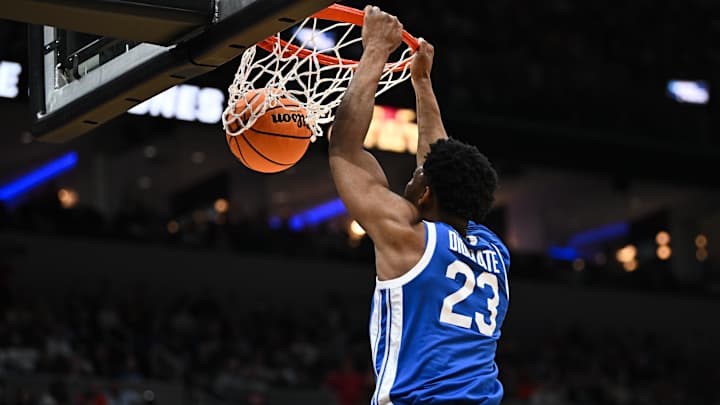
The Kentucky Exodus Just Lost Its Toughest Defender: Mouhamed Dioubate Becomes the 4th Wildcat to Hit the Portal – And His Departure Reveals a Deeper Problem for Mark Pope. He Was Supposed to Fit… So What Changed?
The list keeps growing.
And with each new name, the questions in Lexington get louder.
On Monday, Mouhamed Dioubate officially became the fourth player to enter the transfer portal from Kentucky Wildcats men’s basketball this offseason—joining a wave of departures that is quickly reshaping the program.
But unlike some of the others, this one feels different.
Because Dioubate wasn’t just another rotation piece.
He was supposed to be the answer.
A Fit That Made Too Much Sense… On Paper
When Dioubate arrived in Lexington, the logic was clear.
A rugged, physical forward with defensive toughness. A player who had shown flashes of perimeter shooting. A competitor who could bring edge and intensity to a roster still searching for identity.
For Mark Pope, he checked important boxes—especially for a team that needed grit.
And early on, the belief was mutual.
“I know how much trust coach puts in me,” Dioubate said before the season.
“He keeps telling me to be aggressive.”
Aggression was never the issue.
But everything else?
That’s where things began to unravel.
The Problem No One Could Ignore
Kentucky didn’t just struggle this season—they struggled in very specific ways.
Spacing. Shooting. Offensive flow.
And Dioubate, fairly or unfairly, became part of that conversation.
Despite entering the season with a reputation as a developing stretch option, the results told a different story. Opponents adjusted quickly, daring him to shoot—and often winning that gamble.
The numbers were hard to overlook.
Defenses sagged. Driving lanes disappeared. Offensive sets stalled.
And suddenly, a player brought in to help balance the floor was becoming part of what tilted it.
Effort Was Never the Question
If there’s one thing no one inside the program questions, it’s Dioubate’s effort.
He played hard. He defended. He attacked the rim with force.
In many ways, he embodied the physical identity Kentucky wanted.
But modern college basketball isn’t built on effort alone.
It’s built on fit.
And that’s where things became complicated.
When Pieces Don’t Quite Connect
Basketball, at its highest level, is often about chemistry as much as talent.
And Kentucky’s roster, at times, felt like pieces that didn’t fully connect.
Lineups featuring multiple non-shooters created congestion. Ball movement slowed. Spacing collapsed.
Players like Dioubate, Brandon Garrison, and Otega Oweh often found themselves operating in the same areas—crowding the paint instead of stretching it.
The result?
An offense that never quite found rhythm.
And players who, individually, may have fit… but collectively, didn’t.
So Why Leave Now?
By itself, Dioubate entering the portal isn’t shocking.
But the timing—and the pattern—are.
He’s now the fourth Wildcat to make that move, joining Jaland Lowe, Brandon Garrison, and Jasper Johnson.
That’s not coincidence.
That’s transition.
Sources around the program suggest Mark Pope is aggressively pursuing a different roster identity—one built around spacing, shooting, and immediate offensive efficiency.
If that’s the case, the message is clear:
Fit matters more than potential.
And for players who don’t perfectly align with that vision, roles can change quickly.
The Bigger Concern No One Is Saying Out Loud
Here’s the uncomfortable question:
Was this just about Dioubate… or is it about something deeper?
Because when multiple players exit in a short span—especially ones expected to contribute—it raises concerns beyond individual performance.
Roster construction.
System fit.
Development timelines.
All of it comes into focus.
And while the transfer portal era has normalized movement, this kind of clustering still signals something bigger.
A Reset in Real Time
What’s happening at Kentucky Wildcats men’s basketball isn’t just turnover.
It’s a reset.
Mark Pope isn’t tweaking around the edges—he’s reshaping the core.
That means bringing in players who fit immediately. Players who don’t need time to adjust. Players who can deliver results now.
It’s a bold approach.
But it comes with pressure.
Because when you move on from players who bring toughness and defensive presence, you have to replace more than just production—you have to replace identity.
What Comes Next for Dioubate
For Dioubate, the next chapter could look very different.
There will be interest—plenty of it.
A forward with his physicality, defensive mindset, and willingness to compete is valuable. In the right system—one that better complements his strengths—he could thrive.
Sometimes, it’s not about ability.
It’s about environment.
And What Comes Next for Kentucky
For Kentucky, the stakes just got higher.
Every departure adds urgency. Every roster spot becomes more critical.
Because rebuilding through the portal isn’t just about adding talent—it’s about getting it right.
And if the fit still isn’t there?
The cycle continues.
The Question That Still Lingers
Dioubate was supposed to help define this team.
Instead, he’s now part of the group leaving it behind.
So what changed?
Was it performance?
Fit?
Strategy?
Or something deeper within the program’s direction?
Right now, there’s no single answer.
But one thing is becoming clear in Lexington:
This isn’t just a roster update.
It’s a turning point.
And the real story of Kentucky’s offseason?
It’s only just beginning.




