


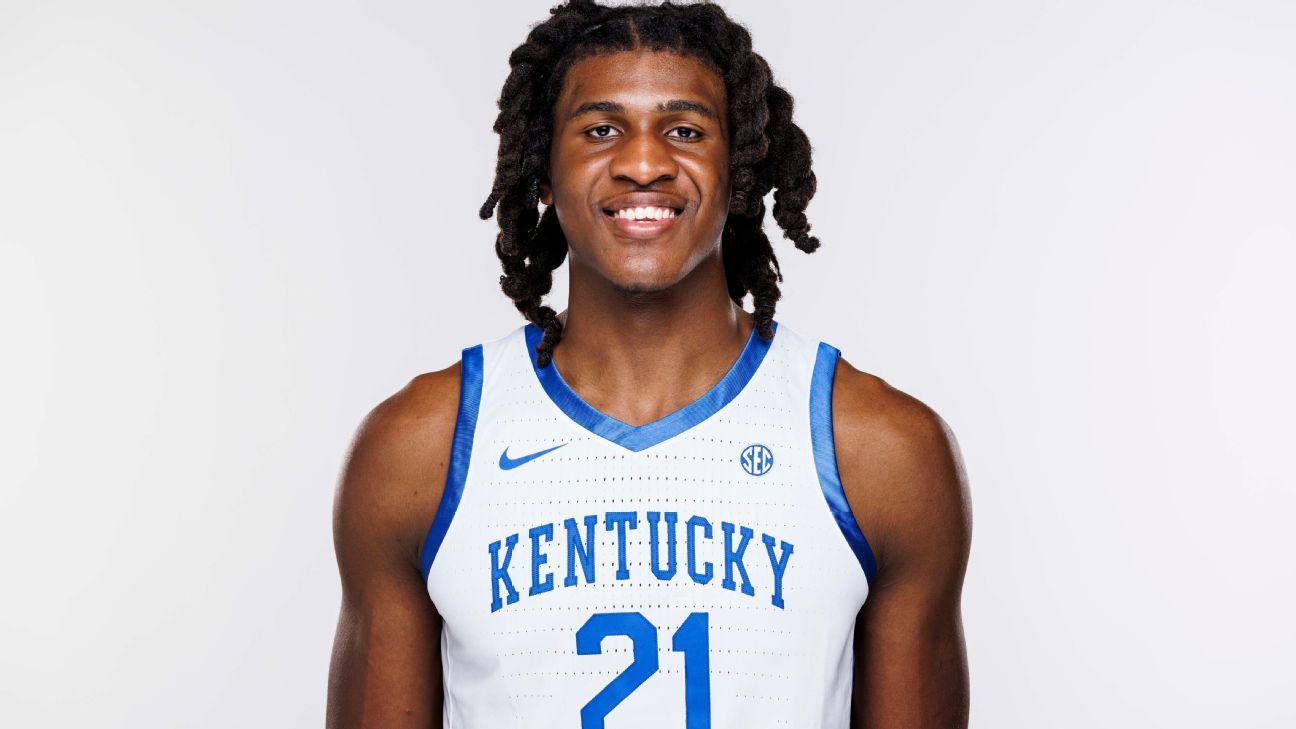
Just months ago, Jayden Quaintance was being projected as one of the brightest young stars in basketball — a near-consensus top-five pick destined to make an immediate impact at the next level. His combination of size, athleticism, defensive instincts, and raw upside had scouts salivating. NBA front offices were already envisioning how he would fit into their long-term plans. But now, in a stunning turn of events, that once-certain trajectory has become clouded with uncertainty. Injuries, limited playing time, and the emergence of a historically deep draft class have dramatically altered the conversation. And as the buzz grows louder, one question refuses to go away: could Quaintance shock the basketball world and return to the Kentucky Wildcats men’s basketball for another season?
It sounds almost unthinkable at first. After all, players with Quaintance’s level of talent rarely delay their leap to the NBA. The financial incentives, prestige, and lifelong dream of playing at the highest level usually make the decision straightforward. But in this case, the situation is anything but typical. There are layers of complexity surrounding Quaintance’s journey that make this one of the most fascinating storylines in college basketball today.
To truly understand how we got here, you have to rewind to the beginning of Quaintance’s college career — a journey that has already been filled with unexpected twists. Originally committed to play under John Calipari at Kentucky, Quaintance was viewed as a cornerstone piece of the Wildcats’ future. His commitment generated enormous excitement among Big Blue Nation, who saw him as the next elite big man to dominate in Lexington.
However, everything changed when Calipari made his high-profile move to Arkansas. Like many recruits caught in coaching transitions, Quaintance reevaluated his options. In a surprising decision, he flipped his commitment to Arizona State, opting to begin his college career away from the bright lights of Kentucky basketball. At the time, it seemed like a bold but understandable choice — an opportunity to carve out his own path and develop in a different environment.
And early on, that decision appeared to be paying off.
At Arizona State, Quaintance quickly showcased why he was so highly regarded. His defensive presence was undeniable. He altered shots, protected the rim, and demonstrated a level of versatility that is increasingly valued in the modern game. Offensively, while still raw, he flashed enough potential to suggest that his ceiling was incredibly high. NBA scouts remained intrigued, and his draft stock held firm as one of the top prospects in his class.
But then came the moment that changed everything.
Late in the season, Quaintance suffered a devastating ACL tear — one of the most feared injuries in basketball. For a young player still developing physically and skill-wise, it was a significant setback. Recovery from such an injury is not just about healing; it’s about regaining confidence, explosiveness, and rhythm. The timeline is unpredictable, and the impact can linger even after a player returns to the court.
Despite the setback, Quaintance remained determined. After undergoing surgery and beginning the long road to recovery, he made another major decision: he entered the transfer portal and committed to Kentucky, this time under the leadership of Mark Pope.
The move reignited excitement in Lexington. Fans who had once dreamed of seeing Quaintance in a Wildcats uniform finally got their wish. There was cautious optimism about his recovery timeline, but hope remained that he could contribute at some point during the season.
That hope became reality when Quaintance made his debut against St. John’s.
Even in limited action, the flashes were there. You could see the instincts, the length, and the defensive impact that made him such a coveted prospect. But it was also clear that he was still working his way back to full strength. And then, just as he began to find his footing, another setback occurred. His surgically repaired knee began to swell, forcing him to shut things down after just four games.
Four games.
That’s all NBA scouts had to evaluate during what was supposed to be a critical development year.
And in the world of draft projections, availability matters just as much as ability.
As the season progressed and other prospects around the country put together strong campaigns, Quaintance’s stock began to slide. What was once a near lock for the top five became a more uncertain projection. Suddenly, he was being discussed as a mid-to-late lottery pick, or even outside the top 15 altogether.
Compounding the situation is the strength of the 2026 NBA Draft class. Many analysts have described it as one of the deepest and most talented in recent memory. With so many high-level prospects vying for attention, players who lack a full season of film — especially due to injury — can quickly get lost in the shuffle.
This is where the conversation becomes truly fascinating.
Because while Quaintance still possesses immense upside, the question is no longer just about whether he can make the NBA — it’s about when is the best time for him to make that jump.
Entering the draft this year would still likely result in a first-round selection. That alone is a significant achievement and comes with guaranteed money and security. For many players, that would be more than enough reason to declare without hesitation.
But for a player once projected as a top-five pick, the difference between going fifth and going fifteenth is substantial — not just in terms of immediate earnings, but also in long-term opportunities, team fit, and development trajectory.
And that’s where the idea of a return to Kentucky starts to gain traction.
If Quaintance were to come back for another season, he would have the opportunity to fully recover, regain his form, and showcase his abilities over a complete schedule. With a strong, healthy season, it’s not hard to imagine him reestablishing himself as one of the top prospects in the country.
In fact, some might argue that he could position himself even better for the 2027 NBA Draft, which is widely expected to be less competitive at the top compared to 2026. In a weaker class, a dominant season at Kentucky could catapult him back into the top-five conversation — or even higher.
From a financial standpoint, that could mean millions of dollars in difference over the course of his career.
Of course, the decision is not that simple.
There are risks associated with returning to college. Another injury could further impact his stock. There’s also the reality that NBA teams often prioritize potential over production, meaning his current upside might already be enough to secure a favorable draft position.
Additionally, the modern landscape of college basketball has changed dramatically with NIL (Name, Image, and Likeness) opportunities. While returning to school used to mean sacrificing income, that is no longer the case. At a program like Kentucky, a player of Quaintance’s profile could earn significant NIL deals, potentially offsetting the financial risk of delaying his NBA entry.
Then there’s the Kentucky angle — and it’s a compelling one.
For Mark Pope, having Quaintance return would be a massive boost to the program. Pope is in the process of shaping his roster and establishing his identity in Lexington. A fully healthy Quaintance would not only provide a dominant presence in the paint but also elevate the team’s ceiling on both ends of the floor.
Interestingly, Kentucky’s activity in the transfer portal has also raised eyebrows. While the staff has been active in addressing various needs, their approach to the center position has been relatively quiet. Aside from the expected return of Malachi Moreno, there hasn’t been an aggressive push to bring in another high-level five.
Could that be a sign of confidence that Quaintance might return?
Or is it simply a matter of timing and availability in the portal?
At this stage, it’s impossible to say for certain. But in college basketball, roster decisions are rarely made in isolation. Coaches often have a sense of how situations might unfold, even if nothing is finalized.
For Quaintance, the coming weeks will be critical.
Testing the NBA Draft waters seems like a near certainty. It will allow him to gather feedback from teams, understand where he stands, and make an informed decision about his future. This process has become increasingly common and provides valuable insight for players facing exactly this kind of dilemma.
Ultimately, the decision will come down to a combination of factors: his health, feedback from NBA teams, financial considerations, and personal goals.
Does he bet on himself and return to Kentucky, aiming to restore his stock and potentially become a top-five pick in 2027?
Or does he seize the opportunity in front of him now, enter the draft, and begin his professional career without delay?
Either path has its merits. Either path carries risks.
But one thing is certain: this is a storyline that has captured the attention of the college basketball world.
For Kentucky fans, the possibility — however slim — of seeing Quaintance return for another season is an exciting one. A fully healthy version of the young big man could be a game-changer, not just for the Wildcats, but for the entire landscape of college basketball.
For NBA teams, it’s a matter of evaluating potential versus certainty — weighing what Quaintance could become against what they’ve been able to see so far.
And for Quaintance himself, it’s about making one of the most important decisions of his career.
As the days and weeks unfold, clarity will come. Announcements will be made. Plans will be finalized.
But until then, the question lingers — growing louder with each passing moment:
Could one of the most talented young players in basketball really shock the world and return to Kentucky?
It may have seemed impossible not long ago.
Now?
It feels just real enough to believe.




