


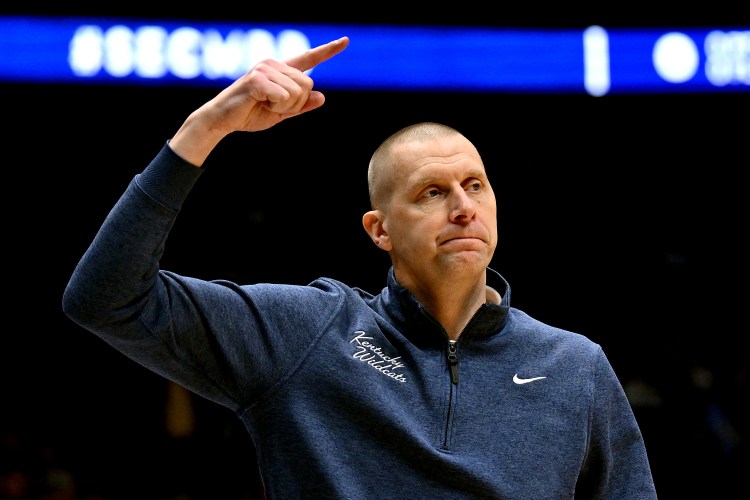
The reality has hit Lexington—and it has hit hard.
Just one year removed from being the biggest spender in college basketball, the Kentucky Wildcats men’s basketball now find themselves navigating a completely different landscape. Gone are the days—at least for now—of simply outbidding the competition for elite talent. Gone is the financial cushion that once allowed Kentucky to assemble a roster filled with high-priced stars.
In its place? Uncertainty. Pressure. And perhaps the most fascinating experiment in modern college basketball.
Because for Mark Pope, survival in 2026 won’t come from spending big—it will come from thinking smarter than everyone else.
Welcome to Kentucky’s new reality.
From $22 Million Dreams to a Budget Reality Check
Last summer, Kentucky went all-in.
Reports indicated that roughly $22 million was poured into constructing a roster built to compete deep into March. It was a bold, aggressive strategy—one that reflected both the expectations of the program and the evolving realities of the NIL era. If elite talent cost money, Kentucky was willing to pay it.
But here’s the harsh truth: money doesn’t guarantee continuity.
As the season ended, so did much of that investment. Players moved on. Eligibility expired. Draft declarations loomed. Transfers became inevitable. And suddenly, the Wildcats weren’t building on a foundation—they were starting over.
Now, only a handful of names remain: Kam Williams, Reece Potter, and Braydon Hawthorne. Promising pieces, yes—but not nearly enough to anchor a championship-caliber roster on their own.
And perhaps most importantly, the financial picture has changed.
As Kentucky legend Goose Givens has indicated, the kind of money that fueled last year’s roster simply isn’t available this time around. Whether due to donor fatigue, shifting priorities, or the natural ebb and flow of NIL collectives, the result is the same:
Kentucky can no longer outspend the problem.
The Portal Has a Price—And It’s Skyrocketing
If Kentucky’s situation weren’t already complicated, the transfer portal market has only made things more difficult.
According to recent data from The Field of 68, the cost of acquiring elite players has reached unprecedented levels. The so-called “Portal Tax” is now a defining feature of roster construction.
Want a top-25 big man?
That will cost you around $5 million.
Need a high-level point guard to run your offense?
Prepare to start bidding at $3.5 million—and that’s just the baseline.
For programs with unlimited resources, those numbers are daunting but manageable. For Kentucky—now operating with tighter constraints—they are borderline prohibitive.
Think about the math.
To build a competitive starting lineup through the portal alone, Kentucky would need to invest well over $15 million—just for five players. Add depth, role players, and contingencies, and the cost quickly spirals out of control.
In other words, trying to “buy” a championship roster in 2026 isn’t just difficult—it’s unrealistic.
And that’s exactly why Mark Pope has chosen a different path.
Enter the BLUEprint: Kentucky’s “Moneyball” Moment
When Mark Pope hired Keegan Brown as Director of Roster Management, it didn’t generate the kind of headlines that a five-star recruit would.
But make no mistake—this may be the most important move of Kentucky’s offseason.
Because Brown represents something entirely new in Lexington: a fully data-driven approach to roster construction.
At the center of this strategy is the BLUEprint—a cutting-edge system designed to evaluate players not just on traditional stats, but on advanced analytics, projected impact, and value relative to cost.
It’s not about finding the most expensive players.
It’s about finding the most efficient ones.
The BLUEprint allows Kentucky to simulate how players would perform within their system, identify undervalued talent, and maximize every dollar spent. It’s a tool built for a world where resources are limited—but intelligence can create an edge.
If it sounds familiar, that’s because it echoes the philosophy made famous by Billy Beane during baseball’s “Moneyball” revolution.
And now, that philosophy is coming to one of the most pressure-filled environments in all of sports.
The Gamble: Efficiency Over Star Power
Here’s where things get risky.
Kentucky fans are used to stars.
They’re used to five-star recruits, McDonald’s All-Americans, and lottery picks. They’re used to seeing their team dominate headlines during recruiting season and enter each year with championship expectations.
The BLUEprint challenges that identity.
Instead of chasing the biggest names, Kentucky may target players who don’t command national attention—players who fit specific roles, complement each other, and deliver maximum value for their cost.
That means passing on a $4 million headline-grabber in favor of a $1.5 million “efficiency king.”
It means trusting data over hype.
And it means asking fans to buy into a vision that may not look glamorous on paper—but could be incredibly effective on the court.
The question is simple:
Will it work?
The Nightmare Scenario Nobody Wants to Imagine
For all its promise, the BLUEprint comes with a brutal reality:
There is no margin for error.
If Kentucky misses on evaluations…
If the analytics don’t translate to real-game success…
If the roster lacks the star power needed to compete at the highest level…
Things could unravel quickly.
With Malachi Moreno still testing NBA Draft waters and no major transfer commitments locked in, the Wildcats are walking a tightrope. One misstep could lead to a season that falls far below the program’s standards.
And in Lexington, patience is not infinite.
The pressure on Mark Pope is immense. He wasn’t hired just to rebuild—he was hired to win. To restore Kentucky to national prominence. To compete for championships.
But in 2026, winning won’t come from overwhelming talent alone.
It will come from precision.
A New Identity for Kentucky Basketball
What we’re witnessing isn’t just a roster rebuild—it’s an identity shift.
Kentucky is transitioning from a program that relies on financial muscle to one that relies on strategic intelligence. From a team built on star power to one built on synergy.
It’s a bold move.
It’s a risky move.
And it’s a move that could redefine the future of the program.
If it works, Kentucky could become the model for how to compete in the NIL era without unlimited resources. They could prove that smart roster construction can outperform big spending.
But if it fails?
The backlash will be swift—and loud.
Final Thoughts: The Season That Will Define Everything
For Mark Pope, the 2026 season isn’t just another year.
It’s a test.
A test of vision.
A test of strategy.
A test of whether innovation can overcome limitation.
Because in a world where the cost of talent continues to rise, Kentucky has chosen a different path—one built not on how much you spend, but on how wisely you spend it.
And as the Wildcats prepare for what could be one of the most unpredictable seasons in recent memory, one thing is certain:
The BLUEprint isn’t just a strategy.
It’s a gamble.
And it might just determine whether Kentucky basketball rises back to the top… or faces a reality no one in Big Blue Nation is ready for.




